Europe’s political landscape is shifting and the Kremlin has reasons to be watching closely.
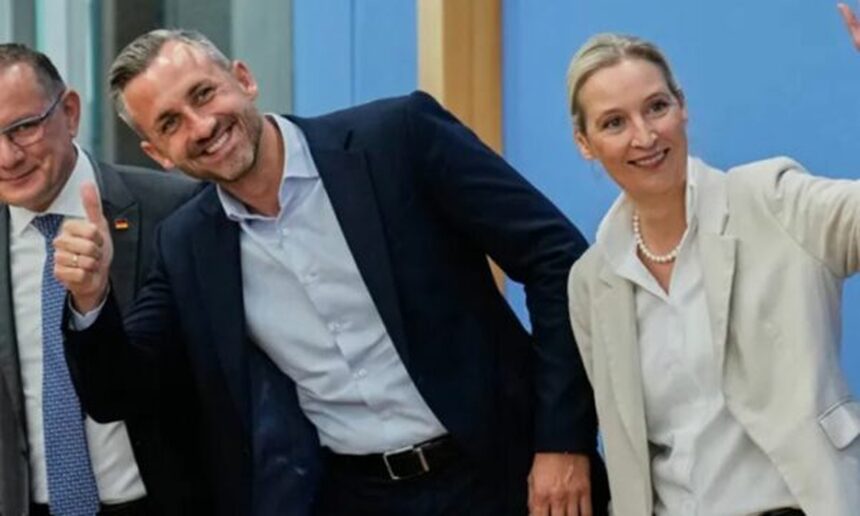
The AfD’s historic victory in Germany’s Saxony-Anhalt election has delivered more than a shock to Chancellor Friedrich Merz’s government. With roughly 44% of the vote, the far-right party achieved its strongest state-level result ever, putting it closer than any far-right party in postwar Germany has come to governing a German state.
For Bloomberg, the result represents something bigger: another sign of Europe’s growing political space for forces that are more sympathetic to Moscow and increasingly skeptical of support for Ukraine.
The AfD has openly advocated closer relations with Russia and opposed continued support for Ukraine. Its success comes at a particularly sensitive moment, as European governments accuse Moscow of escalating hybrid activities against the continent.
German Chancellor Friedrich Merz has warned that the Kremlin seeks to undermine Western values and destabilize the political systems built around them.
And the concern does not stop at Germany.
France and Italy are moving into the spotlight
France and Italy two of Europe’s most influential political powers are also seeing stronger voices questioning the current European approach to Ukraine.
In France, National Rally figure Jordan Bardella has argued that French military support for Kyiv should become more transactional, with Paris seeking concrete guarantees and benefits in return for further assistance.
Marine Le Pen remains a major force in French politics, while Bardella could become prime minister if Le Pen succeeds in the next presidential election.
Italy presents a different, but still significant, challenge. Former general Roberto Vannacci has been gaining political traction with a nationalist platform focused heavily on immigration and the future of the war in Ukraine.
Yet Europe’s right-wing forces are far from united.
The European right is not one bloc
AfD’s increasingly hard-line position has created tensions with other nationalist and populist parties.
Le Pen cut political cooperation with AfD in 2024 after controversial remarks by an AfD politician about members of the Waffen-SS.
Italian Prime Minister Giorgia Meloni has also maintained distance from AfD, particularly because of its relationship with Russia. Meloni’s Brothers of Italy has instead emphasized Italy’s transatlantic alliances.
So the emerging political picture is more complicated than a simple “pro-Russia” bloc.
But there is a common trend: mainstream European parties are facing growing pressure from nationalist and populist movements that challenge the established consensus on immigration, Ukraine, European integration and relations with Moscow.
Moscow has no reason to slow down
The political shifts are unfolding while Russia continues its confrontation with Europe.
Irish Prime Minister Micheál Martin has warned that Russia is becoming increasingly reckless within the EU, while Russian Foreign Minister Sergei Lavrov has accused Germany of moving toward direct confrontation with Moscow.
Lavrov even described Berlin’s response to the Leipzig airport drone incident as potentially representing the beginning of a “real war.”
The timing is striking.
Europe is trying to strengthen its defenses against Russian pressure at the same moment that political movements more sympathetic to Moscow are gaining electoral momentum.
That creates a difficult question for European leaders:
What happens when the political forces most willing to challenge Russia from outside Europe become weaker, while those more willing to accommodate Moscow become stronger inside Europe?
The answer could shape not only the future of support for Ukraine, but the direction of European politics itself.
The AfD’s victory in Saxony-Anhalt may therefore be about much more than one German state.
It could be another warning that the battle over Europe’s future is being fought not only on the battlefield in Ukraine, but also inside Europe’s ballot boxes.