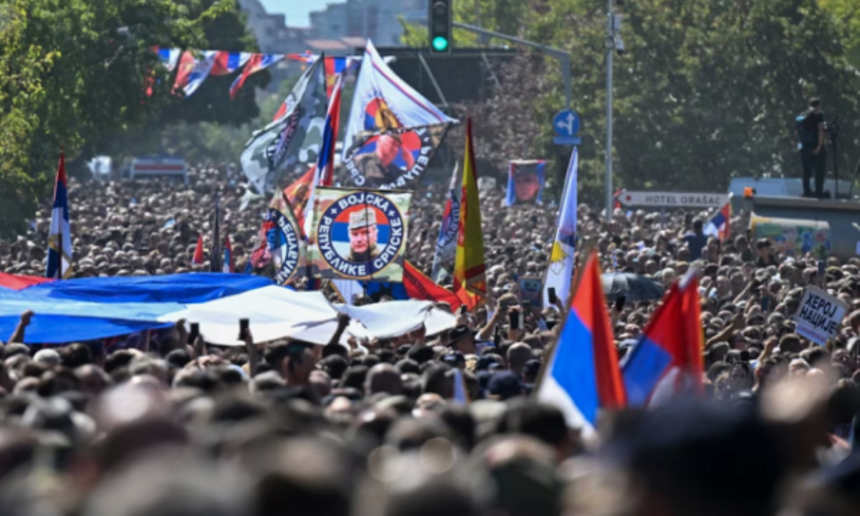
The European Union has significantly toughened its tone toward Serbia following the public glorification of convicted war criminal Ratko Mladić and the scenes witnessed in Belgrade during his funeral on September 7.
The shift became particularly evident a day after the funeral. While the European Commission initially stopped short of describing the ceremony as a state funeral with official honors, European Commission President Ursula von der Leyen and European Council President António Costa subsequently issued a much stronger response.
“The images from yesterday’s funeral of Ratko Mladić in Belgrade were shocking,” the two EU leaders said, criticizing the presence of senior Serbian officials and what they described as elements of official support during the ceremony.
They argued that such conduct reflects a failure to confront one of the darkest chapters in Europe’s recent history and is incompatible with the values underpinning Serbia’s path toward European Union membership.
Warnings of possible consequences
The stronger reaction from Brussels has also fueled debate over whether Serbia could face concrete consequences.
European politics professor John O’Brennan has argued that the EU should go further, including considering a suspension of Serbia’s accession process.
Meanwhile, members of the European Parliament have warned that they could seek to suspend or withdraw financial assistance to Serbia. It remains unclear, however, whether the EU will be prepared to take concrete measures beyond political statements.
O’Brennan has argued that Serbia must face consequences for glorifying convicted war criminals, saying a country seeking EU membership cannot simultaneously honor individuals convicted of war crimes and genocide.
Michael Leigh, a former director-general for enlargement at the European Commission, has also warned that the conduct and messages coming from Serbia’s leadership carry consequences for the country’s European trajectory.
According to Leigh, Serbia’s progress toward EU membership would be considerably faster if its leaders demonstrated through actions, rather than words, their commitment to democracy, the rule of law, minority rights and good-neighborly relations.
Plenković: Glorification of Mladić incompatible with European values
Croatian Prime Minister Andrej Plenković has likewise described the glorification of Mladić as incompatible with the values underpinning European integration.
Plenković has argued that those who give state honors to a convicted war criminal fail to understand the principles for which the EU stands, including democracy, the rule of law and respect for human rights.
The controversy has therefore raised questions about whether Brussels could translate its stronger rhetoric into practical measures.
Two potential tests could come soon: a possible October visit to the region by von der Leyen and Serbia’s access to funds under the EU’s Growth Plan for the Western Balkans.
According to the sources cited in the report, the possibility that Serbia could be excluded from von der Leyen’s planned October regional tour is no longer being ruled out.
EU financial assistance could also become an indicator of Brussels’ evolving approach. Payments under the Growth Plan are linked not only to reforms but also to good-neighborly relations and regional cooperation.
The response to Mladić’s funeral has therefore opened a broader debate over whether Serbia’s European path can continue without a more direct political cost for the glorification of war criminals and the participation of state officials in such events.