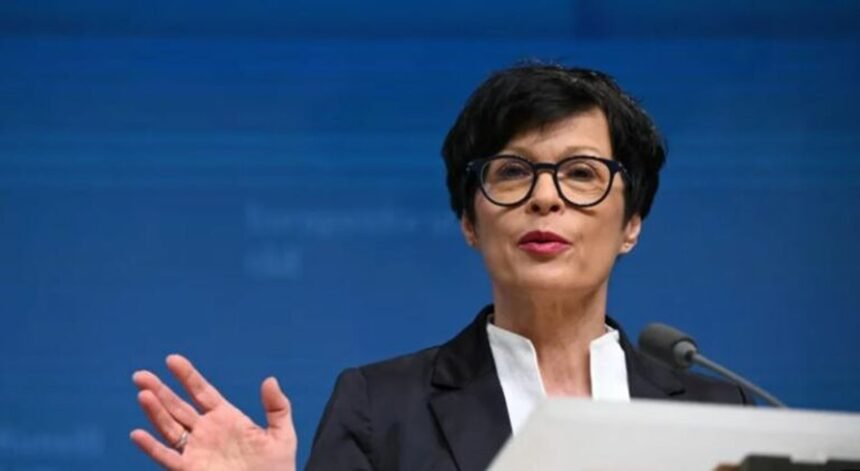
European Union Enlargement Commissioner Marta Kos has condemned the presence of senior Serbian officials at the funeral of former Bosnian Serb military commander Ratko Mladić, calling it “deeply regrettable” and a sign of failure to confront one of the darkest chapters of Europe’s recent history.
Kos made the remarks in response to Croatian MEP Željana Zovko, who had contacted the European Commission over the glorification of Mladić and the attendance of senior Serbian officials at his funeral.
“The European Commission, including myself personally, has made it clear that any glorification of war criminals is incompatible with the values of the European Union,” Kos said.
Mladić, the former commander of the Army of Republika Srpska, was convicted by the UN tribunal in The Hague and sentenced to life imprisonment for genocide, crimes against humanity and war crimes committed during the 1992–1995 Bosnian war.
He was buried on September 7 at the Topčider Cemetery in Belgrade. Serbian ministers, Republika Srpska leader Milorad Dodik, Serbian President Aleksandar Vučić’s son Danilo Vučić and Russian Ambassador to Serbia Aleksandr Botsan-Kharchenko attended the funeral.
Kos said that glorification of war criminals, genocide denial and historical revisionism have no place either in the EU or in countries seeking membership.
“We stand in solidarity with all victims, survivors and their families. Therefore, elements of official support and the presence of some senior Serbian officials at Ratko Mladić’s funeral are deeply regrettable. They demonstrate a failure to confront a dark chapter of Europe’s recent history,” she said.
The EU commissioner called on Serbian authorities and other political actors across the Western Balkans to respect the dignity of victims, act responsibly and work toward genuine reconciliation and good-neighborly relations.
Kos nevertheless said she remained convinced that Serbia’s progress toward EU membership, in line with the bloc’s established criteria, would be in the interests of the EU, Serbia and the wider region.
She stressed that EU enlargement is a merit-based process and that progress is assessed across all areas of EU policy, including fundamental issues.
“The end of October will bring our next assessment as part of the annual enlargement report, and relevant developments concerning Serbia’s European path will be taken into account,” Kos said.
She added that decisions on concrete next steps in Serbia’s accession process ultimately rest with the EU Council.
Kos also said that no recent steps had been taken toward Serbia’s integration into the Schengen area.