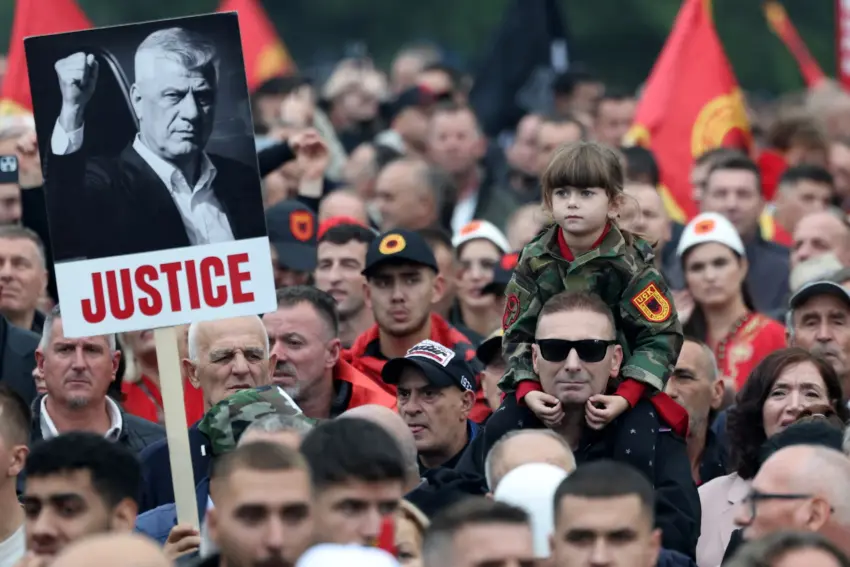
The defense teams representing former Kosovo Liberation Army (KLA) leaders have announced that they will appeal the first-instance convictions handed down by the Kosovo Specialist Chambers in The Hague on September 16.
Former Kosovo President Hashim Thaçi was sentenced to 25 years in prison on four war-crimes counts. Former KLA spokesman Jakup Krasniqi also received a 25-year sentence, while Kadri Veseli was sentenced to 18 years and Rexhep Selimi to 13 years.
The four defendants were found criminally responsible for war crimes including unlawful or arbitrary detention, cruel treatment, torture and murder. The trial panel, however, rejected the prosecution’s charges of crimes against humanity.
The four former KLA leaders have been in detention in The Hague since November 2020.
What happens after an appeal is filed?
Under the Rules of Procedure and Evidence, a party seeking to appeal a judgment, a sentence, or both must first submit a notice of appeal setting out the grounds for the challenge. The notice must generally be filed within 30 days of the judgment.
The appeal is then handled by a three-judge Court of Appeals Panel. Its presiding judge may appoint a reporting judge to oversee procedural matters before the appeal is formally considered.
The reporting judge can issue decisions, orders and directions necessary to prepare the case and must keep the Appeals Panel informed of significant procedural issues.
Within 21 days of the notice of appeal, the presiding judge or reporting judge convenes a conference to address issues concerning the appeal.
The appealing party must subsequently file its appeal brief, setting out its legal arguments and the authorities on which it relies. This is generally due within 60 days, or within 30 days when the appeal concerns only the sentence.
The opposing party then files a response brief. The applicable deadline is generally 30 days for appeals concerning the judgment and 15 days when the appeal concerns only the sentence.
A reply may then be submitted within a further 15 days, or 10 days in sentence-only proceedings.
After the written submissions have been completed, the Appeals Panel may schedule an oral hearing if it considers one necessary.
Can new evidence be introduced?
The appeals process can also involve additional evidence.
Under the applicable rules, parties may seek to introduce additional evidence during the appeal. If such evidence is admitted, the opposing party may be given an opportunity to present counter-evidence.
The Appeals Panel considers any additional evidence it admits alongside the evidence already contained in the case record.
After considering the parties’ submissions and the admissible evidence, the panel deliberates and issues its judgment.
The Appeals Panel can uphold, overturn or modify the first-instance judgment. In certain circumstances, it can also order a retrial.
If an appeal is filed only by the convicted persons, however, the Appeals Panel cannot impose a more severe sentence than the one handed down at first instance.
How quickly can an appeal be decided?
The Appeals Panel is required to issue its judgment within 60 days of the final submission by the parties.
The rules allow an extension of up to one additional month, provided that the extension is justified.
The defense team for Thaçi has indicated that the overall appeals process could nevertheless take years, particularly if the case proceeds through further stages of judicial review.
What are the legal grounds for an appeal?
Under the Law on the Specialist Chambers and Specialist Prosecutor’s Office, first-instance judgments may be challenged on three principal grounds.
An appeal can argue that:
- the trial panel made an error of law that invalidates the judgment;
- the trial panel made a factual error that resulted in a miscarriage of justice; or
- the trial panel made an error concerning the sentence imposed.
If a party remains dissatisfied with an Appeals Panel decision, further proceedings may be possible before the Supreme Court Panel and, subsequently, the Constitutional Court of the Specialist Chambers, subject to the applicable legal requirements.
What did the trial panel find?
The convictions came after a trial lasting 41 months.
The trial panel found Thaçi, Krasniqi, Veseli and Selimi guilty of war crimes but acquitted them of the charges of crimes against humanity.
According to the judgment, the four men, together with other KLA leaders, pursued the objective of achieving Kosovo’s independence and establishing political and institutional control over an independent Kosovo.
The panel found that, in pursuing those objectives, the defendants shared a common approach toward people considered obstacles to their political and military aims, who were allegedly to be “targeted,” “eliminated” or “neutralized.”
According to the court’s findings, those targeted included members or representatives of rival political and military groups, particularly individuals associated with the Democratic League of Kosovo (LDK) and the Armed Forces of the Republic of Kosovo (FARK), people considered connected to Serbian authorities, and members of Roma and Serb communities.
The trial panel said the common objective was implemented through killings, unlawful arrests and detention, physical and psychological mistreatment, intimidation and what the judgment described as “special warfare.”
The court found that Thaçi, Krasniqi, Veseli and Selimi contributed to the implementation of that common objective.
Findings concerning Thaçi
Regarding Thaçi, the panel found that he played a key role in formulating and implementing the common objective. It also found that he personally participated in certain crimes, citing the case of Behajdin Allaqi.
Findings concerning Veseli
For Veseli, the court emphasized his position as head of the KLA Intelligence Directorate, which the panel found had responsibility for identifying, monitoring and neutralizing people suspected of being “collaborators.”
The court found that Veseli did not take steps to prevent, investigate or punish crimes despite being aware of them.
Findings concerning Selimi
The panel found that Selimi made a substantial contribution to the implementation of the common objective.
At the same time, it noted that his position as KLA Inspector General gave him less authority over other KLA members than some of the other defendants had exercised.
Findings concerning Krasniqi
Krasniqi, who served during the war as KLA spokesman and a member of its General Staff, was found to have used his position, leadership role, authority and status to contribute to the implementation of aspects of the common objective that the court found to have been criminal.
The first-instance judgment is therefore not the final stage of the proceedings. The appeals process will determine which parts of the judgment, if any, are upheld, modified or overturned.