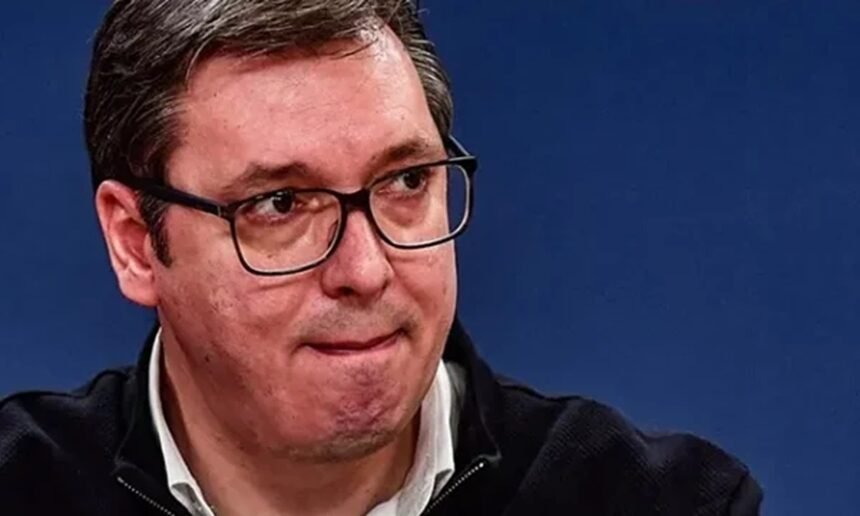
Serbian President Aleksandar Vučić said there should be no “euphoria” over the first-instance convictions of former Kosovo Liberation Army (KLA) leaders by the Kosovo Specialist Chambers, urging a cautious assessment of the verdict and its broader implications.
Speaking in Belgrade on Wednesday evening, Vučić said Serbia should “patiently wait” and carefully consider the messages contained in the ruling.
“We should not accept everything that happened today with any kind of euphoria, but rather patiently wait and understand well the messages that came today,” Vučić said.
He argued that the Specialist Chambers had not established that there was a widespread or systematic attack against the civilian population because, in his view, the court did not want to undermine the KLA’s credibility.
The court convicted former KLA leaders Hashim Thaçi, Jakup Krasniqi, Kadri Veseli and Rexhep Selimi at first instance of several war crimes. The defendants can appeal the verdicts.
Vučić also emphasized that further legal avenues remain available. He said that even if the convictions are upheld on appeal, proceedings could potentially be subject to further review before the Constitutional Court of Kosovo if it finds that the rights of one of the defendants were violated during the proceedings.
The Serbian president said the day’s reactions had demonstrated, in his view, how some actors in the region perceive Serbs and their wartime victims.
He criticized what he described as “silence and hypocrisy” by parts of the international community and cited statements from regional officials who reacted to the convictions.
Vučić also criticized Croatia’s response to the verdict, pointing to the Croatian Foreign and European Affairs Ministry’s statement that the ruling did not change the historical context of the Kosovo war or the fact that Kosovo’s population had been subjected to repression under Slobodan Milošević’s regime.
He argued that such statements failed to adequately acknowledge crimes committed against Serb civilians.
“Serbs in the countries of the region do not exist as victims,” Vučić said, arguing that Serbs are portrayed as perpetrators in regional statements and political discourse.
He also accused regional actors of applying “double standards” in their responses to war-crimes issues, comparing reactions to the Specialist Chambers verdict with international and regional criticism surrounding the recent funeral of former Bosnian Serb commander Ratko Mladić, who was convicted of genocide and other war crimes by the International Criminal Tribunal for the former Yugoslavia.
Vučić said Serbia would nevertheless continue seeking dialogue with neighboring countries.
“Serbia will always extend its hand to everyone. If they want [dialogue], they want it; if they do not, so be it,” he said, while calling for relations in the region to be improved through what he described as civilized dialogue and mutual respect for interests.
He also said the Serbian public needed to continue preserving the memory of Serbian victims of the wars of the 1990s.
“If we do not remember our victims, no one will remember them,” Vučić said.
The Serbian president’s remarks came on the same day that the Specialist Chambers issued its first-instance verdicts against the four former KLA leaders. The proceedings remain subject to appeal, meaning the convictions are not yet final.
Asked about comments by Russian Foreign Minister Sergei Lavrov regarding the possibility of Russia-Ukraine talks being hosted in Belgrade with U.S. mediation, Vučić said there was currently no such proposal under discussion.
“We have no such illusions because Serbia is a small country,” Vučić said, adding that while Serbia would be willing to host talks, he believed a meeting at a lower level would likely be held in an Arab country.