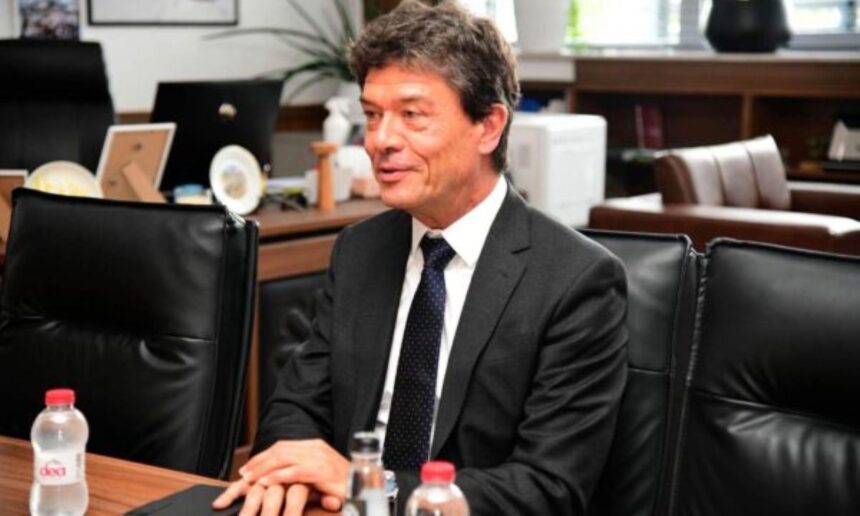
French Ambassador to Kosovo Jean-François Huchet said that the European Union’s enlargement has returned to the center of Europe’s strategic agenda and has become a geopolitical necessity.
Speaking in Prishtina at a discussion titled “Positions of European Capitals on Enlargement: Perspectives, Priorities and Kosovo’s Path to the EU,” Huchet said that enlargement had for years been treated primarily as a technical process, but Russia’s war in Ukraine had changed the approach to European integration.
According to Huchet, the European project is first and foremost a project of peace, security and stability on the continent.
“Enlargement has become a geopolitical necessity, a way of bringing the Western Balkans firmly into Europe,” Huchet said.
He stressed that France supports a merit-based enlargement process, while also emphasizing that the EU itself must prepare its institutions, policies and budget for a larger membership.
Regarding Kosovo, the French ambassador said its European path should also be discussed within Kosovo itself, rather than only in European capitals.
“Kosovo has taken important steps, has applied for membership, and its citizens have gained visa-free travel to the Schengen area, a very concrete European achievement,” he said.
However, Huchet said that the path ahead requires sustained reforms in the rule of law, stronger institutions and continued engagement in the dialogue with Belgrade.
He described the dialogue with Belgrade as essential for regional stability and Kosovo’s European trajectory.
“France stands ready to accompany this process as a partner and friend of Kosovo,” Huchet said, referring also to the recent visit to Prishtina by French Minister Benjamin Haddad.
The ambassador also highlighted the importance of energy security, saying it has become inseparable from the EU enlargement process.
Issues including security of energy supplies, decarbonization, modernization and integration into European markets require regional cooperation, integrated markets, infrastructure and investment, he said.
Huchet stressed that these challenges cannot be addressed by any single country and require a coordinated European and regional approach.