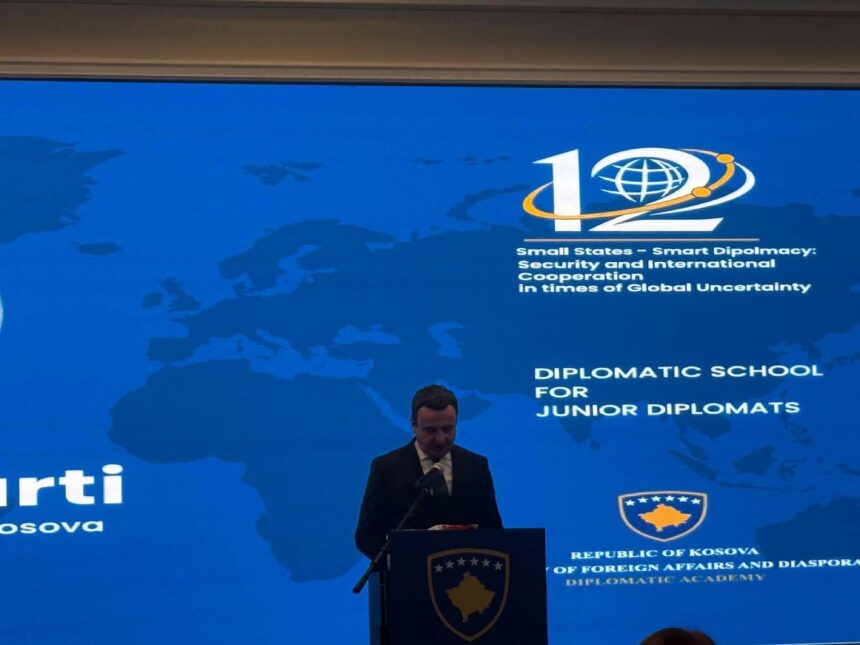
Kosovo’s membership in the Council of Europe and Interpol would strengthen human rights protection and international cooperation in the fight against crime, Prime Minister Albin Kurti said at the opening ceremony of the 12th edition of the Diplomatic School for Young Diplomats, organised by the Kosovo Diplomatic Academy.
Kurti stressed that greater international integration remains important for Kosovo’s citizens, highlighting the benefits that membership in both organisations would bring.
“Nevertheless, we must not lose sight of the importance that greater international integration would have for the citizens of Kosovo. Membership in the Council of Europe, for example, would give all citizens of Kosovo access to the European Court of Human Rights and the broader European human rights protection system. Meanwhile, membership in Interpol would enable Kosovo’s law enforcement institutions to exchange information and cooperate in real time with police forces around the world, strengthening our ability to prevent and respond to cross-border crime,” Kurti said.
He noted that through diplomacy, international cooperation and dialogue, Kosovo had moved beyond the initial challenges of state-building towards more active participation in regional and international affairs.
“Through diplomacy, international cooperation and dialogue, we have moved from the initial challenges of state-building towards becoming an active participant in regional and international affairs. The process of integration into the European Union continues, while for the past two years, citizens of Kosovo have been travelling visa-free to countries in the Schengen Area,” he said.
Kurti added that the issues shaping international politics — including peace and security, sovereignty, development, human rights and the rule of law — have also significantly shaped Kosovo’s experience as a state.
“The fact that this programme has now been organised for twelve years reflects the interest and commitment of a generation of diplomats ready to engage with global challenges and contribute to finding solutions. Kosovo is an excellent place for this exchange of experiences. Many of the key issues shaping international politics today, such as peace and security, sovereignty and development, human rights and the rule of law, international law, and the role of small states in a changing world order, have significantly shaped Kosovo’s experience as a state,” he said.
Kosovo’s Diplomatic Transformation
Deputy Minister of Foreign Affairs and Diaspora Kreshnik Ahmeti spoke about Kosovo’s transformation from a place where the international community was present to a state that represents itself around the world through its own diplomatic and consular missions.
“Kosovo has a special relationship with diplomacy and the international community. Not so long ago, we were a people living under United Nations administration. Through the United Nations Mission in Kosovo and many other international organisations and missions, a large part of the world was present here,” Ahmeti said.
“Today, in the 15th year since the declaration of independence, Kosovo is itself present around the world through more than 50 diplomatic and consular missions in over 30 countries. This transformation is perhaps one of the best ways to understand our country’s journey,” he added.
Mirjeta Behluli, director of the Kosovo Diplomatic Academy, emphasised the importance of professional training for foreign service officials, developing institutional capacity and strengthening international cooperation.
“The Diplomatic Academy has the mission and institutional responsibility to support the training and professional development of foreign service officials. In this regard, we attach particular importance to capacity-building, advancing diplomatic skills and strengthening international cooperation,” she said.
Behluli announced that the academy had signed more than 45 memorandums of understanding with diplomatic academies and partner institutions around the world. She also highlighted the importance of strategic diplomacy for small states.
“To date, we have signed more than 45 memorandums of understanding with diplomatic academies and partner institutions around the world. For small states, diplomacy is essential. Size should not determine influence. What matters is the ability to build partnerships, cultivate trust and use diplomacy strategically,” she said.