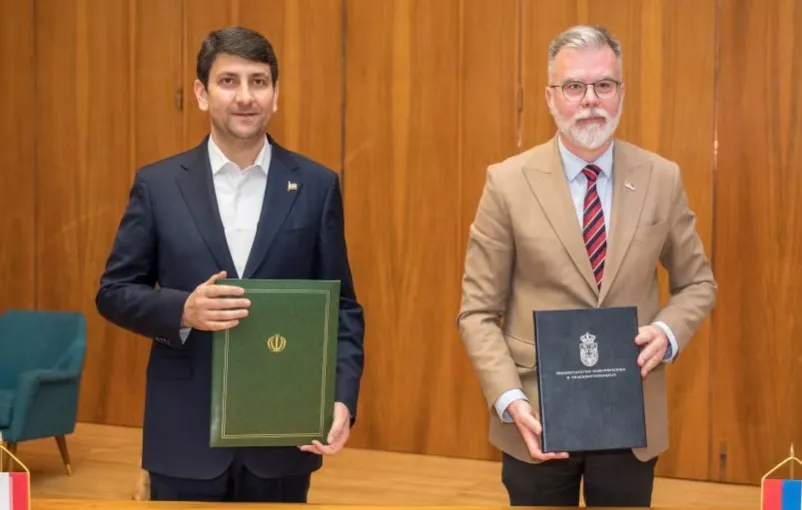
Serbia’s growing cooperation with Iran in artificial intelligence (AI) and information and communications technology could provoke a response from Washington, as US lawmakers consider sanctions against Serbian officials over Belgrade’s ties with Russia, China and Iran.
According to a report by Radio Free Europe/Radio Liberty (RFE/RL), Serbia and Iran signed a memorandum of understanding on technological cooperation in February 2025. Since then, the two countries have agreed to establish a joint committee to implement the agreement, while ministers from both governments have held talks on expanding cooperation.
The developments come amid heightened tensions between Washington and Tehran and ongoing international sanctions against Iran, while Serbia continues to pursue membership in the European Union.
A bipartisan initiative recently introduced in the US Senate proposes legislation targeting Serbia, including potential visa and financial sanctions against Serbian officials.
“Serbia and Iran have deepened technological and political ties despite the extensive sanctions imposed on Iran by the United States and the international community,” the proposal states. It was introduced by Republican Senator Chuck Grassley and Democratic Senator Richard Blumenthal.
Serbian and Iranian ministers discuss expanded technology cooperation
In late February 2025, Iranian Telecommunications Minister Seyed Sattar Hashemi visited Serbia and signed a memorandum of understanding with Dejan Ristić, Serbia’s then-minister of information and telecommunications.
The agreement covers information and communications technology, information security, e-commerce, e-government and artificial intelligence. Ristić highlighted the potential for companies from both countries to cooperate in third markets.
Iran outlined a broader set of potential areas for collaboration, including 5G technology, digital infrastructure, cybersecurity, data transfer, technology start-ups, joint research laboratories and the exchange of experts.
In early July 2026, Serbia’s current information and telecommunications minister, Boris Bratina, met Hashemi in Tehran. The two sides agreed to establish a joint committee to oversee implementation of the memorandum.
Bratina’s visit drew controversy in Western countries because he represented the Serbian government at the funeral of Iran’s Supreme Leader Ayatollah Ali Khamenei, who had been killed in US missile strikes, according to the report.
Following the meeting, Iran’s telecommunications ministry said Hashemi had proposed exchanging expertise in areas including data centres and artificial intelligence.
“Iran is ready to share with Serbia its experience in producing its own hardware equipment, developing data centres and cloud infrastructure, as well as implementing joint projects in artificial intelligence,” Hashemi said.
He also identified the creation of a data transmission corridor between Iran and the Balkans as a key objective.
Bratina similarly highlighted optical networks, artificial intelligence, e-learning and the video game industry as potential areas of cooperation.
Serbia’s Ministry of Information and Telecommunications did not respond to RFE/RL’s questions about whether further progress had been made or what specific projects the partnership might involve.
Expert warns of potential consequences for US technology companies
Aleksandar Linc Gjorgjević, an artificial intelligence expert and director of the Data Science Conference, expressed scepticism about the practical benefits of Serbia’s cooperation with Iran.
He questioned what Tehran could offer Serbia technologically, given Iran’s international isolation and the presence of major American technology companies in Serbia.
“There is an open conflict between Iran and the United States. At the same time, most companies developing artificial intelligence in Serbia are American or work for the American market,” he said, according to RFE/RL.
He added that this raised questions about how Serbia could cooperate with a country subject to international sanctions while maintaining its technological partnerships with the United States.
According to the American Chamber of Commerce, major US technology companies operating in Serbia’s AI sector include IBM, Microsoft and Oracle.
In March 2026, Serbia’s Office for Information Technology and e-Government also signed a memorandum of understanding with IBM on cooperation in information technology and artificial intelligence.
Gjorgjević warned that integrating Iranian technology into Serbia’s information and communications systems could raise concerns among American companies.
“They could quite legitimately view such a step as a negative signal,” he said, adding that Washington could respond with consequences if the cooperation moved from agreements to practical implementation.
He argued that the United States has elevated artificial intelligence to a major strategic priority, making the issue particularly sensitive.
Gjorgjević described Belgrade’s approach as “diplomatic acrobatics”, suggesting that Serbia was attempting to maintain favourable relations with several competing international partners simultaneously without a consistent long-term strategy.
Iran seeks to build its own AI capabilities
International isolation and restricted access to Western technology have pushed Iran to develop domestic technological capabilities.
An analysis by US cybersecurity company Recorded Future found that Tehran has sought to build a domestic artificial intelligence ecosystem and strengthen its research capacity, although economic isolation limits access to technology and skilled personnel.
In November 2021, Iran’s then-supreme leader, Ali Khamenei, described artificial intelligence as a crucial issue for the future, arguing that it would play a significant role in global governance.
He called on Iran to become one of the world’s leading countries in the field.
Iran subsequently began developing a national AI roadmap, drawing on strategic documents from 23 countries. Its plans included directing 80 per cent of AI research towards domestic needs, applying the technology in 45 per cent of industrial sectors, investing $8 billion and increasing AI’s contribution to gross domestic product to 12 per cent.
These targets were outlined in the Recorded Future report cited by RFE/RL.
Serbia has its own AI infrastructure and ambitions
Serbia currently has no dedicated law regulating artificial intelligence, although it has adopted an AI Development Strategy for 2025–2030 and ethical guidelines for the development and use of the technology. The guidelines are not legally binding.
Gjorgjević said Serbia nevertheless has strong technological capabilities, particularly in engineering.
The country launched its National Artificial Intelligence Platform at the State Data Centre in Kragujevac in late 2021. Official sources describe the platform as a high-performance supercomputer capable of processing large volumes of data rapidly.
Serbia has also expanded its technological partnerships beyond Iran, signing bilateral agreements on information and communications technology, telecommunications, information security or artificial intelligence with around ten other countries.
These include China, Qatar, the United Arab Emirates, Israel, Egypt, Türkiye, the United Kingdom, Burundi and Angola.
Serbia’s ties with China have also attracted criticism
Belgrade has intensified its AI cooperation with China since 2019. In 2026, representatives of the two countries signed an AI cooperation memorandum and an agreement to establish the World Organization for Cooperation in Artificial Intelligence.
These ties have drawn criticism from the United States and the European Commission.
The Commission has previously reminded Serbia that it has committed to aligning its legislation with EU rules, including the bloc’s regulatory framework for artificial intelligence and the EU AI Act.
Meanwhile, publicly available documents indicate that Iran’s Ministry of Information and Communications Technology has agreements explicitly covering AI cooperation with Serbia, Iraq and Russia. Iran also maintains technological cooperation with China, with artificial intelligence identified by Iranian officials as a key area of bilateral collaboration.
The expanding network of partnerships highlights the challenge facing Serbia as it seeks to maintain relations with competing geopolitical powers while pursuing EU membership and continuing to attract investment from American technology companies.
Whether the Serbia-Iran agreements lead to concrete joint projects remains unclear. However, experts warn that their implementation could raise strategic and commercial concerns in Washington.