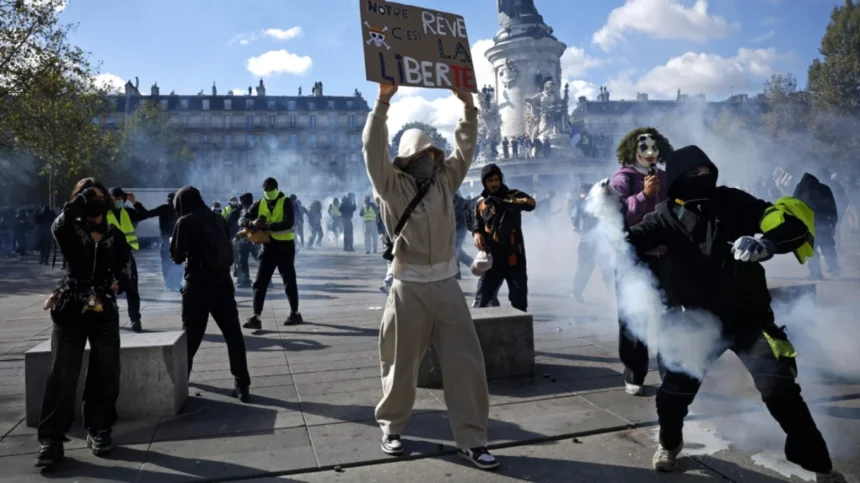
European regulators are investigating whether foreign actors are exploiting unrest and episodes of violence in France and other European countries through coordinated disinformation campaigns on social media.
According to security officials cited by the Financial Times, accounts previously associated with pro-Russian propaganda and far-right groups have circulated violent videos, raising concerns that the content could intensify tensions and fuel further disorder.
Alongside Russia, experts have raised questions about possible Iranian and Algerian influence. However, there is currently no concrete evidence that these actors directly instigated violence on the ground or significantly shaped the course of events.
“We want to see to what extent the platforms are cooperating,” an EU official said, stressing that social media companies must not allow their algorithms to amplify potential disinformation campaigns.
Pro-Russian networks accused of amplifying unrest
David Colon, a researcher at Sciences Po and an expert on disinformation, said Kremlin-linked influencers had amplified developments through false narratives.
He cited Russia’s Storm-1516 operation, known for information manipulation campaigns, as well as the Matryoshka influence network.
However, Colon emphasised that pro-Russian influencers were not responsible for triggering the protests and had not determined how they unfolded.
The French government and other authorities have asked intelligence agencies to examine whether individuals linked to Russia played a more active role in inciting violence in Paris and other major cities.
A senior European intelligence official said there was no concrete evidence so far of direct provocations by Russian agents. The activity identified appeared to be concentrated primarily online and to be reacting to events on the ground, while French investigations remained at an early stage.
Old footage circulated as if it showed events in France
One case identified by the Financial Times involved a video showing protesters setting off fireworks. The footage was shared on X and attracted nearly six million views.
It was presented as having been filmed in France, but it actually showed protests in Tbilisi, Georgia, in 2024.
The incident illustrates how old footage or videos taken in other countries can be misrepresented to create a false impression of current events and heighten tensions online.
According to the European External Action Service, France ranks second in continental Europe, behind Ukraine, in terms of being targeted by state-sponsored disinformation operations.
In 2023, individuals suspected of having links to Russia painted Stars of David on buildings in Paris. France’s Viginum agency, which monitors foreign digital interference, assessed that the operation was intended to fuel divisions within French society.
Questions raised over possible Iranian and Algerian influence
Experts have also raised questions about potential influence operations linked to Iran and Algeria.
Colon cited Shahin Khazami, a French-Iranian influencer who has published videos about the protests in France, including footage of police using force against demonstrators. One of his videos reportedly attracted around four million views on X.
Khazami has categorically denied allegations that he acts as an agent of a foreign state. He has said he works as an independent journalist and argued that his pro-Palestinian political views are being used to discredit him.
Experts warn that the combination of influencers, social media algorithms and foreign actors can accelerate the spread of emotionally charged content, contributing to polarisation and potentially encouraging violent behaviour.
Concerns spread beyond France
Concerns about social media’s role are not limited to France.
In Italy, where violent protests took place over the weekend, particularly in Milan, Defence Minister Guido Crosetto described the situation as a form of “hybrid warfare” conducted through unconventional means, including TikTok, other social networks and YouTube.
In Belgium, authorities have also warned that they will examine TikTok’s role in spreading content related to the unrest.
Regulators are additionally asking online marketplaces, including Amazon and Vinted, to block the sale of products suspected of originating from looting.
Authorities are expected to examine the role of far-left organisations, which are suspected of involvement in some incidents. However, intelligence officials have cautioned against overstating foreign interference, noting that domestic political radicalisation and public grievances remain among the principal explanations for the unrest.
Brussels warns social media platforms
The European Commission has held meetings with French authorities and media regulator Arcom to discuss cooperation with social media platforms, including X, where racist and violent content has spread rapidly.
Brussels has urged platforms to prevent their algorithms from amplifying violence and similar incidents.
According to the Commission, national authorities have primary responsibility for addressing the situation, but the EU could intervene if the risks become systemic and platforms fail to cooperate.
“Violence that takes place offline must not be amplified or rewarded by online algorithms,” European Commission spokesperson Thomas Rainier said.
Despite concerns about foreign interference, European officials have stressed that its role should not be overstated. External actors may seek to exploit public anger and amplify it online, they said, but that does not mean they are the primary cause of the unrest.