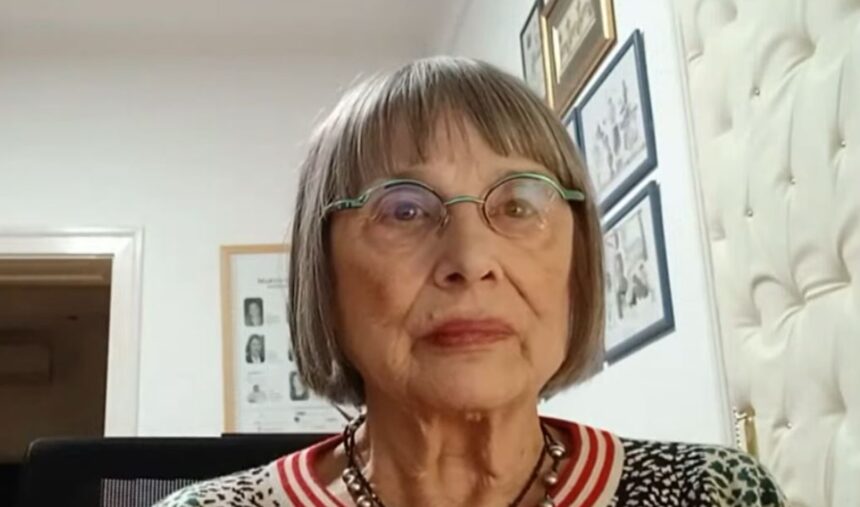
Natasha Kandić, founder of Serbia’s Humanitarian Law Center, has criticised Aleksandar Vučić’s speech following his defeat in the October 25 parliamentary elections, particularly his remarks about Kosovo and his accusations against political opponents.
In an interview with the Croatian newspaper Jutarnji list, Kandić said Vučić initially presented himself as a responsible politician by acknowledging the election defeat, only to return to his familiar nationalist rhetoric by accusing his opponents of surrendering Kosovo.
“He said it in a calm tone, as if he were the most responsible politician in the world. He is someone who knows how to act and present himself as responsible, but then he started talking about how these people are surrendering Kosovo, as if Kosovo were something Serbia gets to decide,” Kandić said.
According to Kandić, Vučić began his speech like an international statesman accepting defeat but ended it with offensive language and accusations against his opponents.
“He started out like a world statesman, accepting defeat. He was almost ready to go and greet and kiss all the students,” she remarked ironically.
Kandić also addressed Vučić’s decision to mention her by name during his post-election speech, when he declared sarcastically: “I congratulate Natasha Kandić; her politics have won.”
She argued that Vučić was attempting to associate the student movement with her positions on war crimes, the Srebrenica genocide, and Serbia’s responsibility for its past.
According to Kandić, Vučić sought to convince voters that the students shared her positions on Srebrenica, Ratko Mladić, and the Hague Tribunal — positions that contradict the nationalist narrative promoted by his government.
Discussing Serbia’s political future, Kandić said the Student List’s victory could help improve relations with neighbouring countries, although the extent of the political transformation remains uncertain.
“We still do not know the transformative potential of this Student List, how far it will go, or where its limits are. I would say it is certain that the tone towards neighbouring countries will change and that it will undoubtedly become more peaceful in Bosnia and Herzegovina,” she said.
Kandić also suggested that a change of government in Belgrade could reduce the political influence that Milorad Dodik enjoyed under Vučić’s leadership.
She stressed that Serbia’s next government would face significant international obligations, including addressing the Kosovo issue, pursuing European integration, and confronting the country’s past.
Kandić expressed hope that political change would create opportunities to strengthen the rule of law, fight corruption, and reform state institutions.
However, she warned that Serbia faces deep-rooted social problems, particularly in the media sector, which she described as corrupt and heavily influenced by political power.
“Everything is corrupt; everything is paid for. There is nothing honest about it. Money led almost all media outlets, except two or three, to support Vučić,” she said.
According to Kandić, the state of the media reflects broader problems within Serbian society, where even sections of the academic community have supported those in power without meaningful opposition.
In conclusion, she argued that Serbia needs not only a political change but also a profound social and cultural transformation.
“We have become a neglected, uneducated, and primitive society. Look at Twitter it is horrifying how many attacks there are. I have received thousands and thousands of terrible messages, and I wonder how this will disappear. Who will re-educate this society?” Kandić concluded.