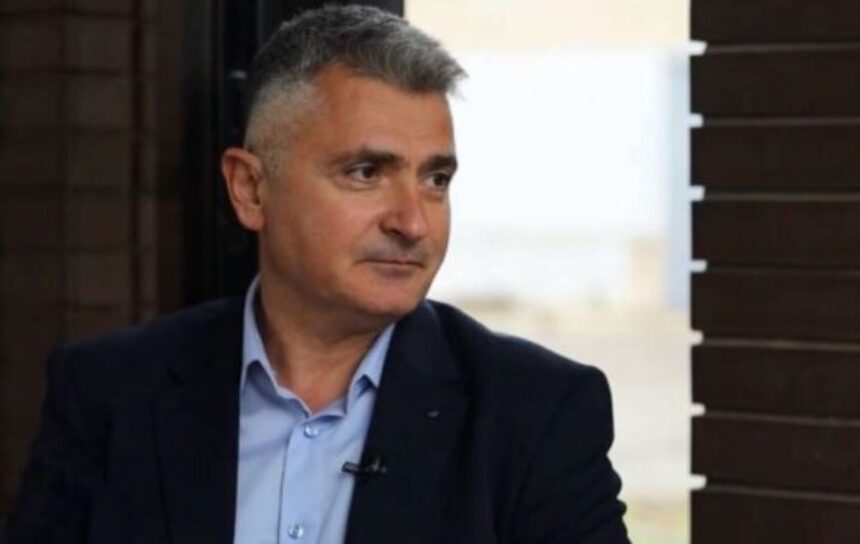
Ilija Sardanović, the leading candidate on Serbia’s student-backed “Students Are Winning” list, has pledged to continue dialogue with Kosovo and respect international agreements signed by previous governments, while insisting that such agreements may be reviewed for compliance with Serbia’s Constitution.
In an interview with Radio Free Europe, Sardanović said continuing dialogue on Kosovo would remain a central part of the student movement’s political platform. However, he emphasized that Serbia’s domestic and foreign policies, including its approach to Kosovo, must be consistent with the country’s Constitution.
His comments suggest that the incoming political leadership intends to maintain the dialogue process while leaving open questions about the implementation of existing agreements.
“The continuation of dialogue on the issue of Kosovo and Metohija is a fundamental part of the student plan,” Sardanović said, using Serbia’s official terminology for Kosovo.
Asked whether this commitment included full implementation of the 2013 Brussels Agreement on the normalization of relations between Kosovo and Serbia, he said the new authorities would respect internationally agreed protocols.
“All protocols agreed to by our officials on behalf of Serbia may be reviewed to determine whether they are in accordance with the Constitution of the Republic of Serbia,” he said.
Sardanović did not give a definitive answer on whether he would be willing to meet directly with Kosovo Prime Minister Albin Kurti, saying strategic decisions would be made after the new government was formed.
He also declined to state what position the incoming government would take on a request for the extradition of Milan Radoičić to Kosovo, saying any decision would have to follow Serbian legal procedures.
EU integration remains a stated priority
Sardanović said Serbia would continue pursuing membership in the European Union, describing the process as a commitment dating back to 2000.
He pledged that the new government would align domestic policies with Chapters 23 and 24 of the EU accession negotiations, which cover the judiciary and fundamental rights, as well as justice, freedom and security.
He identified the rule of law, media freedom, equality, human rights and the fight against corruption as priorities for advancing Serbia’s European integration.
Sardanović also criticized the previous government for what he described as a decline in public support for EU membership. He argued that citizens had not received sufficient information about the benefits of joining the bloc.
On relations with Russia, he did not announce a decision to impose sanctions on Moscow. Instead, he said foreign-policy questions should be discussed openly with the public rather than determined by a single political leader.
He suggested that Serbia’s position on sanctions could be reconsidered through a broader public debate, adding that foreign policy should reflect the will of the majority of citizens.
New government promises transparency and institutional reform
Sardanović said the student movement would seek greater transparency over major infrastructure projects and foreign investment agreements signed under the previous administration.
He specifically mentioned the Belgrade Waterfront development and Chinese investments, pledging to seek full access to contracts and related documents to determine whether the agreements complied with Serbian law.
He said the movement could not reach definitive conclusions about the contracts before gaining access to them.
On relations with Republika Srpska, Sardanović pledged continued cooperation while expressing support for dialogue between the entity’s authorities and Bosnia and Herzegovina’s central institutions in Sarajevo.
Asked about the 1995 Srebrenica genocide, he said courts had already issued judgments and argued that historical questions should be addressed by historians. He also referred to documents adopted by Serbia’s parliament in 2010.
His remarks did not directly address the International Court of Justice’s finding that genocide had been committed at Srebrenica.
Promises on media freedom and accountability
Sardanović also pledged to strengthen freedom of expression and end practices that prevent activists and cultural figures from entering Serbia because of their public statements.
Regarding public broadcasters, he said apologies from media management alone would not be sufficient to guarantee fair editorial policies.
He called for continuous oversight of public broadcasting and said the Regulatory Authority for Electronic Media (REM) should perform its duties in accordance with the law.
Sardanović also confirmed that a lustration law — intended to address the involvement of public officials in abuses under previous political systems — was included in the student movement’s program and could be among the legislation considered by the new parliament.
Government formation still pending
Sardanović said the final election results had not yet been formally announced by Serbia’s Republican Electoral Commission, and that the process of forming a government could begin only after the official results and the constitution of the new parliament.
He said the parliamentary majority of the student-backed list would determine candidates for government positions, stressing that the movement was designed to operate collectively rather than around a single leader.
He also rejected accusations that the movement had encouraged violence during incidents involving the pro-government outlet Informer, saying its members had called on citizens to remain peaceful and respect the law.
Sardanović placed responsibility for preventing further violence on the outgoing government, which remains in a technical mandate until the new authorities take office.
The interview outlines the student movement’s stated priorities on Kosovo, EU integration, relations with Russia, media freedom and transparency. Its positions on Kosovo remain qualified, however, by the insistence that existing agreements must be assessed against Serbia’s Constitution — a condition that could become significant in future discussions over implementation of the Brussels Agreement and subsequent commitments.