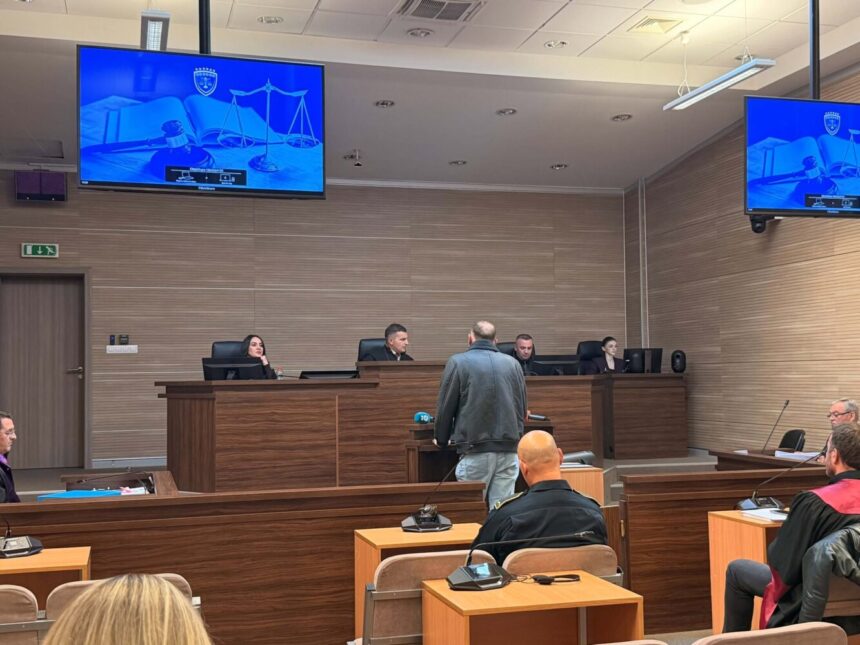
A police officer who previously worked with Muharrem Qerimi has testified in the espionage trial against Qerimi and Bedri Shabani, stating that Qerimi was never an informant for the Kosovo Police and that much of the information he provided during their meetings was inaccurate or incomplete.
The witness, identified as A.K., gave his testimony during proceedings at the Basic Court in Prishtina, answering questions from Special Prosecutor Bekim Kodraliu, Ekonomia Online reported.
A.K. said he had worked with Qerimi for approximately two years after Qerimi was transferred from the Ferizaj region to the General Directorate’s Investigations Department in Prishtina in late 2004 or early 2005.
According to the witness, they lost contact for an extended period after Qerimi left the Kosovo Police, resuming their meetings in early 2022.
“I do not know officially why he left, but what was being said was that it had something to do with abuse of official duty,” the witness said, emphasizing that he had no formal knowledge of the circumstances surrounding Qerimi’s departure.
He said he met Qerimi approximately five or six times after their contact resumed, usually in Prishtina, and that Qerimi had generally initiated the meetings.
Witness says information was often incomplete
The witness explained that one of his responsibilities within the police had involved handling information sources. He said Qerimi would sometimes contact him claiming to have information to share, but the material provided was often unreliable or incomplete.
“Most of the information was either inaccurate or incomplete for the purposes of the work. No, Muharrem was not an informant for the Kosovo Police,” A.K. testified.
He also described a conversation in which he told Qerimi that their communication had to change after Qerimi was no longer a police officer.
The witness said he had explained that Qerimi could still provide information to the police, but only as an unregistered source, and that they could no longer discuss matters as they had when both were working within the institution.
Witness learned of alleged BIA links through the media
A.K. said he first learned of allegations that Qerimi had cooperated with Serbia’s Security Intelligence Agency, known as the BIA, through media reports following Qerimi’s arrest.
The witness said he later formed the impression that Qerimi’s meetings with him might have served as cover for the activities of which Qerimi is accused. He stressed that this was his own conclusion after learning about the allegations, rather than something he had known at the time of their meetings.
“After his arrest, I learned from the media what he was accused of. My conclusion was that one of the reasons he came to meet me, if he had carried out the activities he is accused of, may have been to use those meetings with me as cover,” he said.
A.K. added that they had discussed matters related to the nature of his work, but Qerimi had never directly asked him for specific information.
Defendants face espionage charges
Shabani and Qerimi are accused of providing information to the BIA concerning the Kosovo Liberation Army (KLA), massacres committed during the war in Kosovo, the Kosovo Intelligence Agency, the Kosovo Police and the Police Inspectorate of Kosovo.
According to an indictment filed by Kosovo’s Special Prosecution Office on February 19, 2025, the defendants allegedly held in-person meetings in Serbia with a senior BIA official and a former Serbian police commander. Prosecutors also allege that information was transmitted through mobile phones and email.
Both men have pleaded not guilty to espionage. Qerimi is additionally charged with unlawful possession of a weapon, a charge to which he pleaded guilty at the initial hearing on March 17, 2025.
The trial restarted after a change in the judicial panel, announced at the October 9 hearing, when Judge Vesel Ismajli was replaced by Judge Donika Shala-Abdyli because of Ismajli’s approaching retirement.
The case remains ongoing, and the espionage allegations against both defendants have yet to be established by a final court judgment.