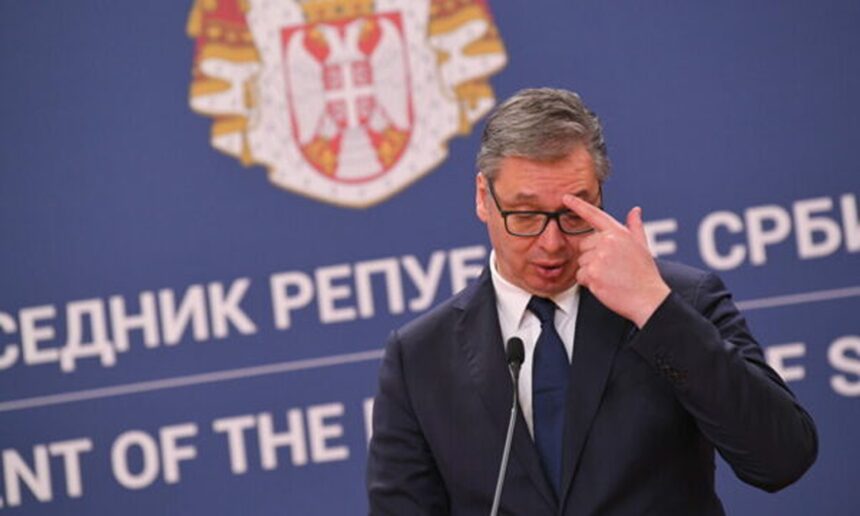
Aleksandar Vučić was reportedly prevented from launching a violent coup following his election defeat after being persuaded to abandon the plan during talks with representatives of European governments, the British newspaper The Times reports, citing politicians and a former senior Serbian police official.
According to the newspaper’s sources, Vučić was prepared to use force to remain in power but changed his position after it became clear that the Student List had won approximately 500,000 more votes in Sunday’s parliamentary elections. He was also allegedly contacted by officials who warned him against attempting to overturn the election results.
Spasoje Vulević, former commander of Serbia’s Special Anti-Terrorist Unit (SAJ), told The Times that Vučić had deployed 4,000 police officers and 3,000 violent individuals to central Belgrade to protect his regime.
“I am 100 per cent certain that he had planned to refuse to acknowledge the results,” Vulević said, according to Nova.
Sandro Gozi, a Member of the European Parliament and president of the European Democratic Party, also said they had received alarming information from diplomatic sources on election day.
“On Sunday, we received alarming reports from diplomatic sources that Vučić was prepared to fight and carry out a coup,” Gozi stated.
Meanwhile, Radomir Saičić, one of the leading candidates on the Student List, claimed there was a plan to overturn the voters’ will by force if the election result proved close.
According to him, Vučić changed his decision after receiving calls from members of the police and other circles who warned him that carrying out such a plan would have serious consequences for him.
According to The Times, men dressed in black were seen moving towards Pionirski Park in Belgrade on election day, where a tent camp set up by Vučić’s supporters was expected to be re-established.
Vulević said they were being deployed in groups of 20 to 30. Meanwhile, members of the Serbian Gendarmerie had taken up positions, several streets were closed, and public lighting was switched off.
Rade Đurić, a legal expert with the Independent Journalists’ Association of Serbia, said he suspected that the authorities had prepared a scenario to challenge the results by alleging voting irregularities and demanding a repeat election. According to him, this could have triggered protests that would subsequently have been used as justification for annulling the electoral process.
However, at 9:30 p.m., around an hour and a half after polling stations closed, Vučić abandoned his challenge to the results, while the groups of men gathered in central Belgrade dispersed.
Unconfirmed claims also circulated in Serbia that Hungarian Prime Minister Viktor Orbán had influenced Vučić’s decision not to take such action.
Vulević believes the Serbian president had faced intense external pressure and received calls from representatives of European governments.
“I believe Vučić received calls from European governments. These were conversations at the highest level,” he said.
A spokesperson for Vučić told The Times that the increased police presence in Belgrade was a response to threats of violence from demonstrators and had nothing to do with any plan to retain power by force.
Meanwhile, Gozi said he could not rule out the possibility that European officials had intervened through phone calls, but added that the election result had been decisive.
“The number of votes against him was simply too large. Vučić was completely taken by surprise,” he concluded.