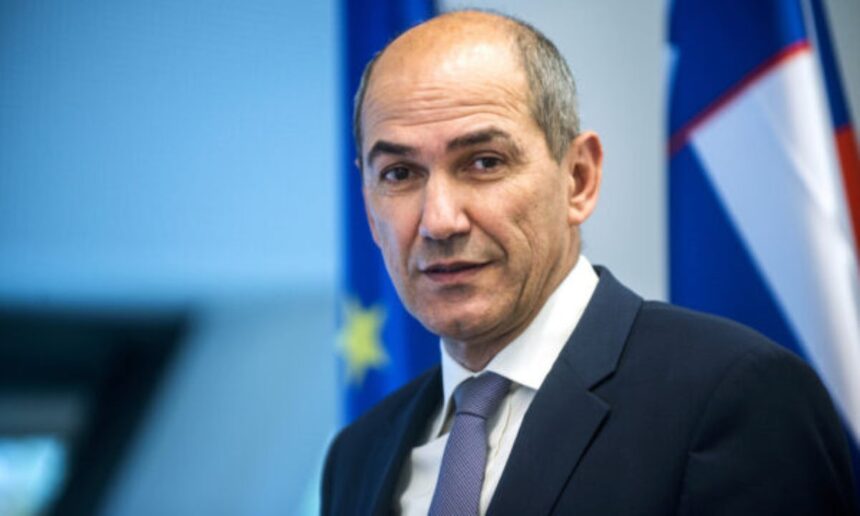
Slovenian Prime Minister Janez Janša has said Slovenia will not support further progress in Serbia’s European Union accession process until Belgrade hands over archival records belonging to the former Yugoslav secret police and other state security institutions relating to Slovenia.
Janša made the demand following the electoral victory of Serbia’s student-backed “Students’ List,” which is expected to lead the formation of a new government in Belgrade.
Rather than simply congratulating the election winners, Janša said Slovenia would welcome efforts by the incoming Serbian authorities to accelerate EU accession negotiations, but insisted that the transfer of the historical archives must come first.
“We will not give our consent to any progress until Serbia hands over to Slovenia all archives of the UDBA, SDV, JNA, ZSNZ and other services of the former Socialist Federal Republic of Yugoslavia relating to Slovenia,” Janša wrote on X.
The demand concerns records held by former Yugoslav security and military institutions, which could shed light on the activities of the communist-era secret police and its networks in Slovenia.
Dispute over former secret police records
Following his post, Janša shared a message from Igor Omerza concerning European Commissioner for Enlargement Marta Kos, who had said after the Serbian election victory that the EU’s doors remained open to Serbia.
Omerza referred to his book about Kos and repeated allegations that she had cooperated with the Yugoslav secret police, known as UDBA.
He argued that relevant documentation could potentially be found among the archives and said the opening of secret police records remained an important issue for understanding Slovenia’s past.
The allegations against Kos remain disputed. She has repeatedly denied claims that she worked as an informant for the Yugoslav secret service.
According to Slovenian media outlet 24ur, Kos had not commented on the latest accusations at the time of reporting.
Slovenia’s domestic political debate
The controversy has also prompted criticism from within Slovenia’s governing political camp.
Matej Grah, a member of parliament and secretary of the Freedom Movement party, accused Janša of using the Serbian election result to pursue domestic political disputes with long-standing opponents.
“It is possible that this documentation may also be found,” Grah said, referring to the archives. He added that Janša was using what he described as a democratic victory in Serbia to advance a domestic political confrontation.
The dispute places Serbia’s EU accession prospects alongside a long-running debate over access to former Yugoslav security archives and accountability for the activities of communist-era intelligence services.
Janša’s position signals that Slovenia intends to make the transfer of records relating to its territory a condition for its support of Serbia’s further progress toward EU membership.