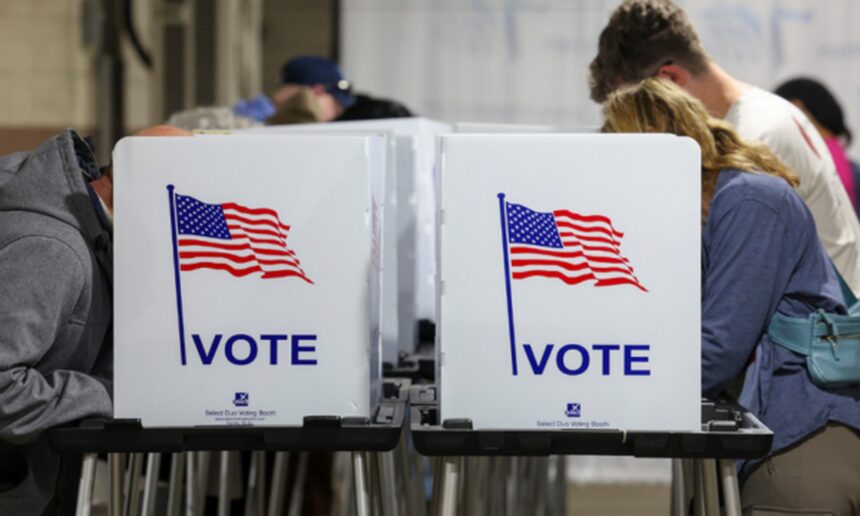
Americans are voting today in the US midterm elections, widely viewed as a referendum on Donald Trump’s second presidential term and an opportunity for his opponents to curb the president’s power, The Guardian reports, as cited by Express.
Democrats and Republicans have intensified their campaigns in recent days, urging voters to support their candidates. Control of both chambers of the US Congress – the Senate and the House of Representatives – is at stake in these elections. Both are currently controlled by Republicans.
The election campaign has been dominated by US President Trump, who has held dozens of rallies across the country, urging supporters of his “Make America Great Again” (MAGA) movement to vote for Republican candidates and presenting the election as an endorsement of his presidency as well.
Historically, the party that controls the White House tends to lose seats in Congress during midterm elections. Democrats are hoping that declining support for Trump will translate into a major wave of votes in their favour, allowing them to take control of both chambers of Congress.
Democrats are seeking control of the Senate and the House of Representatives to limit Trump’s power. During his term, the president has pursued an aggressive anti-immigration campaign involving mass arrests and deportations, waged war with Iran, imposed tariffs on foreign imports and launched major construction projects, including the construction of a ballroom at the White House.
Opinion polls have suggested that Democrats are well positioned to win a majority in the House of Representatives. However, regaining control of the Senate presents a greater challenge. As part of their campaign, Democrats have targeted several seats currently held by Republicans, including those in Ohio, Texas and Maine.
The latest polls published on Sunday by The New York Times and Siena University show Democratic candidates leading in five of the seven key Senate races. These include Texas and Kansas, two states where Democrats have not won Senate elections since 1988 and 1932, respectively.
However, the final days of the campaign have not been without divisions within the Democratic Party. In Michigan, where the race is considered crucial to both parties’ ambitions of controlling the Senate, Democratic Congresswoman Haley Stevens, who lost the party primary to Abdul El-Sayed, endorsed his Republican opponent, Mike Rogers, on Sunday.
Her decision triggered strong reactions from fellow Democrats. The dispute between Stevens and El-Sayed’s campaign began after an election advertisement funded by an outside group attributed the high cost of living in the United States to American support for Israel. Senate Democratic Minority Leader Chuck Schumer described Stevens’ endorsement of the Republican candidate as an “outrageous betrayal”.
“Regardless of what they are trying to distract you with, the reason is that they are taking money out of your pockets,” El-Sayed said on Monday at a rally attended by hundreds of supporters in Royal Oak, Michigan.
The division in Michigan came just days after Democrats faced another unfavourable development in Alaska. According to reports, the campaign of Democratic Senate candidate Mary Peltola was involved in efforts to recruit a candidate with a name almost identical to that of her Republican opponent, Senator Dan Sullivan. Peltola has denied knowing about any such scheme by her campaign.
Before these reports emerged, the US Department of Justice had filed a lawsuit seeking to prevent the certification of the Senate election results in Alaska in the event of a Republican candidate’s defeat, citing the risk of “voter confusion” due to the presence of two candidates named Dan Sullivan on the ballot. However, a judge dismissed the lawsuit on Sunday.
Meanwhile, Trump has remained at the centre of the election campaign, travelling across the United States and delivering a series of speeches in support of Republican candidates. This comes despite polls showing that his presidential approval rating has fallen to record lows, ranging between 33 and 37 per cent.