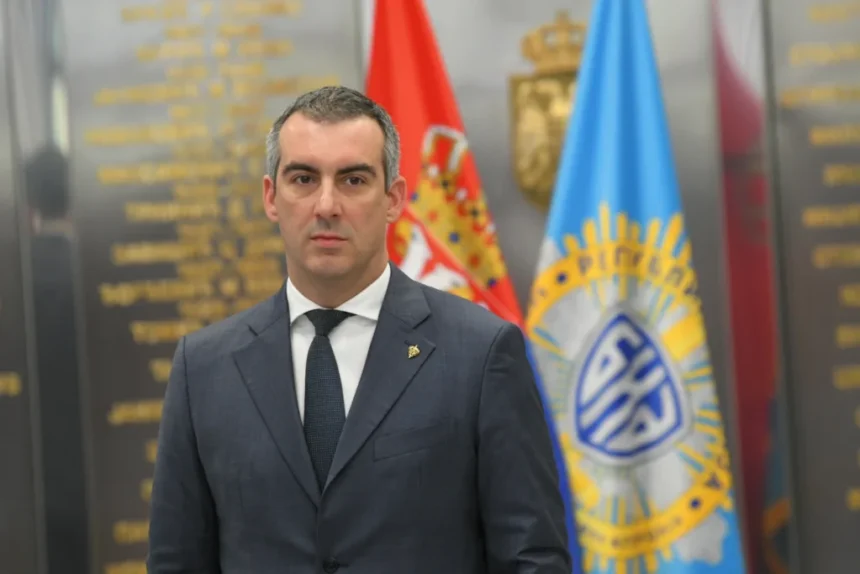
Serbian opposition figures and civil society representatives are calling for the dismissal and potential prosecution of Vladimir Orlić, director of the Security Intelligence Agency (BIA), following revelations by the weekly magazine Radar about alleged surveillance of students, university professors, prosecutors and journalists.
According to political analyst Dragan Popović, director of the Centre for Practical Politics, the allegations raise questions not only about Orlić’s responsibility but also about the wider functioning and future of the agency.
The debate intensified after Serbia’s Organised Crime Prosecutor’s Office reportedly opened a case concerning Orlić, based on a criminal complaint filed by lawyer Ivan Ninić.
Before assessing the allegations, the article points to Article 20 of Serbia’s Law on the Security Intelligence Agency, which stipulates that BIA employees cannot be members of political parties. It argues that the Serbian Progressive Party (SNS) has increasingly placed political appointees in senior state positions, including at the intelligence agency, with some officials reportedly freezing their party membership while serving in government institutions.
Former BIA director Bratislav Gašić announced in May 2017 that he had suspended all his SNS positions, including his membership in the party’s presidency. After leaving the agency, he returned to a ministerial post.
The article also recalls controversies during Gašić’s leadership, when the BIA was publicly associated with investigations into a range of incidents, including the landslide in the Grdelica Gorge, the burning of electrical switches at the Batajnica COVID-19 hospital, alleged irregularities involving grain contracts and missing public reserves.
However, Popović argues that concerns about the agency became more serious under Orlić, whom he describes as a longstanding political ally of President Aleksandar Vučić.
Calls for a broader investigation and reform
Popović says the latest revelations suggest that the BIA has effectively been transformed into an extension of the ruling SNS.
“For years, we have heard various accounts, and now they are increasingly being confirmed through the work of investigative journalists and evidence indicating that the BIA has practically become a party outpost,” Popović said.
He compared the agency’s alleged role to that of the SNS Executive Board, arguing that its activities have moved away from the responsibilities assigned to it under Serbia’s Constitution and laws.
Popović said the country should consider a comprehensive restructuring of the agency, including whether it should be abolished and rebuilt or subjected to fundamental reforms.
He also called for accountability for Orlić and other senior officials allegedly involved in abuses of office, as well as for judges who authorised the surveillance measures.
Those responsible, he argued, should be questioned about the legal grounds on which they approved the monitoring of journalists, activists and politicians.
Orlić’s previous role in parliament
The article also draws parallels between Orlić’s tenure as BIA director and his earlier role as Speaker of the Serbian Parliament.
Opposition lawmakers have repeatedly accused him of disregarding parliamentary procedures and restricting their ability to carry out their work.
In May 2023, following the mass shootings at Vladislav Ribnikar Primary School in Belgrade and in the vicinity of Mladenovac, opposition MPs demanded an urgent parliamentary session on the country’s security situation.
Footage from the time showed parliamentary security personnel blocking an entrance and preventing opposition lawmakers from entering to personally deliver citizens’ demands to Orlić.
Tensions escalated again in September 2023, when security personnel entered the parliamentary chamber during a session on budget revisions as opposition MPs protested and disrupted proceedings with whistles and vuvuzelas.
Popović described Orlić as an example of how political loyalty can be used to place individuals in positions of authority over major state institutions.
Surveillance allegations involving students, prosecutors and journalists
The latest controversy began after Radar reported the discovery of a suspected listening device in an amphitheatre at the University of Belgrade’s Faculty of Law.
The faculty’s dean reportedly ordered an inspection after students raised concerns that the room might be under surveillance. During the inspection, cables and equipment believed to include a listening device and a camera were found inside a box marking an emergency exit. Police were subsequently called to examine the equipment.
Radar later reported that the BIA had monitored several prosecutors from the Organised Crime Prosecutor’s Office (TOK), including their email communications.
According to sources cited by the magazine, the surveillance was formally introduced on suspicion of espionage, while one of the alleged motives was to obtain information about the TOK investigation into the collapse of the railway station canopy in Novi Sad.
The report said the monitoring also affected other prosecutors who shared offices with those under surveillance, including TOK chief prosecutor Mladen Nenadić.
According to Radar, the measures were authorised on several occasions between April and October 2026. The magazine further reported that Orlić initiated their termination on October 29, four days after the elections. Although the measures were initially stopped, they were subsequently reinstated for activities related to monitoring criminal groups.
The magazine also reported that the BIA had sought surveillance measures against Radar editor-in-chief Vesna Mališić and journalists Sandra Petrušić and Milan Radonjić.
According to the publication, the Higher Court in Belgrade initially approved the measures on June 12, 2026. The authorisation reportedly included the recording of communications inside the magazine’s offices at Terazije 5 in Belgrade, potentially affecting communications involving other members of the editorial team.
The allegations have raised broader questions about the use of Serbia’s intelligence services, judicial oversight of secret surveillance and the protection of journalists, prosecutors and other individuals from unlawful monitoring.
The claims reported by Radar and the calls for accountability have placed Orlić’s leadership of the BIA under renewed scrutiny, while also prompting debate over the need for institutional reform and an investigation into the authorisation and implementation of the surveillance measures.