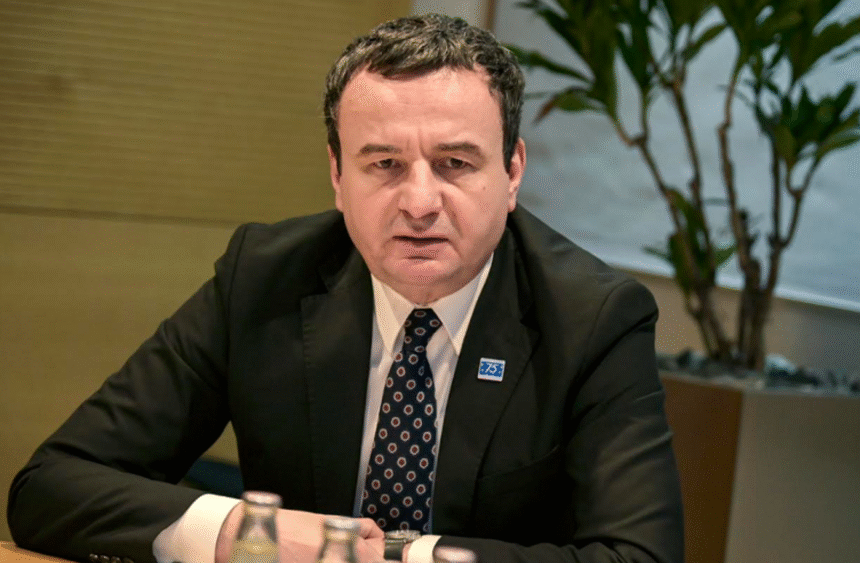
In an interview with the French news agency AFP, Kosovo’s acting Prime Minister Albin Kurti spoke about the early parliamentary elections scheduled for Sunday, December 28, as well as relations with Serbia, Russian influence in the region, and ties with the United States.
Kurti said that his party, Vetëvendosje, is aiming for a clear and decisive victory, stressing that the result should exceed 50 percent of the vote.
“We need a decisive victory. In February we won with 42.3 percent, and this time we aim to surpass the 50 percent threshold,” Kurti told AFP.
Addressing the Kosovo–Serbia dialogue, Kurti emphasized that normalization of relations is necessary, but described it as extremely difficult due to what he called Serbia’s authoritarian regime.
“We must normalize relations with Serbia. But normalization with a neighbor that does not recognize you and refuses to acknowledge crimes committed during the war is extremely difficult,” Kurti said.
He stressed that an existing normalization agreement must be implemented, which, according to him, implies mutual recognition, at least de facto.
Kurti added that for dialogue to resume meaningfully, Serbia must extradite Milan Radoičić, whom Kosovo authorities accuse of organizing the September 24, 2023 terrorist attack in Banjska, during which Kosovo Police Sergeant Afrim Bunjaku was killed.
He said he expects the European Union, particularly Germany and France, to increase pressure on Belgrade to hand over Radoičić.
In the interview, Kurti also expressed concern over Russia’s influence in the Western Balkans, pointing to close ties between Moscow and Belgrade.
“There are many connections between the two countries, and in its efforts toward Western Europe, Russia may count on Serbia as an ally. This is worrying for Kosovo,” Kurti noted, adding that Kosovo is working closely with its partners to counter this influence.
Kurti also addressed Kosovo’s agreement with the United States to accept 50 migrants from third countries expelled from the U.S., noting that only one migrant has arrived so far.
“We are not asking for financial assistance in return. We are doing this to help the United States, which is Kosovo’s partner, ally, and friend,” he said.
He did not rule out the possibility that Kosovo could reach similar agreements with other European countries in the future.