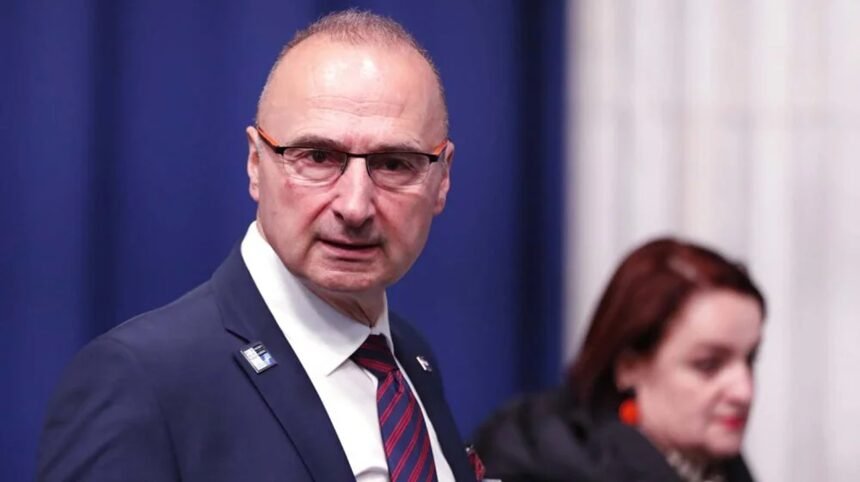
Croatia’s Foreign Minister Gordan Grlić Radman has delivered a message that Belgrade would rather avoid hearing: glorifying Ratko Mladić is not reconciliation, it is an insult to the victims and it has no place among European values.
Speaking to N1 Croatia in Bled, Grlić Radman was unequivocal about the legacy of the Bosnian Serb general convicted by the Hague Tribunal for genocide, crimes against humanity and war crimes.
“Remember Srebrenica,” he said, stressing that Mladić’s glorification represents a profound insult to the victims of war crimes.
That statement cuts directly into one of the most uncomfortable questions facing Serbia today:
Can a country seriously claim to be moving toward Europe while its war criminals continue to be treated by parts of society as heroes?
Mladić Is Not a Hero — He Is a Convicted War Criminal
There should be no confusion about who Ratko Mladić was.
He was convicted of genocide and other grave international crimes.
His name is inseparable from Srebrenica, Sarajevo and the campaign of terror and persecution carried out during the Bosnian war.
Yet following his death, the region has once again witnessed displays of admiration and glorification.
For the victims, this is not history.
It is a continuing wound.
And when political figures, football supporters or public institutions participate in the rehabilitation of convicted war criminals, the message is not merely about the past.
It tells survivors what their suffering is worth today.
That is why Grlić Radman described the glorification of Mladić as an insult to victims and stressed that such behavior does not contribute to reconciliation.
More importantly, he made the European dimension explicit:
“These are not European values.”
Serbia Wants Europe — But Europe Has Standards
This is where the issue becomes impossible for Belgrade to escape.
Serbia repeatedly presents EU membership as a strategic objective.
But European integration is not simply a technical exercise involving chapters, funding and negotiations.
It is also about democratic standards, the rule of law, respect for international judgments and confronting the legacy of war crimes.
A country cannot ask Europe to recognize its European future while simultaneously allowing its wartime past to be romanticized.
You cannot demand European integration and then treat the convictions of international courts as optional.
You cannot speak about reconciliation while glorifying the people responsible for crimes against the very communities with whom reconciliation is supposedly being pursued.
And you cannot ask victims to “move on” while perpetrators are turned into national symbols.
Croatia’s Position on Dodik Is Different — and Deliberate
Grlić Radman was also asked why Croatia does not advocate sanctions against Milorad Dodik and other Serbian political figures.
His answer was revealing.
Croatia, he said, is focused on the stability, security and territorial integrity of Bosnia and Herzegovina and on protecting the rights of Croats living there.
That position may disappoint those demanding stronger sanctions against Dodik, but it also highlights Croatia’s calculation: regional stability is the priority, while other institutions should deal with individual sanctions and accountability.
Yet on the issue of Mladić, Croatia is considerably less ambiguous.
There is no diplomatic grey zone around the glorification of a convicted war criminal.
There should not be.
The Mladić Funeral Question Is Bigger Than a Funeral
The question of whether Mladić could receive the highest state honours in Serbia has therefore become a test of Belgrade’s political direction.
A funeral is temporary.
A state honour is a political statement.
If the Serbian state were to officially honour Mladić, it would send a message far beyond his family or supporters.
It would raise the question of whether the state itself is prepared to associate its institutions with the legacy of a man convicted of genocide.
That is why the distinction between a private funeral and a state ceremony matters enormously.
And that is why Vučić’s refusal to speculate on what would happen if Mladić were buried with the highest honours leaves an uncomfortable question hanging in the air.
Where exactly does Serbia stand?
The Balkans Cannot Reconcile With Two Versions of History
The region cannot build genuine reconciliation while maintaining two completely incompatible versions of the past.
One version remembers the victims.
The other manufactures heroes out of convicted perpetrators.
One accepts the judgments of international courts.
The other questions, minimizes or ignores them.
One wants European integration.
The other continues to romanticize the ideology and figures associated with the wars of the 1990s.
Those contradictions cannot continue indefinitely.
If Serbia genuinely wants to be part of a European political community, then it must understand that European integration comes with a historical responsibility.
War criminals are not heroes. Genocide is not patriotism. And glorification is not reconciliation.
Croatia has now said it openly.
The question is whether Belgrade is willing to hear it.
And more importantly, whether Europe is willing to enforce the standards it claims to believe in.