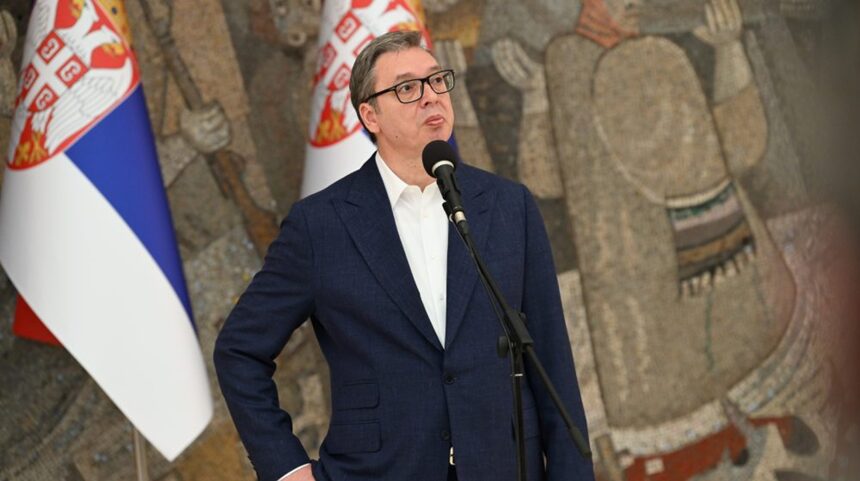
Serbian President Aleksandar Vučić has called early parliamentary elections after nearly two years of political turmoil, with analysts warning that the vote will be among the most uncertain since he came to power, according to Deutsche Welle.
DW described the decision as the formal end of what it characterized as the government’s prolonged effort to buy political time following the collapse of the railway station canopy in Novi Sad, where 16 people were killed.
The report argues that the elections will take place without the government having made significant concessions, including failing to fully implement recommendations from the OSCE Office for Democratic Institutions and Human Rights (ODIHR) and facing criticism over compliance with Serbia’s Constitution and laws.
DW noted that Vučić waited almost two years before calling the election, at a point when he is believed to have strengthened his political position and recovered some support.
Filip Švarm, editor-in-chief of the weekly Vreme, said the state apparatus and public resources were likely to be mobilized in support of the ruling camp during the campaign.
“At this point, further postponement of the elections would not be desirable, because it could create the impression that Vučić feels weak and insecure,” Švarm said, adding that Vučić himself has acknowledged that these could be the most uncertain elections since he came to power.
Political scientist Duško Radosavljević was considerably more critical, arguing that Vučić does not appear to be preparing for the possibility of defeat.
“He probably believes he has secured everything necessary not to lose the elections,” Radosavljević said, arguing that Vučić belongs to a group of leaders who do not allow themselves to be defeated through a peaceful and democratic process.
Radosavljević also said the political environment had changed significantly. While Vučić had previously faced a weak and divided opposition, he now faces what he described as a mobilized society.
The parliamentary opposition is entering the election campaign divided, having failed to reach an agreement on a joint electoral strategy. That fragmentation could weaken its prospects against the ruling coalition.
At the same time, a future student-backed electoral list is emerging as a potentially serious challenger, with its campaign expected to emphasize stronger election monitoring and high voter turnout.
Radosavljević also pointed to growing differences within the European Union over Serbia and Vučić’s government.
He argued that Vučić has increasingly relied on a limited number of political allies within the EU, while not all European governments share what he described as the perception of Serbia as a source of “stability.”
“You cannot talk about fulfilling democratic conditions and then say that they apply to some countries but not to our friend Aleksandar because he belongs to the family of our parties,” Radosavljević said.
The election campaign is therefore expected to test not only the strength of Vučić’s political machinery but also whether Serbia’s increasingly mobilized opposition and student movement can translate public discontent into an effective electoral challenge.