A coalition of five European Union member states has formally called on the European Commission to overhaul its enlargement methodology by granting Western Balkan candidate nations gradual, sector-by-sector access to the EU Single Market. The initiative is being explicitly framed as a critical geopolitical maneuver to anchor the region to the West and shield it from Russia’s expanding sphere of influence.
The proposal was outlined in a confidential non-paper circulated among the 27 EU member states last Friday, first obtained and reported by Raportuesi. The document was jointly authored by Austria, the Czech Republic, Italy, Slovakia, and Slovenia—an informal pro-enlargement club within the bloc.
“Systemic Sectoral Integration”: How It Works
The five nations argue that the traditional, rigid all-or-nothing approach to EU membership has stalled, causing dangerous enlargement fatigue. To reverse this trend, they are advocating for a model they term “systemic sectoral integration.”
Instead of waiting decades for full political membership, candidate countries like Albania, Bosnia & Herzegovina, Kosovo, Montenegro, North Macedonia, and Serbia would gain immediate economic rewards as they align their domestic legislation with Brussels.
   [THE GRADUAL INTEGRATION LIFECYCLE]
   Candidate Aligns Chapter Regulations -> Verified Compliance -> Access to Specific EU Market Sector
   *Crucial Caveat: Structural "reversibility clauses" will freeze market access if a nation backslides on democratic standards.
The proposal outlines several highly lucrative, priority economic pillars that could be unlocked incrementally:
- Infrastructure & Utilities: Comprehensive integration into EU transport networks and unified energy/electricity markets.
- The Innovation Sphere: Immediate access to the EU’s Digital Single Market and joint competition strategies.
- Industrial Resilience: Inclusion in the EU’s critical raw materials supply chains.
- Social Mobility: Implementing a youth mobility framework, drawing inspiration from the recently established UK-EU youth mobility agreement.
“To maintain the momentum of enlargement and advance European integration, strong and attractive incentives are needed,” the five nations emphasized in the text. “The merit-based—and if necessary, step-by-step—approach to the European Single Market represents exactly such an incentive.”
Pushback: “Not Ambitious Enough”
Despite its intent to revitalize the Western Balkan track, the non-paper has already drawn criticism from both regional leaders and foreign policy intellectuals for being overly cautious.
The document stops short of the bolder institutional reforms recently demanded by regional diplomats. For instance, Albania’s Minister for Europe and Foreign Affairs, Ferit Hoxha, suggested in an interview with Euractiv last week that candidate nations should be granted official observer status within EU governing bodies and legislative institutions the moment they successfully close specific negotiating chapters. The five-nation paper focuses purely on economic integration, leaving political decision-making locked.
   [THE ALBANIAN MODEL VS. THE EU-5 MODEL]
   • EU-5 Proposal: Incremental economic entry into the Single Market (Sectors only).
   • Hoxha Proposal: Incremental political entry (Observer status in Brussels decision-making bodies).
Milan Nič, a senior research fellow at the German Council on Foreign Relations (DGAP), expressed deep skepticism regarding the novelty of the text:
“It sounds like a slightly more sophisticated version of the previous push for gradual integration,” Nič observed, noting that the document fails to break any genuinely new diplomatic ground.
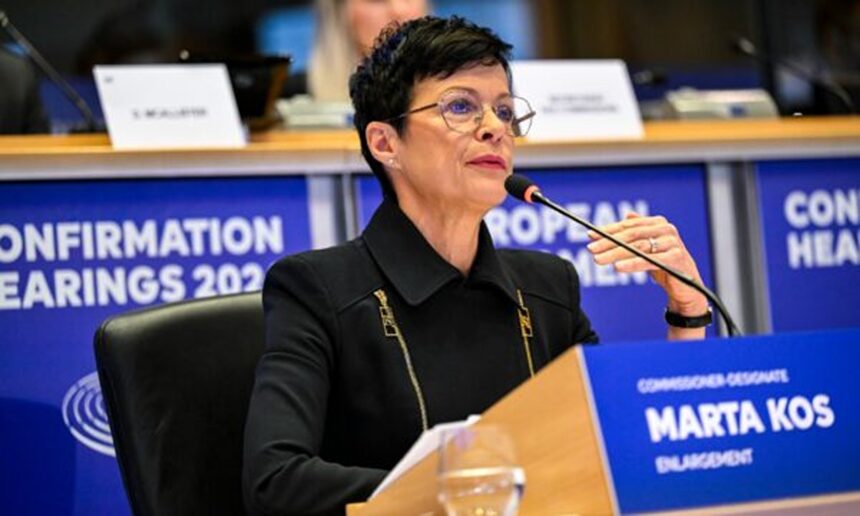
The Mandate for Enlargement Chief Marta Kos
The authors of the non-paper have explicitly directed their appeal toward the newly appointed EU Commissioner for Enlargement, Marta Kos, urging her to utilize this text to draft a concrete, actionable legislative framework.
By tying economic perks directly to regulatory alignment, the five capitals believe Brussels can wield a powerful tool to stabilize its southeastern flank. “This approach would expand and strengthen the Single Market, contributing to the geo-economic relevance and strategic autonomy of the EU, while bringing candidates closer and helping to counteract the malign influence of third countries,” the document concludes.