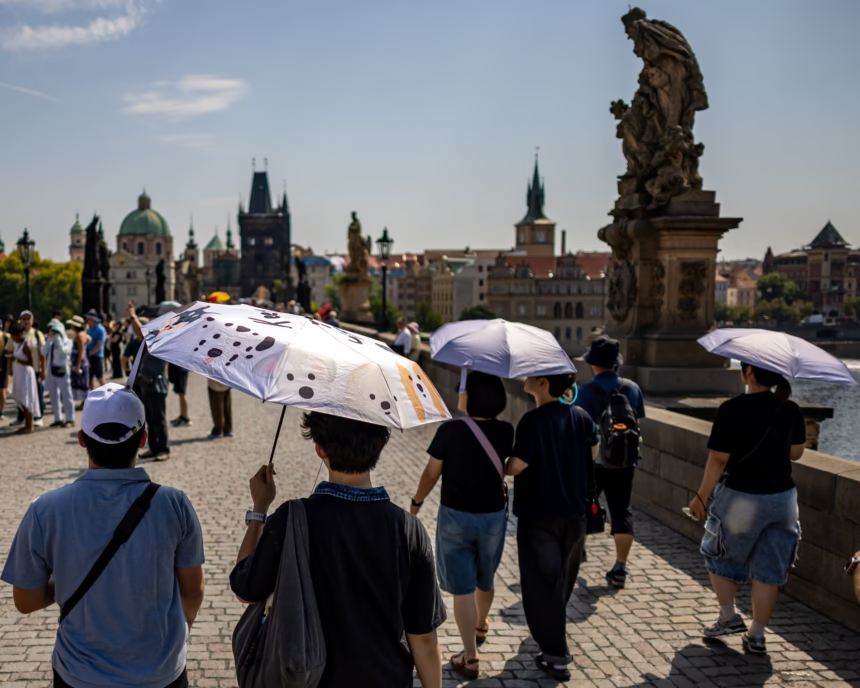
Temperature records have been broken in several countries across Central and Eastern Europe as extreme weather conditions continue to fuel wildfires and droughts throughout the continent.
Countries including Slovakia, Austria, and Hungary recorded unprecedented temperatures. On Thursday, Slovakia’s hydrometeorological agency reported that a new national maximum of 42°C (108°F) had been reached in Dolné Plachtince, according to The Guardian.
Authorities in Poland were forced to shut down the coal-fired Kozienice and Połaniec power plants after critically low water levels in the Vistula River limited the availability of cooling water. The shutdown removed approximately 1.3 GW of capacity from Poland’s electricity system.
On Wednesday, Polish Prime Minister Donald Tusk urged employers to take measures to protect workers, including providing air conditioning and access to cold drinking water.
In Germany, climate activists demanding an end to fossil fuel use demonstrated outside the Chancellery, criticizing the government’s lack of action to protect people from extreme heat. According to new estimates from the Robert Koch Institute, around 11,900 people across Germany have died due to heat-related causes this summer.
“This extreme heat and its consequences are the result of a completely irresponsible and extremely dangerous fossil fuel policy,” said Annkatrin Schwirten from Fridays for Future Berlin. “We must not become accustomed to thousands of heat-related deaths every summer.”
Hungarian Prime Minister Péter Magyar announced on X on Thursday that the nuclear power plant, which had been temporarily shut down, would resume operations.
“Good news: we are already nine centimeters above Sunday’s lowest Danube level, and rainfall is expected in the Austrian basin areas,” he wrote. “One of the turbines at the Paks nuclear power plant is operating again. Despite this, there will still be a strong need for voluntary reductions in electricity consumption during today’s heat.”
Experts warn that prolonged heatwaves and drought conditions are being intensified by the growing climate crisis, placing enormous pressure on local communities, critical infrastructure, and wildlife across the region.
Paweł Pomian from EKO-UNIA, a Polish environmental organization, said that “power plants driving climate change are increasingly becoming victims of it themselves.” He added that the extreme conditions caused by fossil fuel consumption should serve as “a wake-up call not only for Poland but for the whole of Europe.”
“The faster we develop wind and solar energy — technologies that require less water to generate electricity — the better we can protect both energy security and our rivers,” he said.
The devastating heatwaves have also stripped vegetation of moisture, leaving much of the continent vulnerable to wildfires. Around 500,000 hectares have burned across the European Union since the beginning of the year, mainly in Spain and France, according to data from the European Forest Fire Information System. An additional 292,000 hectares have burned in Ukraine.
The severity of wildfire conditions — driven by hot, dry, and windy weather that makes fires harder to contain — has reached record levels for this time of year, with alarming margins in several countries.
In Austria, which recorded a record temperature of 41.2°C on Wednesday, cumulative wildfire danger levels are more than twice as severe as the previous record for this period.
In the Czech Republic, where a national temperature record was set earlier this summer, wildfire conditions in early August were more than 50% worse than the previous record. In Slovakia, conditions were 32% worse.
Last week, a rapid analysis by the World Weather Attribution consortium found that global warming had made the hot, dry, and windy conditions of the previous month at least 20 times more likely in Spain and twice as likely in France.