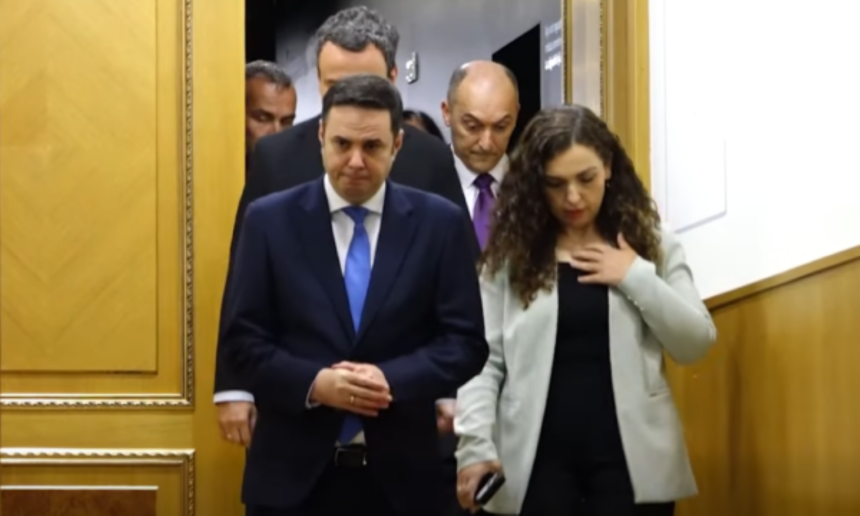
The first open refusal from within the Democratic League of Kosovo (LDK) has complicated the parliamentary arithmetic behind an agreement between Albin Kurti and Lumir Abdixhiku to support Bekim Sejdiu as Kosovo’s next president.
Kosovo’s caretaker Prime Minister and Vetëvendosje leader Albin Kurti and LDK leader Lumir Abdixhiku agreed on Thursday that Sejdiu would be their joint candidate for head of state.
However, the election remains far from guaranteed.
With the Democratic Party of Kosovo (PDK) refusing to participate in negotiations over the presidency and the Alliance for the Future of Kosovo (AAK) presenting six conditions for supporting the establishment of institutions without joining the government, Kurti and Abdixhiku will need to carefully secure enough votes in the Assembly.
The first clear sign of potential internal resistance came from LDK MP Avdullah Hoti, who told Gazeta Express that he would not vote for Sejdiu.
Asked whether he would support Sejdiu’s candidacy, Hoti replied simply: “No.”
In a subsequent Facebook post, Hoti said his opposition was based not on personal reasons but on what he described as a political and institutional principle.
“The President of the Republic must be a unifying figure who builds consensus beyond party interests and represents the general interest of citizens. In my assessment, this candidacy does not meet that criterion,” Hoti said.
Can LVV and LDK Elect Sejdiu?
Kurti and Abdixhiku reached their agreement during their fourth meeting since August 13, when LDK withdrew from talks over entering a governing coalition with Vetëvendosje and dropped its demand to hold the presidency.
Announcing the agreement, Abdixhiku said LDK would support it because “the state is more important than any party interest.”
LDK is expected to hold a meeting of its leadership followed by a meeting of its parliamentary group, where the agreement and Sejdiu’s candidacy are likely to be discussed further.
Under Kosovo’s Constitution, a presidential candidate must receive two-thirds of the votes of all Assembly members — 80 votes — in either of the first two rounds.
If no candidate reaches that threshold, a third round is held between the two candidates who received the highest number of votes in the second round. In that round, at least 61 votes are required to elect the president.
Vetëvendosje currently has 53 MPs, while LDK has 18, giving the two parties a combined total of 71 votes.
If they were joined by all 11 MPs representing non-Serb minority communities, they could theoretically reach 82 votes — enough to elect Sejdiu in the first or second round.
But that calculation is far from certain.
Hoti’s public refusal has already reduced confidence that all LDK MPs will follow the party leadership’s position. Several other LDK lawmakers have also been vocal critics of Vetëvendosje and have even called for Abdixhiku to step down as party leader.
Their participation in a vote supporting a joint candidate agreed with Kurti therefore cannot be taken for granted.
The positions of Bosniak MP Duda Balje and Gorani MP Adem Hoxha could also prove important, as both have previously demonstrated that they may not automatically align with government-backed political calculations.
Agreement Comes Amid Institutional Deadlock
Abdixhiku called for the Assembly to be constituted without delay following the agreement, followed by the election of a new government and Sejdiu’s election as president.
Kosovo, however, remains in a complicated institutional situation.
At Kurti’s request, the constituent session of the Assembly, which began on August 6, was interrupted twice. Kurti did not propose a candidate for Assembly speaker, arguing that electing the speaker and deputy speakers without a prior agreement on the presidency would be pointless.
According to a Constitutional Court ruling, the deadline for constituting the Assembly expired at midnight on August 7.
Despite this, Avni Dehari, the oldest member of the Assembly and chair of the constituent session from Vetëvendosje, scheduled a continuation of the session for August 8.
That session was interrupted in the same manner and was not subsequently continued.
Vetëvendosje has maintained that the constituent session would not proceed without a prior agreement on the presidency, for which a separate constitutional deadline of 60 days begins only after the Assembly has been constituted.
The agreement between Kurti and Abdixhiku on Bekim Sejdiu has therefore removed one of the main political obstacles cited by Vetëvendosje for delaying the process.
But Hoti’s refusal has also demonstrated that an agreement between party leaders does not necessarily guarantee the votes needed inside the Assembly.
The decisive question now is whether Kurti and Abdixhiku can maintain discipline within their parliamentary groups and secure support from minority MPs — or whether further defections could again put Kosovo’s presidential election, and the formation of its institutions, at risk.