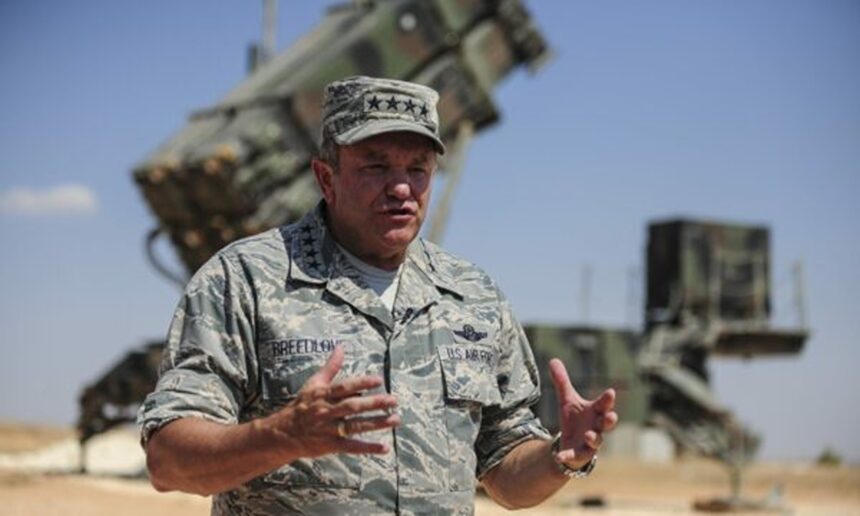
Retired U.S. General Philip Breedlove has warned that rising tensions involving Iran are revealing deep divisions within the West, at a time when its geopolitical rivals appear increasingly coordinated.
Speaking about the situation around the Strait of Hormuz, Breedlove said the crisis is not only a security challenge but also a test of unity for NATO.
According to him, the alliance risks weakening itself if it fails to coordinate internally while facing a more aligned bloc of adversaries, including Russia and China alongside Iran.
Call for consultation and cooperation
Breedlove emphasized that NATO has yet to fully utilize Article 4 of NATO, which allows member states to formally consult when they perceive a threat to their security.
He argued that invoking this mechanism could shift the focus away from public disagreements and toward structured cooperation.
“We should step back from harsh rhetoric and look at this as an opportunity—what can NATO contribute, and how can allies work together?” he said.
NATO’s limits—and capabilities
While NATO was primarily built to defend Europe—particularly against threats from Russia—Breedlove noted that the alliance still possesses capabilities relevant to the current crisis, including naval assets and mine-clearing operations that could be deployed in the Gulf.
However, he stressed that any meaningful involvement depends on consensus within NATO’s top decision-making body, the North Atlantic Council.
If unanimity cannot be reached, he suggested that a “coalition of the willing” could still act under a coordinated framework.
A strategic imbalance
Breedlove warned that the biggest strategic risk lies in the imbalance between a divided West and increasingly aligned rivals.
“If your adversary is united and you are divided, they gain the advantage,” he said, pointing to what he described as growing coordination between Russia, China, and Iran.
He added that continued fragmentation among Western allies could embolden these actors and complicate efforts to manage global crises.
Europe’s role seen as crucial
The former NATO commander also highlighted the importance of European involvement, arguing that broader participation would strengthen deterrence and reduce the burden on the United States.
Without such unity, he warned, Western adversaries may interpret hesitation as weakness.
A moment of choice
Breedlove concluded that the current crisis presents both a danger and an opportunity: NATO can either allow divisions to deepen or use the moment to rebuild cohesion and reinforce collective action.
“The West should not appear divided in front of its adversaries,” he said, urging leaders to reassess their approach and act in a more unified manner.