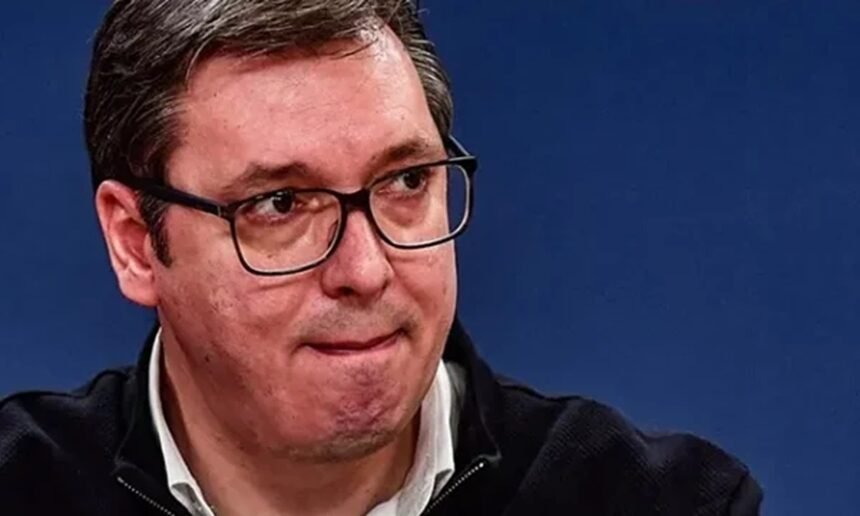
After days of controversy over Ratko Mladić’s funeral and mounting criticism from European officials, Serbian President Aleksandar Vučić is now emphasizing peace, economic growth and Serbia’s path toward the European Union.
The shift in tone is striking.
Speaking at the Beltalks Globsec conference, Vučić said he understood the emotions surrounding Mladić’s funeral but argued that Serbia should now “forget everything” and concentrate on economic development and avoiding conflict.
“We do not need any war,” Vučić said, stressing that peace should be the priority for the Serbian people and that Serbia must continue working toward EU membership.
But the message comes after Vučić and the Serbian state faced intense scrutiny over the public treatment of Mladić, the former Bosnian Serb military commander convicted of genocide, crimes against humanity and war crimes.
Mladić’s funeral in Belgrade drew thousands of mourners, Serbian government officials and prominent political figures, while the ceremony was led by Serbian Patriarch Porfirije. Vučić did not attend personally, but his son Danilo was present.
The funeral triggered strong reactions across Europe, with EU officials and politicians condemning the glorification of a convicted war criminal and questioning whether Serbia’s political direction remains compatible with its stated ambition of joining the EU.
Now, Vučić appears to be presenting a different Serbia to the international audience: a country focused on economic growth, stability and European integration rather than historical grievances.
From confrontation to reconciliation rhetoric
Vučić’s comments nevertheless retain elements of the narrative that has characterized his response to Serbia’s unresolved territorial and historical disputes.
He argued that Serbia was the only country that had lost territory while others had gained territory, adding that Serbs could not simply be expected to welcome decisions made by others.
“And you still expect us to say, ‘Thank you very much, you have made some very nice decisions,’” Vučić said.
He then moved toward a message of reconciliation.
“But we must forgive that and focus on the fact that peace is the priority of the Serbian people. We must work on our path toward the EU.”
The sequence is revealing: the historical grievance remains, but the conclusion is deliberately moderate.
After the political controversy surrounding Mladić’s funeral, Vučić is once again presenting himself as the leader capable of balancing Serbian national sentiment with the demands of European integration.
A familiar political reset
The timing makes the message particularly significant.
The funeral became an international embarrassment for Belgrade, exposing the gap between Serbia’s official European ambitions and the continued public glorification of one of the most notorious figures of the Bosnian war.
European officials responded by questioning Serbia’s commitment to democratic and European values, while criticism also intensified over the government’s treatment of student protesters and the broader political environment under Vučić.
Against that backdrop, the president’s new emphasis on peace and the EU can be read as an attempt to reset the conversation.
Rather than continuing to defend the politics surrounding Mladić, Vučić is shifting the focus toward economic growth, salaries, trade and stability — issues that are easier to present to European audiences as evidence of Serbia’s modern, pragmatic direction.
It is a familiar strategy: when confrontation becomes politically costly, the message changes from nationalism and grievance to stability and economic pragmatism.
Economic growth as a change of subject
Vučić also highlighted Serbia’s economic performance, saying the country recorded 3.5 percent growth in the first half of the year.
But he immediately linked Serbia’s economic prospects to the broader geopolitical environment.
He argued that ongoing wars in Ukraine and the Middle East, along with increasing tariffs, subsidies and trade barriers, were making the global economy increasingly unpredictable.
His argument allows him to move the conversation away from the controversy over Mladić and toward an issue on which the Serbian government can present itself as pragmatic: economic stability.
“We must forget everything, focus on economic growth,” Vučić said.
The choice of words is notable.
The question is not only what Serbia should focus on next, but what Vučić wants the public and international partners to stop focusing on.
The contradiction remains
The problem for Belgrade is that the controversy surrounding Mladić cannot simply be separated from Serbia’s European aspirations.
For the EU, the issue is not merely whether Serbia supports peace in the future. It is also whether the country is willing to confront the legacy of the wars of the 1990s, reject the glorification of convicted war criminals and demonstrate a genuine commitment to European political values.
That is precisely where the funeral created difficulties for Vučić.
The Serbian president can distance himself personally from the ceremony while simultaneously acknowledging and defending the emotions surrounding it. He can emphasize peace while invoking the territorial losses and historical grievances that remain central to Serbian nationalist politics.
And he can reaffirm Serbia’s EU path without resolving the contradictions between that ambition and the political environment at home.
A softer message after a hard political moment
Vučić’s latest comments therefore look less like a fundamental change of policy than an effort to soften Serbia’s international image after a politically damaging episode.
The message is now: peace, growth and Europe.
But the context remains the same: a Serbian political establishment that has struggled to confront the legacy of Mladić, a president who continues to invoke national grievances, and an EU increasingly skeptical about whether Belgrade’s European orientation is strategic or simply tactical.
The shift in rhetoric may help Vučić reduce immediate pressure from European partners.
But it does not erase the images from Mladić’s funeral, the presence of Serbian officials and political figures, or the broader debate over Serbia’s relationship with its wartime past.
After the backlash, Vučić is once again trying to present himself as the voice of stability.
The question for Brussels is whether this is a genuine change in direction — or simply another political reset designed to move the conversation on before the consequences of the previous one become too costly.