In its report titled “Rebellious University: A New Social Dynamic,” the Committee called on EU institutions to make academic freedom a measurable benchmark within Serbia’s accession negotiations, particularly under Chapters 23 and 24.
“Defending university autonomy in Serbia is not only an academic issue, but a fundamental condition for the survival of critical thinking and the democratic potential of society as a whole,” the report states.
The Helsinki Committee described the current state of academic freedom as alarming, warning of a systematic erosion of the autonomy of public universities in the country. It emphasized that university autonomy is formally guaranteed by the Constitution and national laws.
According to the report, universities are particularly targeted because they generate critical thinking and knowledge. It also notes that student protests have further exposed existing pressures on higher education institutions and encouraged parts of the academic community to publicly support them, thereby shifting the balance in relations between the state and universities.
The document argues that pressure on academia is not a series of isolated incidents, but part of a broader strategy of political control and institutional narrowing under the government.
It claims that authorities are using a combination of legislative changes, financial pressure, and direct security interventions to transform universities from autonomous institutions into instruments serving political interests.
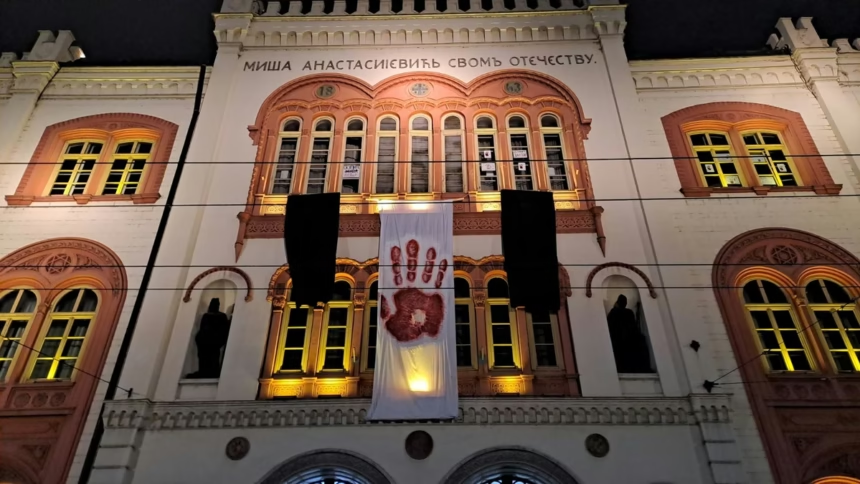
A key turning point highlighted in the report is the death of a student at the Faculty of Philosophy on March 31, which the authorities allegedly used to further discredit the university.
The police raid on the Rectorate of the University of Belgrade and the seizure of documents are described as a precedent and a direct violation of constitutionally guaranteed autonomy.
The Helsinki Committee also pointed to the role of Rector Vladan Đokić, who has become the target of intense media campaigns after resisting police interventions and insisting on institutional integrity. Pro-government media and senior officials, including the president and the prime minister, have labeled him an “instigator of revolution” and accused him of “defaming his own country” due to meetings with foreign diplomats.
The report further warns of what it describes as the “dismantling of universities” through the creation of parallel higher education structures. It cites the establishment of the Faculty of Serbian Studies in Niš, which reportedly replaced certain study programs at the Faculty of Philosophy, as well as plans for a new University of Saint Sava in cooperation with the Serbian Orthodox Church.