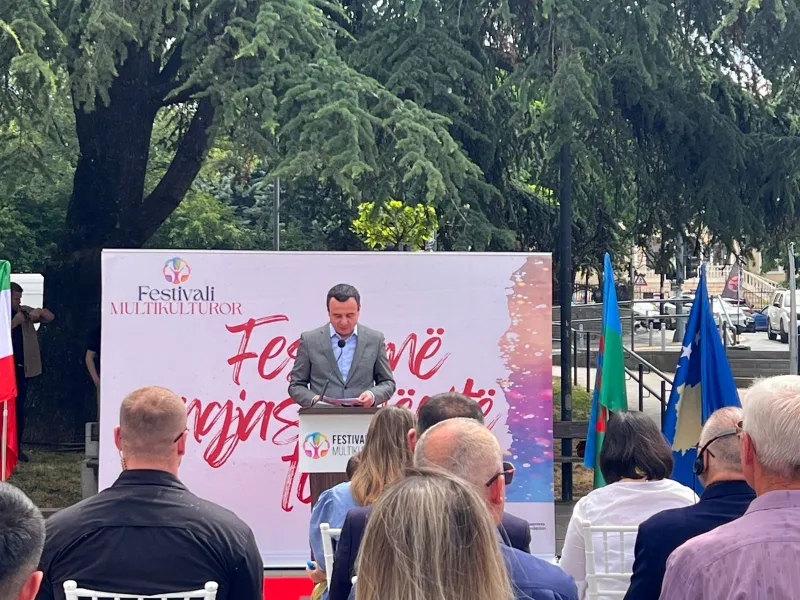
The employment, educational access, and structural social integration of the Roma, Ashkali, and Egyptian communities in Kosovo are marking measurable, historic progression. The milestones were celebrated during the opening of the 8th edition of the Multicultural Festival and Mobile Exhibition “KRAH”, where institutional leaders and civil society groups gathered to assess a decade of inclusion initiatives.
Opening the ceremony, Acting Prime Minister Albin Kurti emphasized that cultural diversity is an indissoluble component of Kosovo’s modern democratic identity.
““Our Republic was built on the principle that all citizens, regardless of ethnicity, language, culture, religion, or background, have an equal place in public, social, and institutional life,”” Kurti stated. “”This festival is a mirror of how the Republic of Kosovo understands and builds itself as a democratic, open, and inclusive state.””
Moving Beyond Statements: Concrete Institutional Backing
Prime Minister Kurti highlighted that Kosovo’s approach to minority inclusion has actively shifted away from passive rhetoric and into binding, state-funded socioeconomic programs.
Kosovo Strategic Inclusion Metrics (2026 Institutional Data):
[Education Support]  --> ~2,000 state scholarships allocated to high school and university students.
[Infrastructure]     --> Permanent direct financial subsidies for community-driven learning centers.
[Housing Upgrades]   --> Over 500 vulnerable families granted access to running hot water and sanitation.
[Market Reach]       --> Technical mediation and hiring networks established across 300+ private corporations.
The Prime Minister noted that the “KRAH” festival itself reflects this institutional growth, evolving from a modest, one-day grassroots initiative eight years ago into a sprawling national platform that connects local artisans, women entrepreneurs, poets, and young creatives from all ethnic backgrounds.
VoRAE: Deconstructing Decades of Systemic Segregation
Isak Skenderi, the Executive Director of the prominent civil rights organization VoRAE (Voice of Roma, Ashkali and Egyptians), delivered a powerful retrospective on the 15-year campaign to dismantle deep-seated barriers facing these communities.
Skenderi noted that when their journey began, inequalities in education were rampant, formal job opportunities were almost non-existent, and daily discrimination actively crippled family development. Today, he argued, the reality on the ground is radically altered.
- Institutionalized Learning: Educational frameworks like community-based learning centers and targeted high school scholarship programs—which originally survived solely via external international donors—have been fully institutionalized and integrated into Kosovo’s public policies.
- Corporate Integration: Through aggressive employment mediation and strategic partnerships with more than 300 domestic companies and corporations, a growing cadre of community members are building long-term professional careers, contributing to the domestic economy, and securing financial independence.
The Greatest Shift: Breaking Stereotypes and Social Taboos
While structural numbers showcase a positive trajectory, Skenderi emphasized that the most profound victory achieved over the past decade goes completely beyond standard statistics: the visible erosion of deep-seated social prejudices.
“”For decades, Roma, Ashkali, and Egyptians have been viewed through the lens of negative stereotypes and deep prejudices,”” Skenderi pointed out. “”Today, we live a completely different reality. Fewer citizens hesitate to have their children share a classroom with Roma, Ashkali, and Egyptian children, and more and more people are happy to have them as equal friends, neighbors, or colleagues. This shift did not happen on its own—it is the result of years of dialogue, awareness, and relentless civil action.””
The “KRAH” Multicultural Festival and Mobile Exhibition will continue throughout the week, deploying various artistic installations, cultural panels, and promotional activities designed to reinforce multi-ethnic dialogue and cement inter-community cooperation across Kosovo.