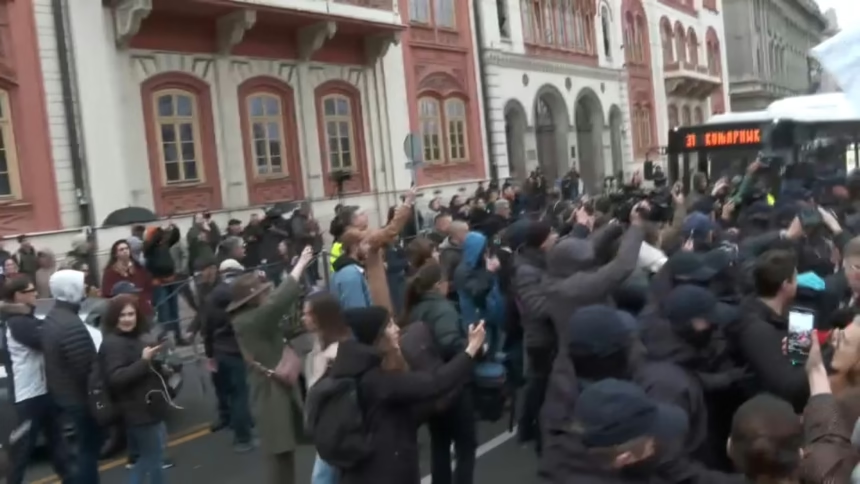
The Belgrade Centre for Human Rights (BCHR) released its annual report on Tuesday, June 23, 2026, documenting a systemic pattern of police brutality, excessive force, and state-sanctioned intimidation targeting young people during the historic student and civil protests of 2025.
The report underscores a dramatic paradigm shift, highlighting that the youth of Serbia have chosen to shed passivity and act as the primary “drivers of societal change” across the nation. However, this mobilization was met with severe, coordinated institutional retaliation.
Failure to Protect and Executive Pardons
The BCHR report reveals that the state mechanism was systematically weaponized against peaceful assembly through both direct action and calculated inaction.
- Collusion with Third Parties: Investigators noted a persistent failure by law enforcement to protect peaceful demonstrators from violent attacks perpetrated by state-affiliated counter-protesters and thugs.
- State-Sanctioned Impunity: The report highlights a deeply troubling trend of executive pardons issued by the state leadership for individuals who committed acts of violence against students. This includes a high-profile case where a driver deliberately plowed a vehicle into a crowd of demonstrators, and another where an attacker fractured a female student’s jaw in Novi Sad.
Key Findings of the BCHR 2025 Youth Rights Report:
[Direct Abuse]    --> Documented symptoms matching sonic weapon deployment on March 15.
[State Impunity]  --> High-level pardons for criminals who assaulted student protesters.
[Academic Purge]  --> Over 100 teachers and professors dismissed for supporting students.
[Underfunding]    --> State education spending hits €2,174 per student (5x below EU average).
The Acoustic Cannon Evidence and the Case of Nikolina Sinđelić
The human rights organization directly challenged the official government narrative surrounding the events of March 15, 2025, in Belgrade. While state officials continue to issue flat denials and label the controversy a hoax, the BCHR confirmed that non-governmental organizations have successfully compiled extensive medical testimonies and eyewitness accounts from citizens who suffered distinct physiological symptoms and injuries matching the deployment of a sonic dispersal device.
Furthermore, the report brought renewed attention to severe abuses of power within the security apparatus, highlighting the case of student Nikolina Sinđelić. In August 2025, Sinđelić came forward to accuse Marko Kričko, the former commander of the Unit for the Protection of Specific Persons and Objects (JZO), of threatening her with rape. The systemic protection of such officials has contributed to an environment of absolute institutional distrust.
Education as a Battleground: The Culture of Punishment
Goran Sandić, the editor of the annual report, delivered a bleak assessment of the academic landscape, stating that during 2025, the educational system was transformed into a punitive tool of the regime.
““Over 100 teachers and professors lost their jobs simply for standing in solidarity with their students,”” Sandić revealed. ““Without free professors and researchers, academic freedom ceases to exist in any meaningful sense.””
Sandić warned that the state is sending a chilling, calculated message to current and future generations of academics:
- Any teacher who supports a student will be fired.
- Any dean who opens university doors to protecting students will be targeted by knife attacks.
- Any rector who defends the student body will face aggressive criminal charges.
Financial Stranguatlon and the Intimidation Effect
Compounding the psychological intimidation is a severe structural underfunding of higher education. The BCHR report notes that Serbia allocates a mere €2,174 per university student, a figure that ranks lower than any European country with available data and stands five times below the European Union average.
Sandić concluded that this combination of financial starvation and physical violence creates a powerful “chilling effect” on working-class families, forcing young people to question whether entering higher education is worth the inherent physical and psychological risks under an authoritarian regime. The year 2025 was ultimately characterized as a period completely devoid of civil dialogue, defined instead by a total breakdown of institutional protections for youth.