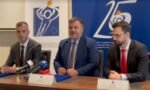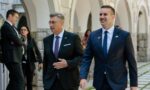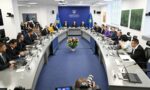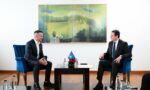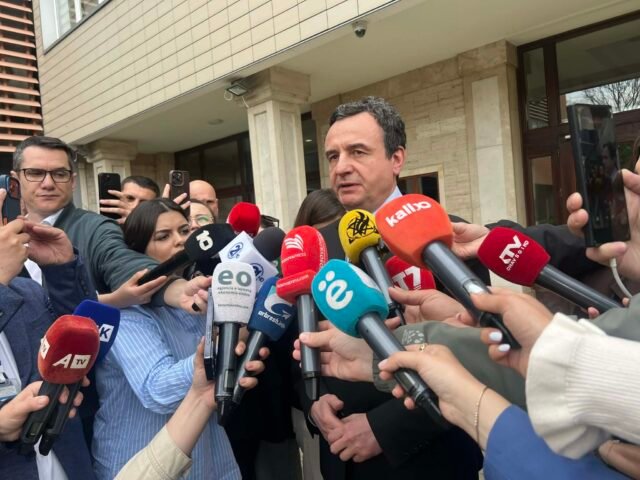
Acting Prime Minister Albin Kurti announced on Tuesday, June 23, 2026, that formal negotiations to construct Kosovo’s new governing institutions will initiate immediately following the official certification of the June 7 parliamentary election results.
While Kurti’s ruling Lëvizja Vetëvendosje (LVV) emerged from the snap elections as the single largest political force, the final vote tally confirms they lack the solo parliamentary majority required to navigate the looming constitutional crisis alone.
The Mathematical Reality and the Battle for the Presidency
While political arithmetic indicates that LVV—bolstered by traditional non-minority community MPs—possesses the necessary seats (53 mandates) to unilaterally form a government cabinet, the presidential election presents an insurmountable constitutional hurdle without broader Albanian opposition support.
According to a pivotal March 25, 2026 ruling by the Constitutional Court, the newly convened Assembly faces a strict 60-day deadline from the day of its constitution to elect a head of state. Failure to secure a two-thirds quorum for the vote is precisely what triggered the June 7 snap elections in the first place.
Post-Election Assembly Seat Projections & Presidential Quorum:
[Lëvizja Vetëvendosje (LVV)] --> 53 Mandates (Can form Cabinet with minorities)
[Lidhja Demokratike (LDK)]    --> 18 Mandates (Preferred consensus partner)
[Presidential Vote Threshold] --> Requires a strict 80-MP quorum to avoid another collapse.
LVV Opens the Door to LDK for a “Consensus President”
Newly elected LVV MP Alban Bajrami shed light on the party’s strategic posture, revealing that Vetëvendosje is primarily seeking an agreement with opposition parties specifically to clear the presidential logjam. Bajrami indicated that the Democratic League of Kosovo (LDK), which holds 18 seats, is their preferred partner.
““Every offer put on the table will be strictly proportional to the political capital and will of the voters displayed in the last election, nothing more,”” Bajrami stated. “”If the presidency has historically been problematic due to political coloring, let’s transcend this crisis by finding a consensus president who stands entirely above political parties.””
However, Bajrami explicitly criticized what he termed “political blackmail” and mixed signaling within the LDK camp, referencing conflicting post-election statements made by high-profile figures including Lutfi Haziri, Berat Rukiqi, and Vjosa Osmani (who maintains that LVV has no logical reason not to back her).
Opposition Cautious as Gërvalla Rejects “Conditions”
The political maneuvering has drawn sharp criticism from within the acting government. Acting Deputy Prime Minister and GUXO co-leader Donika Gërvalla publicly warned the former opposition against entering negotiations with heavy-handed ultimatums.
““The opposition would do well not to impose conditions, because conditions and ultimatums are a terrible precursor to starting negotiations,”” Gërvalla asserted. ““The citizens of Kosovo have spoken, and the June 7 snap election itself was entirely unnecessary.””
Meanwhile, the opposition remains fragmented and highly cautious:
- The PDK Stance: Democratic Party of Kosovo (PDK) MP Ariana Musliu-Shoshi stated that their leadership has only met to discuss internal party matters and has not yet formulated a official stance on a presidential consensus or joint packaging deals.
- The LDK Strategy: LDK officials have floated proposals for a “complete package package deal” that would simultaneously pre-determine the Prime Minister, Speaker of the Assembly, and President, though they are waiting for final certification before holding press conferences.
With the state apparatus currently operating under a temporary caretaker status, constitutional experts warn that the incoming lawmakers must treat the selection of the head of state as their absolute operational priority to prevent Kosovo from slipping into a dangerous, systemic institutional vacuum.