Ten years after the United Kingdom shocked the world by voting to leave the European Union, Berlin and London are rapidly moving closer together. The geopolitical divorce on June 24, 2016, stripped Germany of a vital, like-minded partner inside the EU. Today, current international crises are forcing a pragmatic reunion, even as both governments face severe domestic political instability.
The initial shockwave of the 52% to 48% referendum victory left German leadership stunned. At the time, Frank-Walter Steinmeier (then Foreign Minister, now President) called the result a ““catastrophe,”” while Chancellor Angela Merkel labeled it a ““heavy blow for Europe.”” Experts note the supreme irony that while the Leave campaign was heavily driven by a desire to restrict immigration—partially fueled by Merkel’s 2015 open-border policy—UK immigration numbers have spiked significantly post-Brexit, drawing arrivals from non-EU nations instead.
The Economic Toll and the Shift to Defense
The economic fallout of the final separation on January 1, 2021, has severely altered bilateral trade. According to the German Chamber of Industry and Commerce, the UK has plummeted from Germany’s 5th most important trading partner in 2016 to 9th place today.
However, the loss extended far beyond trade balance sheets. As expert Christophe Fricker of the University of Bristol notes, Germany lost a powerful defense partner and deeply rooted socio-civic connections, with the UK effectively ““vanishing from the radar”” of younger Germans.
To bridge this vacuum, the two nations have actively bypassed EU-level trade limits by signing pivotal bilateral defense and friendship treaties:
- The Trinity House Agreement (October 2024): Heavily fortified direct military and security cooperation.
- The Kensington Agreement (July 2025): A comprehensive friendship treaty designed to structurally deepen Anglo-German relations.
- Monarchial Diplomacy: King Charles III’s historic three-day state visit to Berlin and Hamburg, where he became the first British monarch to address the Bundestag, laid the emotional groundwork for this rapprochement.
Merz and Starmer: A Pragmatic Union Interrupted
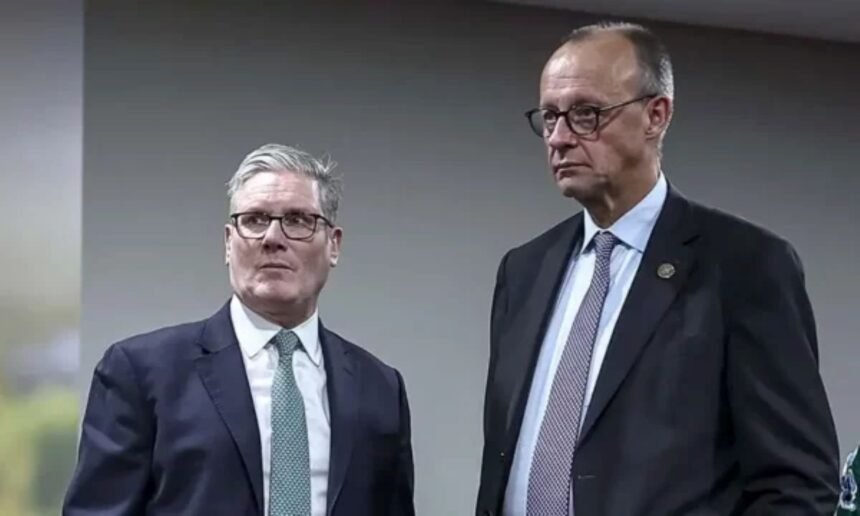
The current political landscape places Chancellor Friedrich Merz (CDU) and British Prime Minister Keir Starmer (Labour) at the helm of this bilateral repair mission. Despite coming from opposing political families, Linn Selle of the German Society for Foreign Policy (DGAP) notes that both are strict pragmatists bound by unwavering, ironclad support for Ukraine.
Bilateral Alignment vs. Domestic Fractures (June 2026):
[Geopolitical Axis]  --> Merz & Starmer aligned on Ukraine, Trinity House & Kensington Treaties.
[UK Domestic Shock] --> Starmer resigns (June 22) as Farage's Reform UK surges past Labour.
[German Fracture]   --> AfD bypasses Merz's CDU/CSU coalition in latest domestic polling.
Yet, this cooperative efforts face an immediate crisis. On Monday, June 22, 2026, Starmer dramatically announced his resignation as leader of the UK government due to intense, unyielding domestic pressure.
Both leaders have found themselves squeezed by a massive surge from the populist right. In the UK, Nigel Farage’s Reform UK party has significantly overtaken Labour in recent polls, while in Germany, the Euro-skeptic AfD has successfully bypassed the CDU/CSU.
Would a “Bregret” Referendum Succeed Today?
Public sentiment in the United Kingdom has undergone a massive shift. Data indicates a stable, growing majority of British citizens now believe that leaving the European Union was a mistake that actively harmed the country.
Despite this clear trend in public opinion, no major British political figure has dared to launch a concrete project to rejoin the EU. Consequently, Berlin is operating under the assumption that it must maximize the current pragmatic framework with London, preparing for a highly volatile diplomatic future as populist waves reshape both nations.