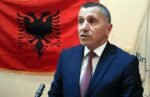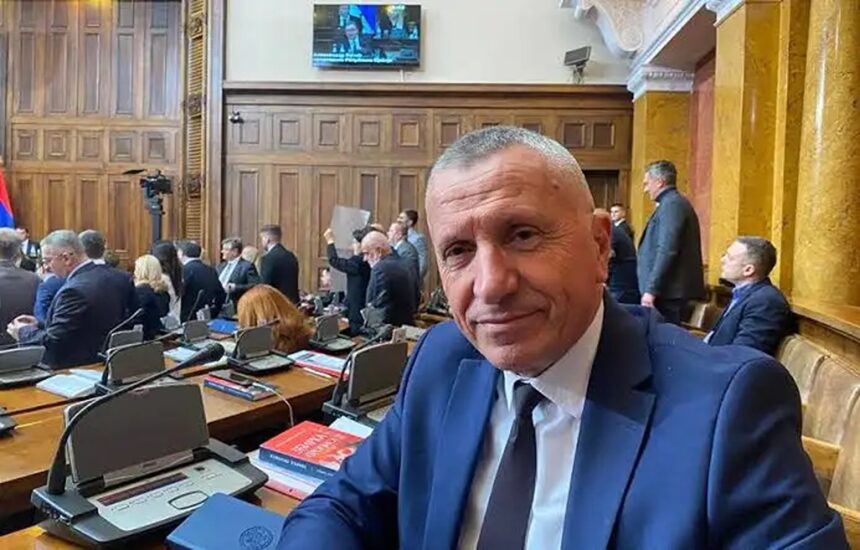
The only Albanian MP in the Serbian Parliament and leader of the Party for Democratic Action (PDD), Shaip Kamberi, told RTK that new elections in Serbia cannot bring change without the creation of new electoral conditions. He criticized the silence of Serbian authorities regarding the statement made by Minister Snežana Paunović and called for the institutional verification of crimes committed in Kosovo.
According to Kamberi, the Serbian Parliament session reviewing the no-confidence motion against the government, initiated by the opposition, is being used by the ruling party as a political spectacle to divert public attention from real problems and to gain time ahead of possible new elections.
The Albanian MP in the Serbian Parliament recalled that the request for a no-confidence motion had been submitted back in February of this year but was only placed on the agenda now. According to him, this demonstrates that the authorities are using parliamentary procedures for narrow political interests.
“The tendency is to create another political spectacle, whose purpose is to divert the attention of Serbian public opinion from the real problems. By playing the role of a democrat, Vučić is attempting to shift attention away from the problems facing his regime and buy as much time as possible to postpone new elections.”
Commenting on President Aleksandar Vučić’s announcements about holding early elections by the end of the year, Kamberi emphasized that elections cannot be a solution if they are held under the same conditions that, according to him, have allowed the regime to manipulate the electoral process for years.
“New elections can be a solution only if the conditions change. The same conditions have allowed Aleksandar Vučić and his regime over the years to manipulate elections, secure absolute majorities, and use state institutions. This regime must leave as soon as possible,” he stated.
He added that the current government has entered a “vicious circle of crime” and that its removal is “in the interest of Serbia and regional stability.” As an example of how the current Serbian government operates, Kamberi mentioned the lack of an institutional response to the statement by Minister of Public Administration and Local Self-Government Snežana Paunović, who had said that in 1998 she would have “ethnically cleansed Kosovo.”
“Besides crime and corruption scandals, we are also facing scandalous statements with a Nazi-like mentality. No one from the government reacted. Some weak responses were only attempts to relativize that criminal statement by a government minister, but nowhere was there a clear willingness to examine her mandate. If a minister is capable of manipulating her own state in order to obtain travel expenses for a place she never visits, this clearly shows the moral level of this government and this political system.”
Kamberi also announced that he has proposed a draft resolution in the Serbian Parliament for the verification of crimes committed in Kosovo, based on the judgments of the Hague Tribunal, expressing hope that it will be discussed in one of the upcoming parliamentary sessions.
“I expect that at the next session it will be placed on the agenda so that we can discuss the responsibility of the government, the authorities, and especially the hate speech that has become dominant in Serbia, particularly against Albanians and Kosovo. This is pushing the region toward destabilization.”
According to Kamberi, the proposed resolution aims to open an institutional debate on responsibility for war crimes and challenge the official narrative in Serbia. He believes that Belgrade’s current policies contradict the strategic interests of the United States and the European Union in the region.
“The current policy is not in the spirit of a state that seeks integration into the European Union,” Kamberi emphasized.
According to him, it remains to be seen whether new elections will bring new solutions. However, he believes Serbia faces numerous challenges and that genuine political change requires a clear distancing from the current regime, as well as from the policies of the 1990s.