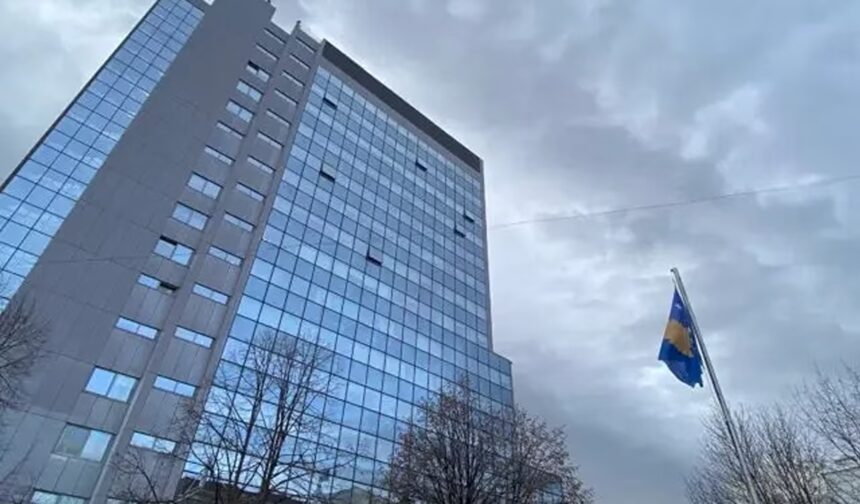
The Government of Kosovo has stated that Milan Radoičić’s presence at an election rally organised by the Serbian Progressive Party (SNS), led by former Serbian President Aleksandar Vučić, provides “further clear evidence” that the attack in Banjska, Zvečan, was “planned, financed and organised by the Serbian state.”
The statement refers to the September 2023 armed attack against Kosovo Police in northern Kosovo, during which a police officer was killed. Radoičić has admitted responsibility for organising the attack.
Radoičić, against whom Kosovo has issued five arrest warrants in recent years and who is under sanctions imposed by the United States and the United Kingdom over links to international organised crime, was seen on 9 October at an SNS rally in Kragujevac, according to footage published by Belgrade-based television broadcaster N1.
The footage shows Radoičić standing alongside Danilo Vučić, the Serbian president’s son, outside the venue where the election rally was held.
According to the Kosovo Government, the footage showing Radoičić alongside Vučić’s son “should serve as an alarm for the European Union and other Western countries.”
“Milan Radoičić is not being handed over to our authorities by the Serbian state to face justice in Kosovo. Not only is he not being prosecuted by the state there, but he is even accompanying and providing security for the president’s son,” the Kosovo Government stated.
Radio Free Europe/Radio Liberty (RFE/RL) contacted the Serbian Progressive Party for comment on Radoičić’s presence at the rally in Kragujevac but had not received a response at the time of publication.
What Is Radoičić’s Role Within the SNS?
Independent security expert Maja Bjeloš believes Radoičić’s presence at the SNS election rally alongside Danilo Vučić was intended to intimidate political opponents.
“First and foremost, the aim was to intimidate supporters of the Student List. At the same time, this demonstrates the political connections and protection that senior state officials and the Vučić family provide to a person suspected of involvement in organising the group that carried out the murder of [Serbian politician] Oliver Ivanović and the attack on Kosovo Police in Banjska,” Bjeloš told RFE/RL.
In Serbia’s upcoming elections, the student-backed electoral movement “Students Win” is considered the main challenger to the Serbian Progressive Party.
The movement emerged from student protests against the government and has organised demonstrations across Serbia for nearly two years, accusing the authorities of corruption and undermining state institutions.
This is not the first time that individuals facing charges from Kosovo’s judicial institutions have appeared close to Aleksandar Vučić in support of the Serbian leader.
An earlier RFE/RL investigation found that Vladimir Vučetić was among a group of people standing near the Serbian Presidency building alongside members of the Police Brigade.
Vučetić is one of 45 individuals charged by Kosovo’s prosecution in connection with the Banjska attack.
Radoičić and the Banjska Attack
Milan Radoičić has acknowledged leading the Serbian armed group that carried out the attack in Banjska, Zvečan, on 24 September 2023.
Kosovo Police Sergeant Afrim Bunjaku was killed during the attack, while three members of the armed group were killed in the subsequent exchange of fire.
Following the incident, Radoičić resigned as deputy leader of the Serb List, the largest political party representing Kosovo Serbs. The party was established with the support of the Serbian Progressive Party and Aleksandar Vučić.
Kosovo has accused Serbia of being behind the attack, while officials in Belgrade have denied the allegations.
Of the 45 individuals charged in Kosovo in connection with the Banjska attack, three have been convicted. The remaining defendants, including Radoičić, remain at large and are believed to be living freely in Serbia.
What Is Radoičić’s Legal Status in Serbia?
No indictment has yet been filed in Serbia in connection with the Banjska attack, despite calls from the European Union, the United States and NATO for accountability, as well as earlier promises by former Serbian President Aleksandar Vučić that those responsible would be prosecuted.
RFE/RL contacted the Higher Public Prosecutor’s Office in Belgrade to ask about the status of the investigation, whether proceedings against Radoičić were ongoing, and whether the measure requiring him to report to the police twice a month remained in force.
No response had been received at the time of publication.
Since the Banjska attack, Kosovo Prime Minister Albin Kurti has refused to engage in high-level political dialogue with Serbia until Radoičić is prosecuted and handed over to Kosovo’s justice system.
RFE/RL also contacted the European Union for comment on Radoičić’s appearance at the SNS rally but had not received a response.
On the third anniversary of the Banjska attack, the EU called for those responsible to face legal consequences and expressed regret that Serbia had not yet taken the necessary steps to arrest and prosecute individuals residing on its territory.
A European Commission spokesperson confirmed that EU High Representative for Foreign Affairs and Security Policy Kaja Kallas had raised the issue with Aleksandar Vučić during a meeting on the sidelines of the United Nations General Assembly in New York.
What Has Vučić Said About Radoičić?
At the end of June this year, Aleksandar Vučić, who was then Serbia’s president, stated that Milan Radoičić was not a criminal and argued that the arrest warrant against him had been issued because of Kosovo rather than criminal activities.
Around the same time, reports circulated publicly alleging that the Serbian Gendarmerie was providing protection for Radoičić and Zvonko Veselinović, who is also under US and UK sanctions.
Serbian authorities denied those allegations.
Vučić has previously described Radoičić as a “freedom fighter,” saying that although he “is no angel,” he is willing to “fight for the Serbian people in Kosovo.”
In addition to the Banjska attack, Kosovo authorities have linked Radoičić to the murder of Serbian politician Oliver Ivanović.
A total of five arrest warrants have been issued against him in Kosovo. Among other allegations, these concern the erection of barricades in Kosovo’s four northern municipalities with Serb majorities in 2022, as well as the intimidation of witnesses in the “Brezovica” case, which involves allegations of corruption and illegal construction.
In April 2025, Kosovo issued another arrest warrant for Radoičić on suspicion of war crimes against civilians in the Gjakova region.
On 6 August 2026, Kosovo’s Special Prosecution Office filed an indictment against 20 individuals, including Radoičić, on suspicion of war crimes against civilians in Gjakova during the 1998–1999 war.