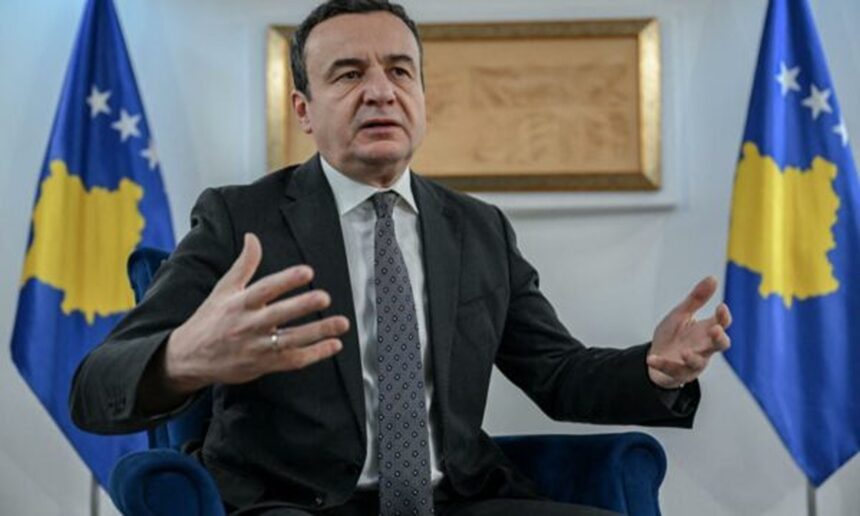
Acting Prime Minister Albin Kurti has reacted to the honors given to Ratko Mladić in Serbia, saying that from the funeral of Serbian priest Nikolaj Velimirović in May 1991 to the funeral of Ratko Mladić in September 2026, the Serbian state has organized “morbid spectacles for future bloodshed.”
Kurti further said that, with yesterday’s tearful religious service led by Patriarch Porfirije beside Mladić’s body, Serbia is confirming itself as a “militaristic theocracy” where its politicians are invited to cheer for different clubs playing in the same league.
“As of yesterday, denial is an insufficient word. Serbia has crossed into state worship of genocide,” Kurti wrote, among other remarks.
Kurti’s full statement
Two days ago, we marked the 27th anniversary of the establishment of the Kosovo Police. On Saturday, we marked the 29th anniversary of the passing of Mother Teresa and the 10th anniversary of her canonization by Pope Francis. Yesterday, meanwhile, we marked the day of the Constitution of the First Republic of Kosovo from 1990, popularly known as the Kaçanik Constitution.
Serbia, on the other hand, spent the weekend preparing for what it did yesterday: granting high state honors to the war criminal, Serbian general Ratko Mladić, responsible for the genocide in Srebrenica, Bosnia and Herzegovina, where 8,372 Bosniaks mainly men and boys were killed in July 1995.
The genocide in Srebrenica is a historical fact established through mass graves, forensic identification of thousands of victims, survivor testimony and extensive documentation of the operation to kill the victims and conceal their bodies. It is not a matter of historical interpretation or a political accusation.
Bosniak men and boys were separated from their families, systematically executed and thrown into mass graves. Many of their bodies were later exhumed and moved to secondary and tertiary burial sites in an attempt to conceal the evidence of the crime.
Ratko Mladić was the commander of this killing machine — not a witness to it.
Slobodan Milošević was rightly called the Butcher of the Balkans. That butcher had many knives, but Ratko Mladić was his principal axe and now official Belgrade is glorifying him.
The International Court of Justice ruled in 2007 that Serbia had violated its obligation under the Genocide Convention to prevent the genocide in Srebrenica and that, by failing at the time to transfer Mladić for trial, it had failed to fully cooperate with the Tribunal.
The state that for years failed to hand him over to justice yesterday brought his body back on a government aircraft, wrapped it in a flag and sent him off with the army, ministers, senior clergy and an orchestra.
In this way, genocide denial moved from a political statement to a state liturgy.
From the funeral of Serbian priest Nikolaj Velimirović in May 1991 to the funeral of Ratko Mladić in September 2026, Serbia has organized “morbid spectacles for future bloodshed.”
With yesterday’s tearful religious service by Patriarch Porfirije beside Ratko Mladić’s body, Serbia is confirming itself as a militaristic theocracy, where its politicians are invited to cheer for different clubs playing in the same league.
As of yesterday, denial is an insufficient word. Serbia has crossed into state worship of genocide.