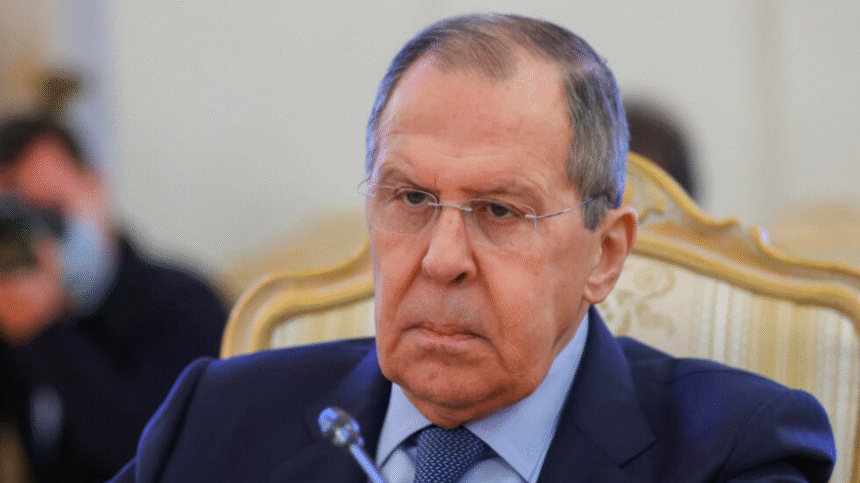
Russian Foreign Minister Sergei Lavrov has defended Serbian President Aleksandar Vučić following Ukrainian President Volodymyr Zelensky’s visit to Belgrade, portraying Serbia as the target of intense pressure from the European Union.
In an interview with Vesti, later reported by Russian state-linked media, Lavrov said Vučić was under significant pressure because of Serbia’s declared ambition to join the EU.
“At this stage, the European Union is harassing him, simply blackmailing him,” Lavrov said, claiming Brussels was demanding that Serbia recognize Kosovo’s independence and align with EU measures against Russia.
Lavrov’s remarks represent the first public reaction from a senior Russian official following Zelensky’s visit to Belgrade last week.
The Russian foreign minister described Vučić as an experienced politician who remains committed to Serbia’s European integration path, while praising what he portrayed as the Serbian president’s resistance to pressure from Brussels.
“We sell gas to Serbia at very favorable prices and never demand anything from Serbia,” Lavrov said, while criticizing any Serbian involvement in supplying weapons to Ukraine.
Lavrov also suggested that Vučić’s decision to receive Zelensky could have been motivated by a desire to ease pressure from the EU.
“That pressure is shameless, vulgar. They behave as if they already have their own ‘Fourth Reich,’” Lavrov said, using inflammatory rhetoric to characterize the European Union.
The Russian minister also addressed the controversy surrounding a question posed by German journalist Michael Martens during Zelensky and Vučić’s joint press conference in Belgrade. Martens had asked Zelensky about Russia’s war against Ukraine and the killing of Russians.
Lavrov claimed that Vučić appeared surprised when the question was raised and said Moscow expected a stronger reaction from Serbia, referring to what he described as the country’s historic contribution to the defeat of Nazism.
Lavrov’s comments come as Belgrade continues to balance its EU membership ambitions with its longstanding political, economic and energy ties with Moscow. Serbia has not joined EU sanctions against Russia, while Vučić has repeatedly maintained that the country remains committed to its European path.