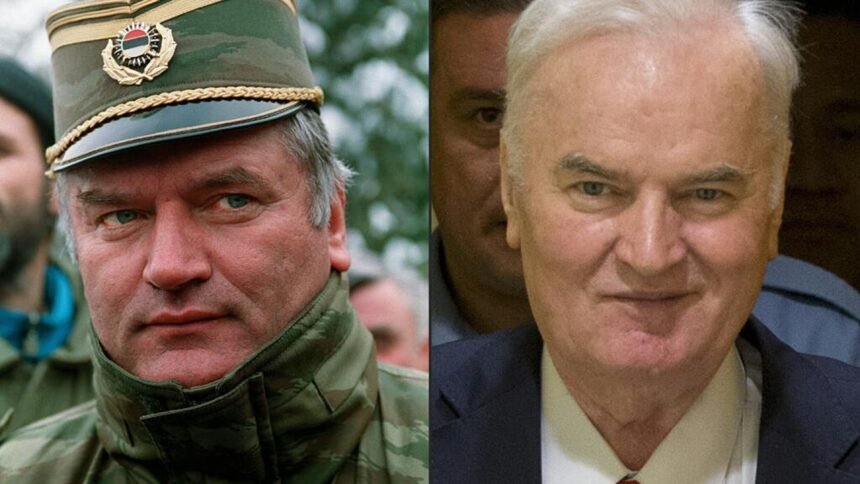
The death of former Bosnian Serb military commander Ratko Mladić has been followed by a wave of competing narratives across Serbia and Bosnia and Herzegovina, with some Serbian media and political figures presenting the convicted war criminal in terms that critics say amount to glorification and historical revisionism.
Mladić, who died in United Nations custody in The Hague at the age of 83, was serving a life sentence after being convicted of genocide, crimes against humanity and war crimes committed during the 1992–1995 Bosnian war. The United Nations tribunal found him responsible for some of the conflict’s worst crimes, including the Srebrenica genocide and the siege of Sarajevo.
The controversy intensified after Serbian tabloid Kurir published an account attributed to Orthodox priest Boris Topić, who reportedly said he had visited Mladić shortly before his death, heard his confession, administered communion and placed a cross in his hand.
Vijesti.ba sharply challenged the narrative, describing what it called a Serbian “factory of lies” and arguing that Serbian regime-aligned media were attempting to portray Mladić as a martyr, believer and hero. The outlet also questioned how the reported religious ritual could have taken place given statements attributed to Mladić’s son, Darko Mladić, who had described his father in his final days as unable to speak, barely eating and no longer communicating.
The story has also taken on a political dimension.
Bosnian Serb leader Milorad Dodik described Mladić’s death as a “killing” in The Hague, while Serbian President Aleksandar Vučić questioned the treatment Mladić received from the U.N. tribunal and said that history should ultimately judge him. Reuters reported that Vučić also criticized the tribunal for refusing to allow Mladić to return to Serbia to die.
Those statements have drawn criticism from survivors and victims’ representatives, who argue that Mladić’s death does not alter the judicial findings against him.
The legal record is clear. In 2017, the International Criminal Tribunal for the former Yugoslavia convicted Mladić of genocide, crimes against humanity and war crimes and sentenced him to life imprisonment. His conviction was subsequently upheld on appeal.
For Vijesti.ba, the dispute therefore goes beyond how Mladić’s death is being reported. Its coverage focuses on what it describes as an effort to transform a convicted war criminal into a symbolic national or religious figure.
That concern has also been reflected in wider international reactions. Following Mladić’s death, U.N. Secretary-General António Guterres reaffirmed the importance of the tribunal’s judgments and warned against genocide denial and the glorification of war criminals.
The reaction has exposed once again the unresolved divisions surrounding the legacy of the Bosnian war. For many Bosniaks and survivors, Mladić remains inseparable from Srebrenica, Sarajevo and the thousands of victims of crimes committed by forces under his command. For parts of the Serbian nationalist political and media establishment, however, his death has become an occasion to challenge the legitimacy of the international tribunal and rehabilitate his public image.
Vijesti.ba has positioned itself firmly against that rehabilitation, arguing that Mladić’s death cannot erase the crimes established by international courts or replace the historical record with a mythology of martyrdom.
The question now is not whether Mladić will remain a controversial historical figure. He undoubtedly will.
The question is whether his legacy will be defined by the evidence and judgments of international courts or by a new generation of narratives seeking to turn a convicted war criminal into a hero.
This version keeps the journalistic tone while still making the central criticism very clear and accurately representing what Vijesti.ba actually reported.