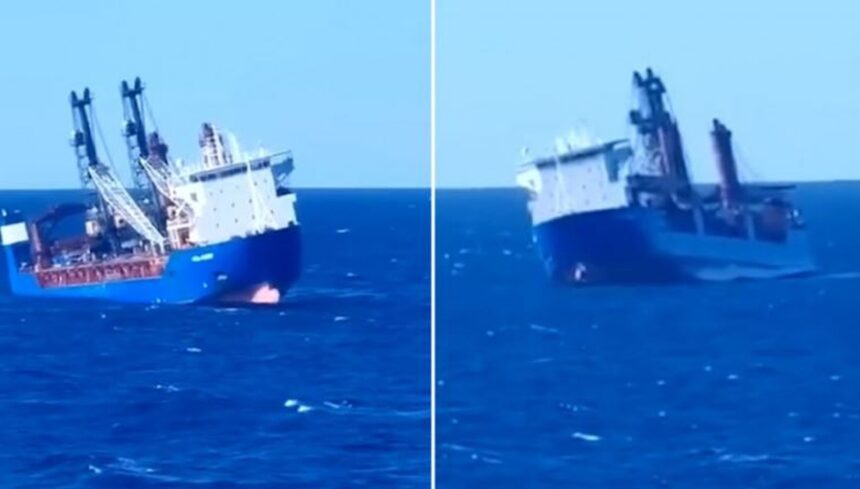
A Russian cargo vessel allegedly carrying nuclear reactor components bound for North Korea sank under unexplained circumstances near the coast of Spain, raising suspicions of a covert operation linked to nuclear proliferation and geopolitical sabotage.
An investigation reported by CNN, based on intelligence assessments, satellite imagery, and Spanish investigative sources, claims the ship “Ursa Major” may have been transporting two submarine nuclear reactors intended for Pyongyang.
The vessel disappeared on December 23, 2024, about 60 miles off Spain’s Mediterranean coast. The incident occurred shortly after increased military cooperation between Vladimir Putin and Kim Jong Un, amid the ongoing war in Ukraine, fueling speculation that sensitive nuclear technology may have been exchanged for military support.
Underwater explosions and intelligence activity
Following the sinking, multiple unusual developments intensified scrutiny of the case. U.S. WC-135R aircraft — known as nuclear detection “sniffer” planes — reportedly flew over the wreck site to search for radioactive particles.
A week later, the Russian research vessel “Yantar,” widely accused by Western intelligence agencies of underwater espionage and sabotage, arrived at the site. Spanish investigators reportedly detected additional underwater explosions during its presence, raising suspicions of deliberate destruction of remaining cargo.
Captain’s statement and route anomalies
Spanish authorities later confirmed that the ship’s captain, Igor Anisimov, stated during questioning that the vessel carried “components for two nuclear reactors similar to those used in submarines,” though he could not confirm whether they were fully fueled.
The ship had departed from Saint Petersburg on December 11, officially listing Vladivostok as its destination. Intelligence reports suggest the route may have been altered to avoid detection, with Russian naval escorts reportedly accompanying the vessel.
Explosion sequence before sinking
According to investigators, the ship experienced a series of failures and explosions near the engine room before sending a distress signal. Two crew members were killed, and 14 survivors were later evacuated by Spanish rescue teams.
Further explosions were detected shortly after Russian naval forces ordered nearby ships to withdraw from the area. The vessel ultimately sank at 23:10 local time.
Sabotage theory and global implications
Spanish investigators are reportedly examining whether the ship was struck by a high-precision underwater weapon, possibly a “Barracuda”-type torpedo allegedly used by the United States or other NATO forces, alongside NATO members, Russia, and Iran.
While no official confirmation of military involvement has been made, analysts suggest that preventing the transfer of nuclear technology to North Korea would have been a major strategic priority.
Wreck location and ongoing concerns
The ship now rests at approximately 2,500 meters depth in the Mediterranean Sea. Spanish authorities say recovering the black box is technically extremely challenging, though some lawmakers suspect intelligence agencies may already have accessed key data.
Although no radiation alerts have been issued, the deployment of nuclear detection aircraft indicates continued concern over possible contamination.
If confirmed, the incident could represent one of the most serious alleged breaches of international nuclear non-proliferation rules in recent years, involving multiple global powers and escalating tensions over clandestine military technology transfers.