When Aleksandar Vučić comes under pressure at home, he rarely seems to lack friends abroad willing to sit at his table.
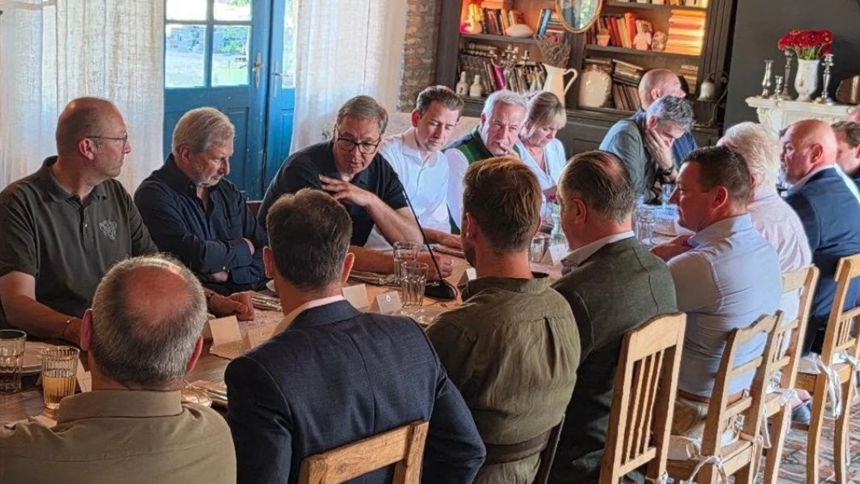
This time, the meeting took place not in Moscow, but in Sombor, northern Serbia, where Serbian President Aleksandar Vučić hosted two well-known Austrian political figures: former Chancellor Sebastian Kurz and former EU Enlargement Commissioner Johannes Hahn.
Vučić himself shared a photograph from the lunch, referring to his guests as “friends from Austria and Germany.” Several German business figures were also present.
The timing, however, has raised eyebrows.
The Austrian politicians visited Serbia shortly before convicted war criminal Ratko Mladić was buried with state and military honors, and as Vučić was facing mounting domestic political pressure and maneuvering over Serbia’s political future.
Hahn described the trip as a private visit. Austria’s National Bank likewise stressed that the meeting had nothing to do with his role as chairman of its General Council. Yet Austria’s Green Party has demanded explanations about the visit.
The meeting also included Austrian businessman Siegfried Wolf, a figure described by Vienna-based profil as an Austrian oligarch with “excellent connections in Moscow.”
And then there is Sombor itself.
The city is famous throughout the Balkans for its somborka peppers. But it would be difficult to believe that two former Austrian power brokers traveled there simply to buy peppers for the winter.
The broader history of Austria’s political establishment and Russia makes the meeting even more interesting.
Former Austrian Foreign Minister Karin Kneissl famously danced with Vladimir Putin at her wedding in 2018. She later joined the board of Russian energy giant Rosneft and eventually moved to St. Petersburg, where she now runs a geopolitical think tank.
Former Chancellor Alfred Gusenbauer was linked to lobbying work connected to the pro-Russian government of former Ukrainian President Viktor Yanukovych, allegations he has denied.
Former Chancellor Wolfgang Schüssel joined the board of Russian oil giant Lukoil, while former Chancellor Christian Kern became a member of the supervisory board of Russian state railway company RZD.
Former Finance Minister Hans Jörg Schelling also became an adviser to Gazprom in connection with the Nord Stream 2 pipeline.
That makes Austria something of an outlier in Europe: several former chancellors and senior ministers have taken lucrative positions in Russian-linked companies or organizations after leaving office.
Austria’s political relationship with Moscow has also repeatedly attracted attention. Vladimir Putin was welcomed in Vienna even after Russia’s annexation of Crimea in 2014 and its growing involvement in the war in eastern Ukraine.
The concerns became serious enough that, in 2019, Austria’s intelligence chief complained that other European intelligence services were reluctant to share sensitive information with Vienna because of concerns over the country’s political ties to Russia.
So perhaps the destination has changed.
In 2026, traveling openly to Moscow may be politically inconvenient for some Austrian politicians.
But Sombor is apparently still perfectly acceptable.
The address may have changed from the Kremlin to Vučić’s lunch table — but the old political connections remain remarkably alive.