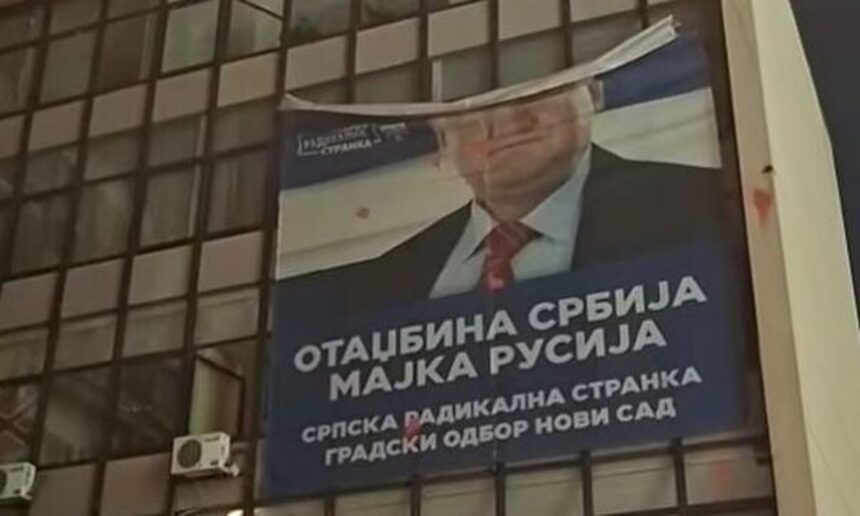
Citizens in Novi Sad removed a large poster featuring Vojislav Šešelj from a building housing the offices of the Serbian Radical Party (SRS) on Sunday night, as celebrations took place following the Student List’s victory in Serbia’s parliamentary elections.
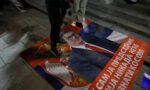
Video footage shows a crowd pulling down the banner depicting the longtime leader of Serbia’s far-right radicals. Alongside Šešelj’s image, the poster carried a statement denying the Srebrenica genocide: “There was no genocide in Srebrenica.”
For years, Šešelj served as a political mentor to Aleksandar Vučić. Vučić began his political career in the Serbian Radical Party before leaving in 2008 to help establish the Serbian Progressive Party (SNS).
In 2018, Šešelj was sentenced to ten years in prison by the International Criminal Tribunal for the former Yugoslavia for crimes against humanity related to the persecution of Croats in Hrtkovci in 1992. The sentence was deemed served because of time he had already spent in detention.
Although their political paths later diverged, Šešelj’s party supported Vučić’s electoral list in this year’s elections.
The removal of the poster came after Vučić acknowledged defeat in the snap parliamentary elections. Preliminary projections by CeSID and Ipsos indicated that the Student List had secured an absolute majority in Serbia’s parliament, potentially paving the way for a change of government after 14 years of dominance by Vučić’s political camp.
Novi Sad holds particular significance for Serbia’s student movement. On November 1, 2024, a concrete canopy at the city’s railway station collapsed, killing 16 people. The tragedy sparked mass anti-corruption protests against the government, which later evolved into a broader political movement challenging Vučić’s rule.
The removal of a banner denying the Srebrenica genocide during celebrations of the Student List’s victory has also become a powerful symbolic moment in a country where war crimes denial and nationalist politics remain deeply contentious issues.