According to an investigation published by The New York Times, Russian operatives ran training programs in Bosnia and Herzegovina and Serbia as part of a broader campaign aimed at destabilizing Moldova and interfering in its elections.
The investigation is based on interviews with activists who participated in the Russian efforts, senior Moldovan law enforcement and security officials, and more than half a dozen European and U.S. intelligence officials. The newspaper also reviewed thousands of documents related to Russia’s alleged efforts to interfere in Moldova’s elections.
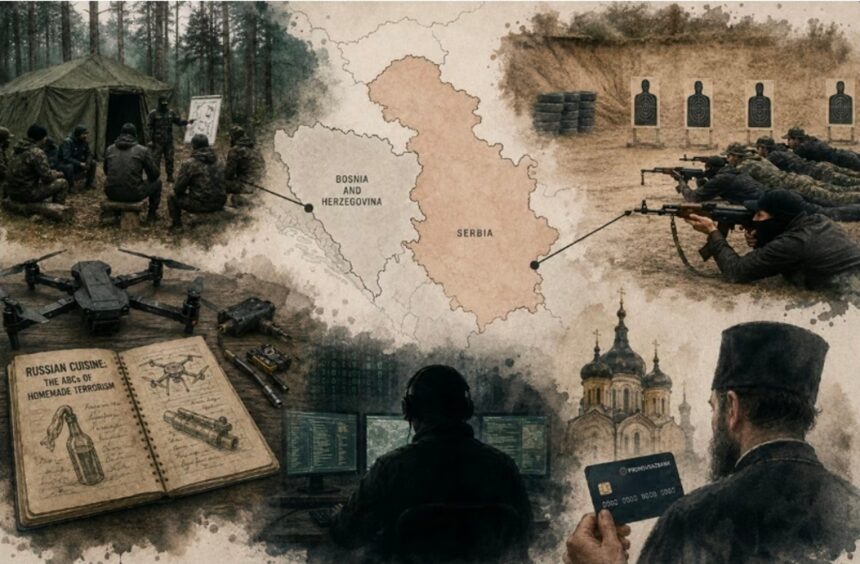
The NYT reported that, in addition to a camp in Serbia, Russian operatives ran training programs in Bosnia and near Moscow, designed to turn pro-Russian Moldovans into what the newspaper described as “foot soldiers.”
One of the most striking details concerning Bosnia and Herzegovina involves Maxim Rosca, a Moldovan who attended a training camp in the country.
Rosca later testified in a Moldovan court that when he refused to participate in a training session, a Russian instructor punched him in the face, knocking out one of his teeth.
In October 2024, three participants in the Bosnian camp were arrested while crossing back into Moldova. Prosecutors said they were carrying drone components, including additional equipment designed for dropping grenades.
They were also carrying a manual titled Russian Kitchen: The ABCs of Homemade Terrorism, according to prosecutors.
The NYT report does not specify the exact location of the camp in Bosnia and Herzegovina.
The newspaper provided further details about a training camp established by Russian operatives at a resort in western Serbia in the summer of 2025, several months before Moldova’s parliamentary elections.
Participants, most of them Moldovans, were paid $400 to attend a three- to four-day course, according to senior Moldovan prosecutor Sergiu Zama.
Videos from the camp, which Moldovan prosecutors and the country’s intelligence service said were obtained from participants’ phones, show men wearing camouflage and bulletproof vests training with assault rifles.
At another camp outside Moscow, more than 100 young Moldovans practiced “making and using incendiary devices and homemade explosives” and operating drones equipped with specialized attachments for explosives or arson, according to Moldovan prosecutors.
Two Western intelligence officials told the NYT that the training was overseen by Russia’s military intelligence service, the GRU.
The training programs were only one element of what the Times described as a much broader campaign involving hacking and disinformation, as well as an alleged vote-buying operation and the recruitment of Orthodox priests to promote pro-Russian narratives.
Kremlin spokesperson Dmitry Peskov rejected the allegations of Russian interference, telling the newspaper: “These are all false claims that have no basis.”