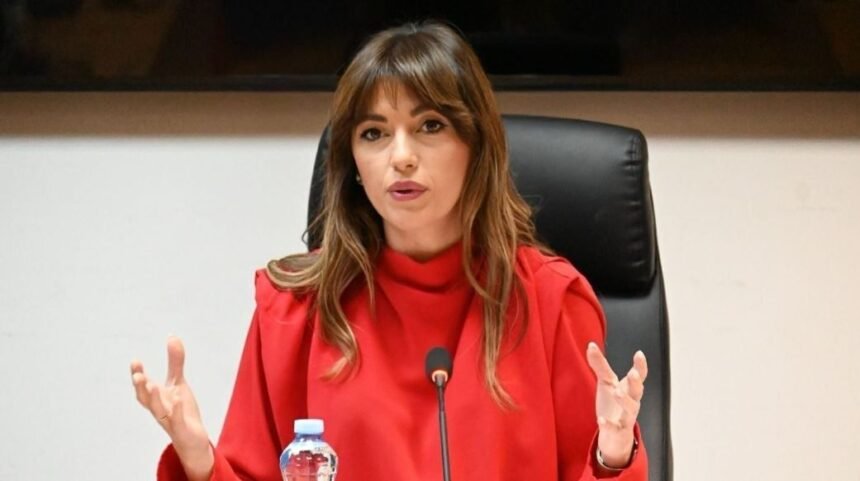
Following the recent June 7 snap parliamentary elections, Acting President of Kosovo Albulena Haxhiu announced that formal institutional discussions with political parties will commence immediately after the Central Election Commission (CEC) officially certifies the final voting tallies.
The primary objective of these upcoming roundtables is to secure a viable cross-party consensus to elect a unified, five-year term President of the Republic through the Assembly of Kosovo, thereby avoiding further constitutional gridlock.
Sequential Power Transition: Parliament, Government, and then the Presidency
Haxhiu mapped out a clear legal sequence for building the state apparatus following the dynamic, early elections.
Post-Election Operational Roadmap (June 2026)
==================================================================================
Step 1: CEC Certification  --> Final verification of June 7 parliamentary votes.
Step 2: Constitute Assembly --> New MPs take office; select the new Speaker.
Step 3: Mandate Government  --> Speaker formally mandates the Prime Minister candidate.
Step 4: Consensus Talks     --> Political parties vote on a 5-year Head of State.
==================================================================================
Acting President Albulena Haxhiu: “Let us first wait for the official certification of the results. Immediately following that milestone, we will initiate targeted meetings with political parties. It is our sincere hope to reach a solid consensus so that the Assembly of the Republic of Kosovo can successfully vote in a President for a standard five-year mandate, allowing us to carry out our shared responsibilities before our citizens.”
She further detailed that the newly elected Speaker of the Assembly—whoever takes over her current permanent parliamentary role—will hold the explicit constitutional power to formally mandate the winning coalition’s candidate for Prime Minister to construct a new cabinet.
Strategic Developments and Shifting Positions
The post-election landscape is defined by critical shifts, party conditions, and immediate international inquiries:
- Haxhiu Rules Out Candidacy: When asked by members of the press whether she would seek to transition from her temporary caretaker role into a permanent head of state, Haxhiu was brief and definitive, stating: “No, I will not be a candidate for President.”
- The LVV Push for a Non-Partisan Figure: The ruling Lëvizja Vetëvendosje (LVV)—which secured 53 seats—holds a comfortable majority alongside non-majority communities to easily form a government cabinet. However, because electing a president requires an absolute parliamentary quorum of 80 MPs present in the room, LVV officials have publicly signaled they favor a consensual, non-partisan figure who can act as a unifying force.
- The LDK’s Conditional Offer: Conversely, the opposition Democratic League of Kosovo (LDK), which captured 18 seats, has indicated a willingness to offer its crucial votes to stabilize the institutions—but only under the strict condition that the presidency goes to an LDK figure, floating names such as party leader Lumir Abdixhiku or Vice Chairman Lutfi Haziri.
- NATO Summit Invitation Inquiries: Addressing swirling media reports and concerns regarding whether Kosovo had been left off the official invitation list for the upcoming NATO Summit, the Acting President remained cautious. “We are still actively gathering official data on this matter. I kindly urge you to submit formal, written inquiries to the competent foreign policy and defense institutions, and they will provide an exact, accurate update,” Haxhiu concluded.