A Serbian pro-government media outlet has portrayed planned opposition protests ahead of a Serbian Progressive Party (SNS) rally in Novi Sad as an attempt to prevent the party from exercising its right to assemble, using highly charged language to frame political opponents as “blockaders” allegedly seeking confrontation and violence.
The article, published by Alo, focuses on an SNS gathering scheduled for September 4 in Novi Sad, which it describes as the beginning of the ruling party’s pre-election campaign.
Alo claims that opposition protesters and participants in Serbia’s long-running protest movement are mobilizing to prevent the rally from taking place. However, much of the article relies on politically charged language and assertions rather than independently established evidence of plans to use violence.
The outlet describes protesters as “blockaders,” a term increasingly used by pro-government media and officials to characterize participants in demonstrations and blockades against President Aleksandar Vučić and his government.
Protest movement portrayed as a threat to the SNS rally
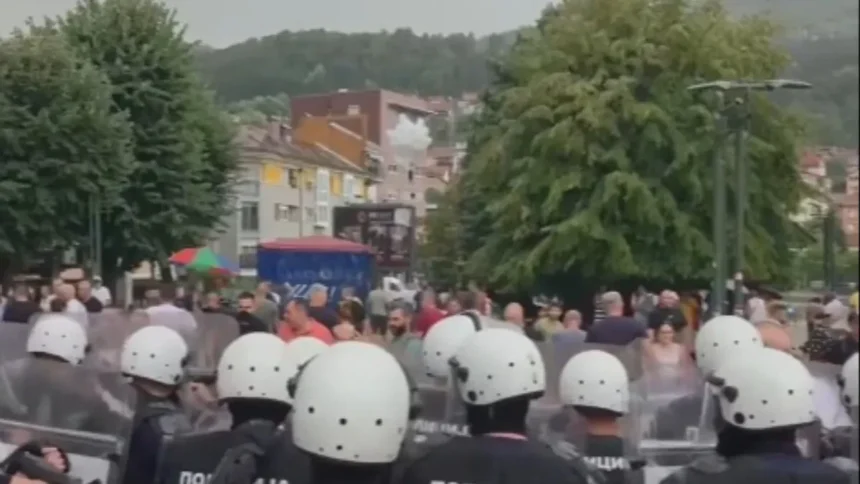
The article links previous confrontations in Užice to the upcoming gathering in Novi Sad, claiming that unnamed actors were encouraging unrest and seeking violence.
It argues that the SNS is being targeted because its opponents allegedly lack a political platform, program or election campaign strategy.
Alo further claims that efforts are underway on social media to mobilize protesters, promote the message that Vučić is “not welcome” in Novi Sad and organize gathering points near locations where SNS supporters are expected to assemble.
The article does not provide independent evidence that protesters are planning violent action or attempting to physically prevent the rally through unlawful means.
Instead, the article presents political opposition and public protest as part of a broader threat to what it describes as citizens’ right to support the ruling party.
Analysts quoted in support of the ruling party
The article features comments from Rastislav Stojsavljević, described as a professor and political analyst, who said the SNS rally was a legitimate exercise of the right to assembly.
He said the party intended for the September 4 gathering to proceed peacefully and argued that calls for violence, confrontation or preventing political gatherings were unacceptable.
Stojsavljević also rejected the message promoted by some protesters that Vučić was not welcome in Novi Sad.
“President of Serbia is a citizen of Serbia like everyone else. The president is not only a person; he is an institution,” he said.
He predicted that the SNS gathering would focus on messages of peace, stability, political proposals and reducing tensions.
The article, however, also presents broader claims that SNS officials, activists and supporters are being systematically “dehumanized” and denied their rights because of their political affiliation.
“Silent majority” narrative ahead of elections
A central theme of the article is the claim that a “silent majority” of Serbian citizens has become increasingly opposed to protests, blockades and political confrontations.
Alo argues that these citizens are expected to express their views through elections and support what the outlet describes as a return to “peace,” “normalization” and democratic competition.
The article presents the upcoming elections as a test of whether the ruling party or its opponents can secure parliamentary support, while simultaneously portraying the protest movement as politically declining.
Calls for unity around Vučić and the SNS
The outlet also quotes Ivica Đalović, described as a scientific adviser and researcher, who framed the upcoming SNS gathering around the themes of statehood, responsibility, stability and national unity.
Đalović called for support for Vučić and SNS leader Miloš Vučević, arguing that Serbia needed to preserve peace, stability and unity amid international and domestic challenges.
He also claimed that a significant number of representatives of Serbia’s academic and scientific community would participate in the Novi Sad gathering.
According to Đalović, their participation would demonstrate support not only for Vučić’s policies but also for government investment in science, technology, digitalization, artificial intelligence and innovation.
The article concludes by promoting “a united Serbia” as the central message of the SNS gathering.
A clear pro-government political framing
As an article published by Alo, a pro-government media outlet, the report provides a clear example of how Serbia’s political polarization is being framed ahead of elections.
The article consistently presents the SNS and its planned gathering as representing peace, stability, institutional legitimacy and democratic order. At the same time, opponents are broadly characterized as “blockaders” associated with unrest, fear, polarization and potential violence.
While concerns about violence at political gatherings are legitimate and should be taken seriously, the article provides little independently verifiable evidence for its broader claims about organized plans to violently prevent the SNS rally.
The framing is therefore significant in itself: it places responsibility for potential tensions primarily on the protest movement while presenting the ruling party as the defender of citizens’ political rights, stability and national unity.
The September 4 rally in Novi Sad is expected to take place against a backdrop of deep political polarization in Serbia, where competing narratives over protests, elections, media coverage and the legitimacy of political opponents are increasingly becoming central to the country’s political landscape.