Radulle Stević is a wanted person in Kosovo, as he is accused of involvement in the terrorist attack in Banjska in Zvecan.
For the United States of America, he is under sanctions due to his ties with Milan Radoičić and Zvonko Veselinović, as well as allegations of organized crime and corruption.
Meanwhile, in Serbia, he is presented as a businessman, owning a construction company in northern Kosovo and luxury apartments in Belgrade.
Stević’s company, Rad 028, owns two apartments and four garages in the Dedinje and Belgrade Waterfront neighborhoods, according to cadastral data analyzed by Radio Free Europe (RFE/RL).
The apartments and garages, based on an estimated market value of real estate in Belgrade, are worth more than 1.5 million euros.
It was not possible for RFE/RL to determine who currently lives in these properties.
The police and the High Public Prosecutor’s Office in Belgrade did not respond to questions about whether they know if Stević, who is internationally wanted at Kosovo’s request, is in Serbia or whether he is under investigation in relation to the Banjska case.
As of the publication of this article, Stević also did not respond to Radio Free Europe’s questions.
Questions were sent to the email address of the company Rad 028 and to Stević’s phone number registered in Serbia, which is still active.
Who is Radulle Stević?
Stević has been presented publicly as a businessman from northern Kosovo who owns a construction company in Zvečan.
These companies are registered in both Kosovo and Serbia, and through public tenders Stević has for years won multi-million-euro contracts from both Belgrade and Pristina.
While Kosovo has stopped awarding contracts following U.S. sanctions, tenders from Serbia have continued.
According to the Kosovo indictment for the armed attack in Banjska, Stević, through his companies, assisted Milan Radoičić in money laundering.
This means, according to the indictment, converting income gained from criminal activity into legal assets and concealing its origin.
For money laundering, the charge against Stević in Kosovo carries a possible sentence of up to ten years in prison.
The indictment also includes Stević’s companies in Kosovo and Serbia.
It states that Milan Radoičić controlled the operation of Stević’s companies and, through money laundering, gained significant power and controlled northern Kosovo through criminal activity.
Radoičić, who admitted that he organized the armed attack against the Kosovo Police in the village of Banjska in September 2023, is charged in Kosovo with terrorism and serious offenses against the constitutional order.
He is described as the “leader of a terrorist group” that attempted to annex northern Kosovo, populated mainly by Serbs, by force and heavy weaponry, with the aim of uniting it with Serbia.
During the Banjska attack, one Kosovo police officer was killed, and in the ensuing exchange of fire, three Serbian attackers were also killed.
On April 24, Kosovo issued the first verdict in the Banjska case—two defendants were sentenced to life imprisonment, while another received 30 years in prison.
More than 40 other accused individuals are not accessible to Kosovo justice.
Apartment in a luxury Belgrade district
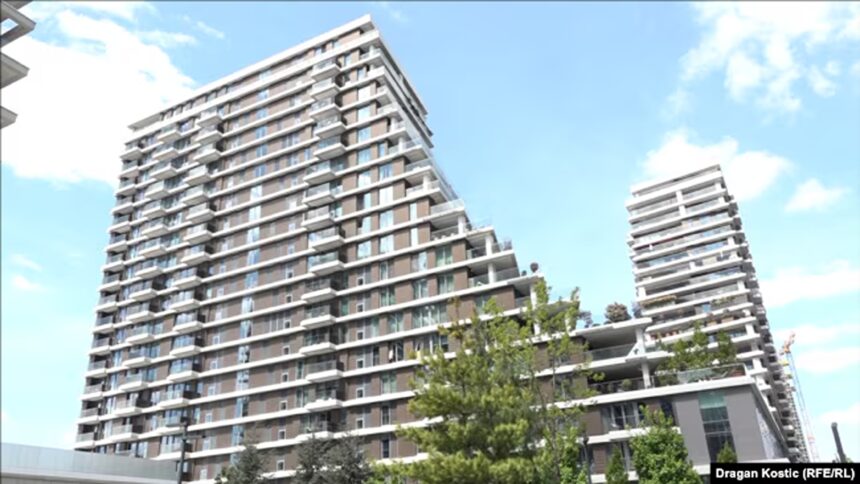
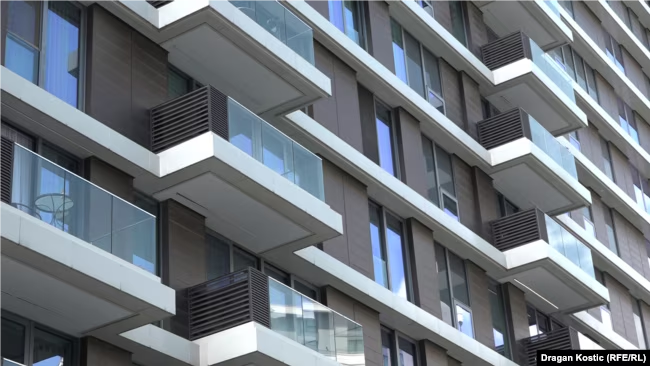
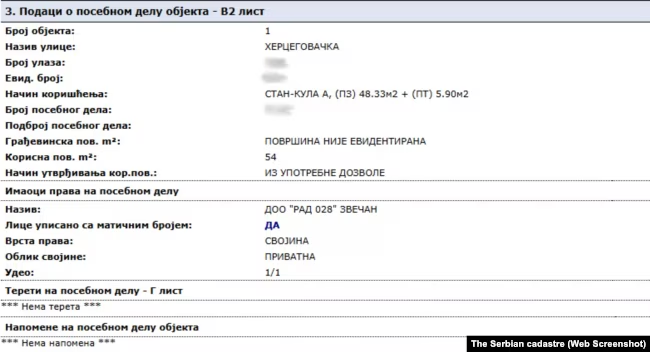
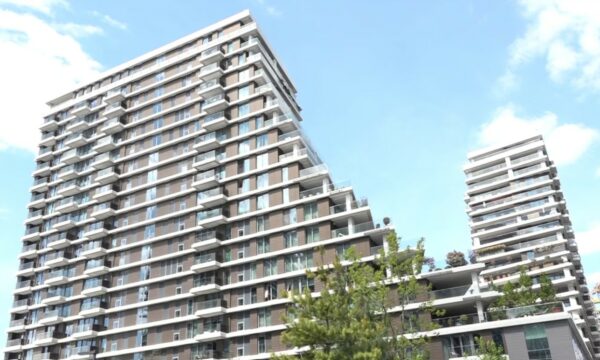
On the seventh floor of one of the towers in the area known as Belgrade Waterfront, there is a 54-square-meter apartment owned by Stević’s company Rad 028.
The company also owns a garage in the same building.
This luxury complex, built on illegally demolished houses along the Sava riverbank, is considered one of the most expensive in Belgrade, with prices ranging from 4,000 to 10,000 euros per square meter.
The value of the apartment and garage owned by Radulle Stević is estimated at around 280,000 euros.
Until September 2024, the company also owned another apartment and garage in this complex.
Records show that Rad 028 owned a 90-square-meter apartment and a garage in the same building.
Serbian cadastral data shows that this apartment now has a new owner, but it is unclear whether it was sold or gifted.
Apartment in Dedinje near Veselinović villas
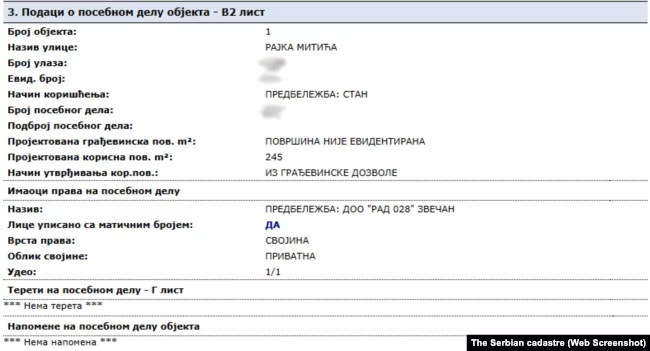
Another property owned by Rad 028 is a 250-square-meter apartment and three garages in a building in the Dedinje district.
Dedinje is one of the most exclusive areas of Belgrade, home to many villas, embassies, and state-protected buildings.
The investigative Balkan network BIRN has reported that Milan Radoičić had a registered residence in this apartment, which is officially owned by Stević’s company.
Nearby is a villa with a swimming pool owned by Žarko Veselinović, brother of Zvonko Veselinović, and his wife.
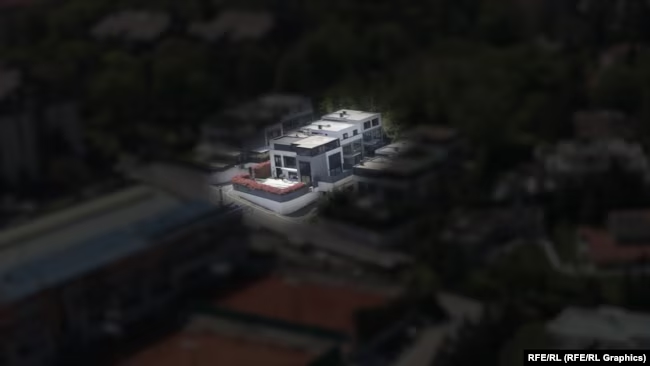
Until recently, the villa was owned by the Inkop company, which belongs to the Veselinović brothers.
Their business partner in Inkop was Milan Radoičić.
He left ownership of Inkop and other companies in October 2023, after publicly admitting that he organized the armed attack in Banjska.
He transferred his shares to Zvonko and Žarko Veselinović.
Like Radoičić and Stević, the Veselinović brothers are under U.S. sanctions on suspicion of links to international organized crime.
However, Serbia does not act on these allegations or international sanctions.
It also ignores Kosovo’s court decision and indictment in the Banjska case.
Where is Radulle Stević?
An international arrest warrant has been issued in Kosovo for Radulle Stević.
All individuals accused in the Banjska case, led by Milan Radoičić, are included in this list.
Radoičić is in Serbia, and his registered address is in Belgrade.
Serbian authorities refuse to extradite him to Kosovo, stating he will be tried in Serbian courts, while Kosovo officials accuse Serbia of protecting him.
There is no official confirmation whether Radulle Stević is also in Serbia.
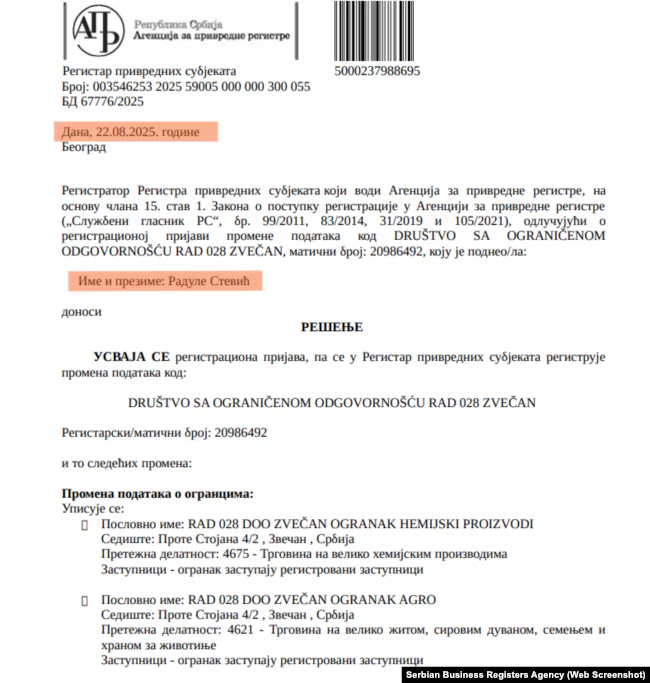
However, his signature was found in a document submitted to Serbian institutions in August 2025.
At that time, Stević submitted a request to the Serbian Business Registers Agency to open two additional branches of his company in Zvečan, Kosovo, dealing with wholesale chemical products and grains.
What does Stević’s company do?
Although Stević and his company Rad 028 are part of the Kosovo indictment, they continue to operate within Serbia’s system.
During 2025, the company was awarded more than 30 contracts worth around 6.5 million euros, mainly related to construction projects in Serb-majority areas in Kosovo.
The company signs contracts with temporary municipal bodies established under Serbian law.
These bodies operated in Kosovo in Serb-majority areas until 2024, when they were shut down by Kosovo authorities, which consider them illegal.
However, these bodies have continued operating from alternative locations in Serbian border towns.
They did not respond to Radio Free Europe regarding the criteria used to award contracts to Stević’s company or how the projects are implemented, especially since Kosovo authorities have suspended Serbian-funded construction projects over the past three years due to lack of permits from Kosovo institutions.
The Government of Serbia and its Office for Kosovo also did not respond.
Four contracts were signed in 2026.
In addition to the renovation of a church in the village of Žerovnicë near Zvečan, Rad 028 was also assigned the supply of New Year packages for primary school students in Kosovo, as well as renovation of a sports field and playground in North Mitrovica.
These projects are worth over 520,000 euros.
In 2025 alone, contracts worth around 6 million euros were awarded to the company, including construction of houses for families in need, renovation of a school in Zvečan, and renovation of a hospital in Llapnasellë.
Educational and healthcare institutions in Serb-majority areas continue to operate under the Serbian system.
RFE/RL was unable to verify whether all these contracts were actually implemented, i.e., whether the houses were built and public facilities renovated.
Tender documents analyzed by RFE/RL show that Rad 028 cooperated with several companies mentioned in the Kosovo indictment for the Banjska case, and that equipment purchases benefited individuals accused in the attack and their family members.
In Kosovo’s system, Stević previously owned two construction companies with similar names: RAD D.O.O. and RAD P.T.P.
These companies won tenders until December 2021, when Stević and his companies were placed under U.S. sanctions.
Between 2018 and 2021, his companies won contracts worth around 5 million euros in Kosovo.
His services were mainly used by Serb-majority municipalities in the north under Kosovo’s system: North Mitrovica, Leposavić, Zvečan, and Zubin Potok.