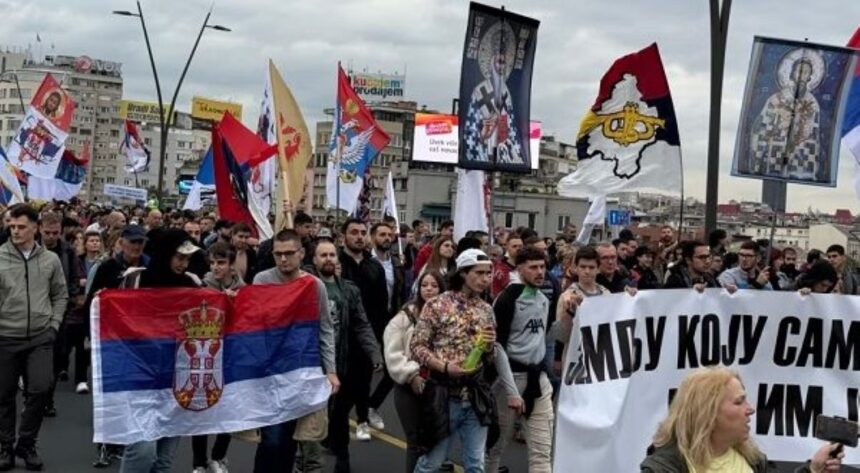
Alongside their highly publicized war against systemic corruption, protesting Serbian students have injected the volatile issue of Kosovo into their core platform.
The publication of a new “Memorandum” by the active student movement—explicitly declaring that Kosovo remains an “integral and inseparable part of Serbia”—has triggered sharp backlash and a wave of division among the very public that has supported their anti-government protests. The internal controversy deepens as the movement gears up to officially enter the broader political arena against Serbia’s ruling regime.
While some citizens argue that adopting a hardline stance on Kosovo is a calculated move to unite a fractured domestic electorate, critics warn that the students are walking directly into an ideological trap. They argue that the youth movement cannot defeat President Aleksandar Vučić’s ruling Serbian Progressive Party (SNS) by simply trying to out-maneuver them on nationalist policy.
Shift from Tragedy to Polarizing Geopolitics
The student coalition, operating under the umbrella group “Students in Blockade” (Studenti u blokadi), originally gained nationwide traction following the November 2024 infrastructure disaster in Novi Sad, where 16 people were killed by a concrete canopy collapse at the central railway station. The tragedy brought hundreds of thousands of Serbians into the streets, with academic bodies accusing the government of lethal corruption and demanding strict criminal and political accountability.
Initially, student organizers maintained that they would focus exclusively on their core demands—the resignation of key ministers, judicial accountability, and the calling of snap parliamentary elections. They had explicitly promised to refrain from taking stances on divisive historical and geopolitical issues that traditionally “polarize the public.”
The sudden release of the Memorandum marks a fundamental shift away from that promise.
“This Memorandum demonstrates that even the younger generation of students is unable to escape the structural trap of Serbia’s deeply entrenched nationalist politics, which continues to rely heavily on the Kosovo myth,” political analyst and retired professor Žarko Korać told Radio Free Europe.
The student movement deliberately operates without a singular centralized leader, relying on faculty plenums and direct democracy via Instagram and Telegram channels to pass resolutions. Despite RFE/RL reaching out to “Students in Blockade” for clarification on who authored the document and why the Kosovo issue was suddenly prioritized, the group has yet to provide an official response.
The Four Points of the Student Memorandum
The document positions the “preservation of Kosovo and Metohija” as the ultimate “common denominator” of all contemporary civic and political struggles in Serbia. To anchor their claims, the students explicitly cite the 2006 Constitution of Serbia, which includes a preamble defining Kosovo as an integral part of the state’s territory.
The text is structured around four primary pillars:
- Constitutional Framework: Any long-term solution must strictly respect the territorial sovereignty outlined in the Serbian Constitution.
- International Integration: The issue of Kosovo cannot be solved in geographic isolation; it must be addressed through active, constructive engagement within complex global channels.
- Institutional Continuity: The Belgrade government must cooperate transparently with relevant international bodies to protect Serbian cultural heritage and local populations.
- Preservation of Parallel Systems: The document expresses urgent concern over the potential closure of the University of Pristina temporarily relocated in North Mitrovica—an institution operating within Belgrade’s parallel system that Pristina views as illegal.
A History of Right-Wing Alignments
This is not the first time right-wing, nationalist rhetoric has crept into the student-led anti-corruption protests. During a major rally held on the religious holiday of Vidovdan in June 2025, student speakers stood alongside controversial right-wing academic Milo Lompar.
Lompar used his speech to demand that Serbia’s foreign policy focus entirely on protecting the “inalienable territory of Kosovo,” while expanding state protections to ethnic Serbs in Republika Srpska (Bosnia), Montenegro, Croatia, and North Macedonia. Later, in October 2025, law students in Belgrade held targeted demonstrations ahead of local elections in Kosovo, demanding institutional pushback against the degradation of Serb rights.
“When Professor Milo Lompar—who holds explicit, unapologetic right-wing political views—was invited to address the student protest back in 2025, it became glaringly obvious that the movement was taking the path of least resistance: the path of nationalism,” Korać evaluated. “The student Memorandum is a completely unoriginal text talking about a peaceful reintegration of Kosovo into Serbia, something that reality dictates will simply not happen.”
The Political Responses: Vučić Dismissses the Initiative
President Aleksandar Vučić wasted no time in dismissing the students’ foreign policy debut. Speaking during a public appearance on May 18, 2026, Vučić claimed the text was completely devoid of political substance.
“There is absolutely nothing written in that document,” Vučić told reporters. “They don’t have a clear grasp on anything, and they completely fail to comprehend the complex geopolitical realities surrounding Kosovo. They only know how to stand against their own state structures and criticize their own people.”
For over a decade, Belgrade and Pristina have engaged in EU-facilitated normalization talks in Brussels. However, high-level diplomatic dialogue has been practically paralyzed since September 2023, following the violent, armed standoff between a Serbian paramilitary group and Kosovo Police forces in the northern village of Banjska. Normalizing ties remains a non-negotiable prerequisite for Serbia’s long-delayed integration into the European Union.
Public Opinion: A Reflection of Historical Echoes
The core tenet of the students’ Memorandum—the rejection of Kosovo’s 2008 independence declaration—is widely shared by the general Serbian public. Independent data published by the Institute for European Affairs indicates that over 50 percent of Serbian citizens remain firmly opposed to recognizing Kosovo under any circumstances.
Interviews conducted by RFE/RL in Belgrade reveal a deeply conflicted electorate:
- Jovan (Belgrade): “I fully support what was their original, primary demand: total criminal accountability for the infrastructure tragedy in Novi Sad. For me, Kosovo is secondary in the context of this specific civic protest.”
- Marko (Belgrade): “It is positive that the students have a defined stance on Kosovo. How they articulate it moving forward is up to them, but I support them because I trust them far more than any established political option.”
- Dragolub (Belgrade): “Publishing this Memorandum was a terrible tactical error. Kosovo has been a sovereign, independent state for a long time, and it will remain so. The students should have stuck to fighting corruption and demanding fair elections.”
For a segment of the public, the very title and tone of the student document evokes dark historical parallels to the controversial 1986 SANU Memorandum issued by the Serbian Academy of Sciences and Arts. That historical text claimed ethnic Serbs were being systematically targeted and endangered across the former Yugoslavia—a narrative that historians and critics view as the primary ideological catalyst for the devastating Balkan Wars of the 1990s, which ultimately culminated in the 1999 NATO bombing campaign and the total withdrawal of Serbian military forces from Kosovo.