Russia’s Supreme Court has barred the liberal Yabloko party from appearing on the ballot in next month’s parliamentary elections, blocking what would have been the only group openly calling for an end to Moscow’s war against Ukraine.
The August 10 ruling, issued during a hearing attended by hundreds of Russians, mostly young people, who gathered outside the court, dashed hopes among anti-war opponents that they would have an opportunity to express their views in the September 18–20 elections.
The decision highlighted the Kremlin’s growing intolerance toward dissent, which has intensified since President Vladimir Putin launched the full-scale invasion of Ukraine in February 2022.
The Central Election Commission had unexpectedly registered Yabloko late last month for the first State Duma elections the lower house of Russia’s 450-seat parliament since the beginning of the full-scale war.
The nationalist Rodina party filed a lawsuit last week seeking to cancel Yabloko’s registration, alleging a series of violations, including improper financing, copyright-related issues and extremism.
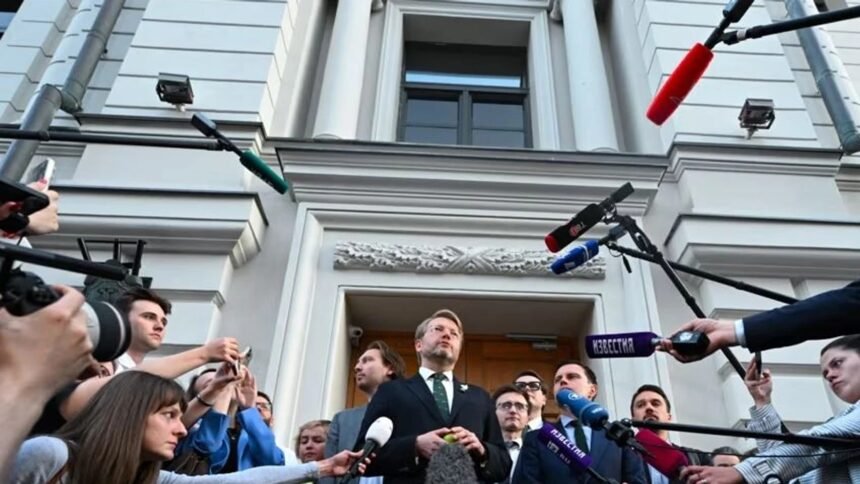
During the hearing, Yabloko leader Nikolai Rybakov rejected the accusations, saying the party was defending the interests of the majority “because preserving human lives is in the interests of the majority of Russian citizens.”
Rybakov said Yabloko would do everything it could to make Russia “a prosperous democratic state.” The party announced that it would appeal the decision, saying: “Let us not despair.”
Judicial decisions in high-profile cases are widely believed to be made by the Kremlin or in close coordination with it. The Supreme Court judge who heard the case against Yabloko has also authored other hard-line rulings, including a decision earlier this year declaring the respected human rights organization Memorial “extremist.”
However, analysts suggested that the developments surrounding Yabloko — first its registration and then its exclusion from the ballot — could reflect internal rivalries among competing interest groups within Russia’s elite: broadly speaking, security officials and hardliners whose instinct is to suppress dissent, particularly opposition to the war, and those who hope the war will end soon.
Polls indicate that a majority of Russians want negotiations to end the war, which has killed hundreds of thousands of Russian soldiers. Recent Ukrainian attacks on oil and gas infrastructure and other targets, sometimes far from the Ukrainian border, have caused civilian casualties and brought the war closer to many Russian citizens.
Putin has rejected calls from Ukraine and the United States for a ceasefire that would freeze the existing front lines, instead demanding that Ukraine hand over territory that Russia has been unable to seize on the battlefield. He has repeatedly said that he will achieve his goals either through diplomacy or by force.
Yabloko emerged in the 1990s and was once an important force in the Duma. But Putin dismantled Russia’s democratic progress after becoming president for the first time in 2000, and the party has failed to win a single seat in elections held since 2003, which have increasingly been accompanied by evidence of manipulation in favor of the Kremlin-controlled United Russia party.