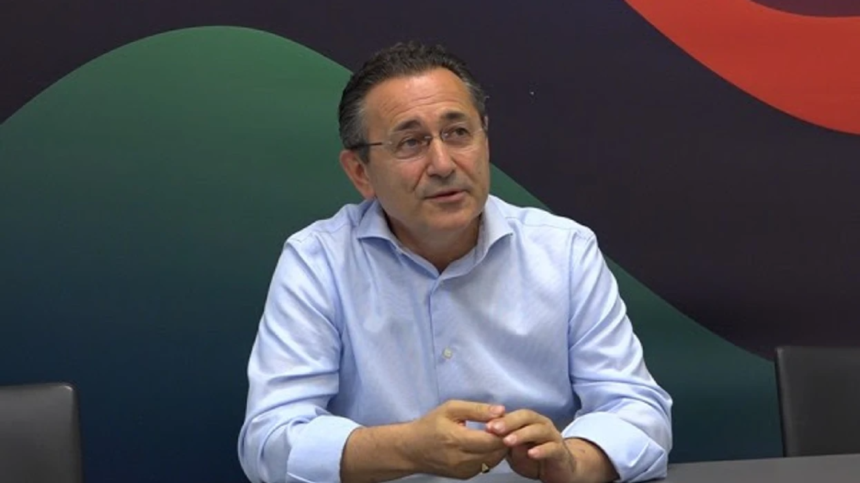
Muharrem Salihu, a businessman from Medveđa, has described the situation in the Preševo Valley as alarming, citing the deactivation of Albanians’ registered addresses and the lack of investment as factors contributing to the departure of Albanians from their ancestral lands.
The businessman, who operates in Italy but remains highly active in supporting his fellow Albanians in the Valley, said that the practice by Serbian authorities is making it increasingly difficult for Albanians to exercise their civil rights and is contributing to the decline of the Albanian community.
“Fundamentally, it is not within anyone’s discretion not even that of the state in which we live to determine what a citizen’s permanent address or temporary address should be. This cannot be done in any form, in any state, without the consent of the person concerned. If, for my own interests, my permanent address is my place of birth, it is not for the state to decide to deactivate that address and leave me stripped of my identity.
You know that when someone’s address is deactivated, they are prevented from renewing other documents. And when you lose your documents, you lose your identity—and consequently your right to inherit property. That is the ultimate objective, because this is a transitional phase. Then you lose your rights to employment and all the other rights enjoyed by an ordinary citizen.
Even prisoners, defendants and criminals have identities. Even graves have identities!
What is being pursued, therefore, is the erasure of records so that, at a certain point, the properties of Albanians can be seized. European law also regulates the issue of properties that remain uncultivated for a long period of time: the state may assume responsibility for them by establishing a public entity involving local or regional authorities and placing those properties under public management. After a certain period possibly 20 to 25 years the historical owners may lose their rights over those properties and they can become public property.
This is the trend toward which Albanian-owned properties in Serbia are heading,” Salihu said.
Salihu also described the economic situation of Albanians living in the region as extremely difficult. According to him, the lack of investment in these areas has contributed significantly to the departure of Albanians from their communities.
“The economic situation is extremely difficult. Albanians live in some of the least developed areas of Serbia. Historically, investment has been avoided in areas predominantly inhabited by Albanians, and this has been one of the factors encouraging their departure, alongside other policies designed to achieve the same goal.
However, Albanians are not generally known for abandoning their ancestral lands. They usually preserve their land even under extreme circumstances. They may leave, but they do not sell it.
The most recent and accelerating factor pushing them away from their lands has been the deactivation of addresses. This has categorically demonstrated the objective behind these actions and provided further justification for the policies preventing investment in areas where Albanians have traditionally lived.
Medveđa, it should also be said, has long served as a kind of testing ground for policies directed against Albanians more broadly, including during the Yugoslav period.
For example, when street and school names were changed in Kosovo, similar measures had already taken place in Preševo, and before Preševo, they had begun in Medveđa, because resistance there was weaker.
The process initially began in Medveđa with the renaming of the ‘Zejnel Hajdini’ school, changing the name of the Albanian national hero Zejnel Hajdini to ‘Zejnel Hajdinović’. It was then extended to the ‘Skënderbeu’ high school in Preševo and later introduced in Kosovo.
Even today, the measures being implemented there are intended to serve as a model for similar actions in other Albanian-populated areas, such as Bujanoc and Preševo,” Salihu said.