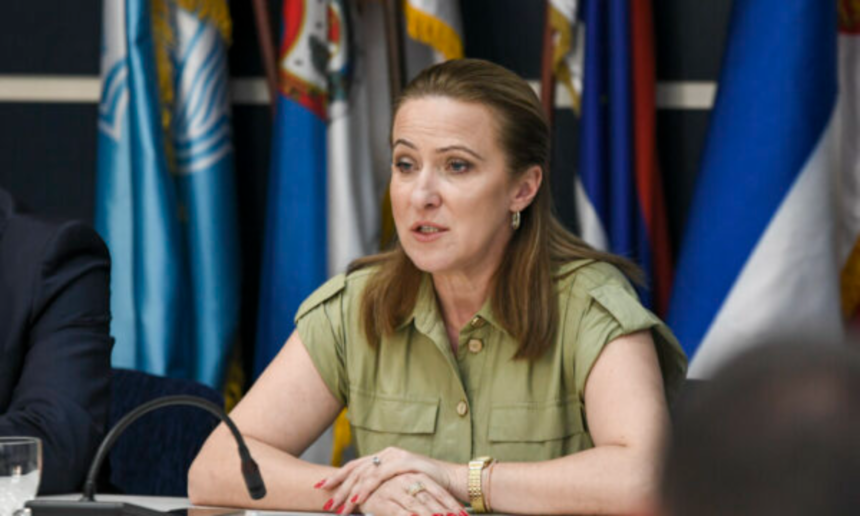
The editor-in-chief of the Serbian magazine Radar, Vesna Mališić, has sharply criticized Serbian Minister of Public Administration and Local Self-Government Snežana Paunović, arguing that she should bear political responsibility for her statement that, had she been in Slobodan Milošević’s position, she would have carried out the ethnic cleansing of Albanians from Kosovo.
In an opinion piece published by Radar, Mališić states that it is clear Paunović will neither be dismissed nor resign, and that the entire affair will end with nothing more than a mild reprimand from President Aleksandar Vučić, an unsuccessful opposition initiative to remove her from office, and several reactions from European officials.
She raises the question of why there was no serious and widespread reaction from the Serbian public, asking whether society has become desensitized to hate speech or whether the minister’s statement is no longer considered unacceptable by a large segment of the population.
According to the author, Serbia’s political climate has been shaped by the ruling coalition, which she describes as being connected to the political structures that, in her view, led the country into the wars of the 1990s. In such an environment, she argues, Paunović made her statement without any hesitation, as though it were something entirely normal.
Mališić argues that Vučić’s response, in which he described the minister’s remarks as “imprudent” and “not sufficiently responsible,” is insufficient to mitigate the consequences of such political rhetoric.
The article further states that an atmosphere has developed in Serbia that relativizes war crimes and promotes individuals convicted of such crimes, citing hate graffiti, historical revisionism, and the appointment of far-right figures to state positions.
The author also refers to the case of writer Vladimir Arsenijević, who was physically attacked by a group of far-right extremists on the eve of a commemoration for the victims of the Srebrenica genocide, while, according to her, the prosecution found no elements of a criminal offense.
In conclusion, Mališić emphasizes that extremist statements are not merely words but can have serious political and social consequences.
“Minister Snežana Paunović must be held accountable for her words. All political consequences stem from extremist rhetoric. Wars are always preceded by the language of war, and those who incite it must not remain politically protected if we want to have a normal society,” she concludes.