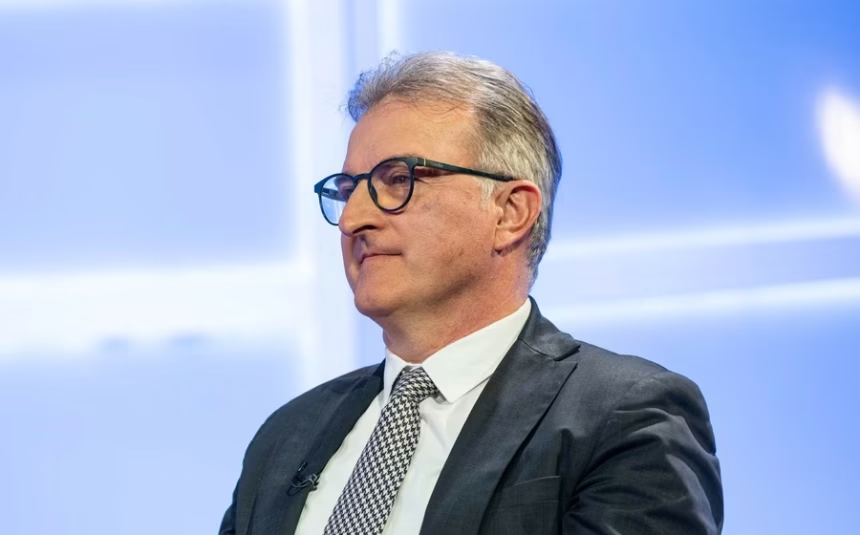
Slobodan Cvejić, Vice President of the “Serbia Center” (SRCE) party and a prominent Member of Parliament, delivered a sharp analysis of Serbia’s political stalemate today, suggesting that President Aleksandar Vučić may be forced into an unprecedented power-sharing arrangement to avoid a total electoral collapse.
In an interview with Nova TV, Cvejić argued that the President is currently stalling on calling new elections because he lacks a viable successor for the presidency while he eyes the Prime Minister’s seat for himself.
The ‘Dual Power’ Dilemma
According to Cvejić, the Serbian Progressive Party (SNS) faces a strategic crisis. If Vučić intends to lead the government as Prime Minister—a move he has hinted at in recent weeks—he must first resign from the presidency.
“He would have to resign as President to run as a candidate for Prime Minister in the near future,” Cvejić explained. “However, he has no strong candidate to enter the presidential race. This means he would have to agree to ‘dual power’ or cohabitation—him as Prime Minister, and an opposition candidate as the new President.”
Cvejić contends that this scenario is unacceptable to Vučić, as it would dismantle the centralized control he currently exerts over the state’s “levers of power,” which the opposition claims are used to shield corrupt activities.
Shifting Public Sentiment
The SRCE Vice President pointed to internal polling and the growing visibility of a united opposition as the reason for the government’s hesitation. He noted that the combination of organized political parties and the “Raspiši pobedu” (Call the Victory) student movement has shifted the political landscape.
- Declining Ratings: Cvejić asserted that research shows Vučić’s popularity trailing behind the combined strength of the opposition.
- The ‘End of an Era’: “Even without the polls, it is more than clear now that he has no chance of winning [a fair] election,” Cvejić stated, adding that the President is merely prolonging the inevitable to buy time for his inner circle.
Institutional Pressure
The analysis also highlighted a culture of “institutional pressure” on citizens and opposition forces. Cvejić emphasized that the international community, particularly the European Union, is watching closely as Serbia approaches a critical decision-making window.
“What is needed are real reforms, independent oversight, and an end to the institutional pressure on citizens,” he added, echoing recent calls from Brussels to freeze EU funds if democratic standards regarding the judiciary and media are not upheld.
What’s at Stake?
With local election results from earlier this month showing cracks in the SNS stronghold and students continuing to block major thoroughfares, the pressure on Vučić to set a date for national elections is at an all-time high. The prospect of cohabitation—once unthinkable in the current Serbian political climate—is now being framed by the opposition as the only logical outcome of a free and fair democratic process.