Serbia’s student-led political movement is preparing to begin negotiations to form a new government after securing a reported parliamentary election victory that could end 14 years of rule by Aleksandar Vučić and his Serbian Progressive Party (SNS).
The Students’ List faces significant challenges as it prepares to take power, including limited governing experience, the absence of a clearly established leader and the task of reforming institutions that critics say have become closely tied to the outgoing government.
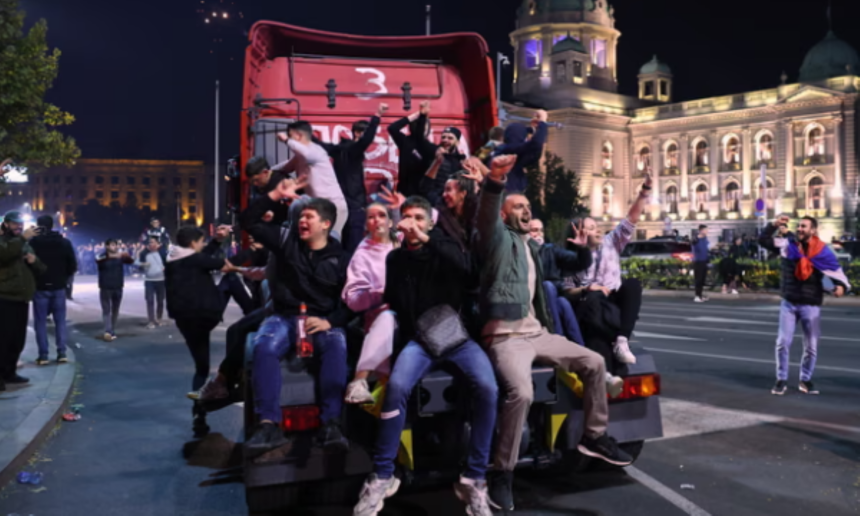
Supporters took to the streets on Monday to celebrate the result after Vučić acknowledged his party’s defeat on Sunday evening, marking a potential turning point in Serbian politics.
Students’ List secures parliamentary majority
According to projections by the Belgrade-based Center for Free Elections and Democracy (CeSID), the Students’ List received 53% of the vote, translating into 141 seats in Serbia’s 250-member parliament.
The SNS secured 39%, equivalent to 103 seats, while the remaining mandates went to lists representing national minorities.
The figures cited in the report indicate that the student movement would have a parliamentary majority, although the formal transfer of power and formation of a government remain to be completed.
The election follows two years of protests sparked by the collapse of a canopy at the railway station in Novi Sad in November 2024, which killed 16 people. The tragedy triggered widespread public anger and demands for accountability, transparency and action against corruption.
The movement’s candidate list brought together academics, actors, farmers and students, reflecting its broad-based structure and collective decision-making approach. However, its lack of a clearly defined hierarchy has left questions about who will become prime minister and who will hold key cabinet positions.
Among its prominent figures are cardiologist Ilija Srdanović, who headed the candidate list; former central bank governor Dejan Šoškić; and University of Belgrade chemistry professor Radomir Saičić.
Anti-corruption reforms at the center of the agenda
The Students’ List has placed the fight against corruption, the restoration of the rule of law and the depoliticization of state institutions at the center of its platform.
Its proposals include establishing an independent police unit under the authority of the prosecution rather than the Interior Ministry, as well as removing officers alleged to have links to organized crime.
The movement also wants to end politically motivated appointments in state-owned companies and strengthen public oversight of government finances.
Among its proposals is the creation of independent bodies to monitor major infrastructure contracts and help prevent the misuse of public funds.
Ana Mirković, an education specialist, psychologist and candidate on the Students’ List, told The Guardian that the movement viewed its electoral success as a responsibility rather than an opportunity to gain power and privileges.
“We do not see the election result as taking power and privileges, but as taking on a historic debt to our people and our children,” Mirković said.
She described the government’s first priority as the “social and psychological detoxification” of the country.
Mirković also pledged to address what she called a system of intimidation and polarization, promising greater media openness, an end to pressure on public-sector employees and an end to what she described as institutional violence.
The movement’s broader goals include publishing government contracts and financial flows, strengthening judicial independence and reforming education and healthcare.
A difficult transition after 14 years of SNS rule
During Vučić’s years in power, critics have accused the government of expanding its influence over the media, judiciary and other state institutions. Serbian elections have also faced allegations of irregularities involving voter registration, media bias and vote-buying.
The incoming majority will therefore face the challenge of translating its promises into institutional reforms while maintaining legal continuity and public confidence.
Analysts have drawn comparisons with Hungary’s Tisza party, led by Péter Magyar, which ended Viktor Orbán’s 16-year rule earlier this year. In both cases, a political change of government raises questions about how deeply the previous administration’s influence extends into public institutions.
However, the Serbian movement’s collective structure and limited experience in government could complicate the process of selecting ministers and establishing a clear decision-making hierarchy.
Nikola Burazer, program director at the Belgrade Centre for Contemporary Politics, said the movement would need to accelerate its internal decision-making after spending months selecting candidates.
“Once people finish celebrating and start thinking about what happened yesterday, we will focus more on what comes next and what the government will look like,” Burazer said. “Twenty-four hours ago, all of this seemed like a fantasy.”
Foreign policy remains an open question
During the campaign, the Students’ List focused primarily on domestic issues, leaving its positions on relations with the European Union and Russia less clearly defined.
The Kremlin said on Monday that it hoped Serbia’s new leaders would recognize that cooperation with Russia was in the country’s interests.
Analyst Dušan Vučićević said the movement had prioritized addressing Serbia’s internal political problems and dismantling what he described as entrenched institutional structures at both national and local levels.
He characterized the election result as a profound political shift that could inspire student movements elsewhere in Europe, although he cautioned that the Serbian model might not be easily replicated.
“This grassroots democratic experiment ultimately managed to secure more than 50% of the vote,” Vučićević told Agence France-Presse.
Vučić, who maintained close relations with Moscow during his time in power, attributed his party’s defeat to what he described as direct support from various European countries and the American “deep state,” which he claimed was also opposed to U.S. President Donald Trump.
The new government’s approach to relations with Russia and the EU will be closely watched as it attempts to establish its foreign-policy priorities alongside its domestic reform agenda.
International leaders react to the result
The Students’ List’s reported victory prompted reactions from several international leaders.
Ukrainian President Volodymyr Zelenskyy described the result as a new chapter in Serbia’s history, expressing hope for the country’s development and closer relations with the European community.
“We wish Serbia success, genuine development and warm relations with the European community,” Zelenskyy said, thanking Serbia for respecting Ukraine’s people, state and independence.
German Chancellor Friedrich Merz said Berlin would actively support Serbia’s European path. He praised the students’ ability to win public support through demands for the rule of law, anti-corruption measures and respect for fundamental freedoms.
The international reactions underscore the significance of the political transition for Serbia’s relations with European partners, although the new government’s precise foreign-policy direction remains to be seen.
Constitutional deadlines and the road ahead
Under Serbia’s Constitution, the new parliament must convene within 30 days of the official announcement of the final election results. Once parliament convenes, the deadline for forming a new government is 90 days.
According to the report, Serbia must also hold a new presidential election before December 27, following Vučić’s departure from the presidency to run for prime minister.
The immediate task for the Students’ List is to agree on its leadership, select a cabinet and establish a governing program capable of delivering on its campaign promises.
The reported election victory marks a major shift in Serbia’s political landscape. But the movement’s ability to turn its anti-corruption pledges and institutional reform agenda into concrete changes will determine how the transition unfolds.