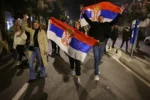
Guests on N1’s special edition of Utisak nedelje have discussed the reported victory of the Students’ List in Serbia’s parliamentary elections, the transition of power and the challenges facing the country as a new political majority prepares to take office.
Academic and Students’ List candidate Radomir Saičić said the movement was not seeking “revolutionary justice” but a system in which the law applies equally to everyone. Student Sonja Simonović said the formation of parliament and the new government would proceed within the shortest legally permitted timeframe.
Political analyst and professor Miloš Bešić argued that Serbian President Aleksandar Vučić was presenting the election defeat to his supporters as temporary, while journalist Slobodan Georgiev declared that “Aleksandar Vučić’s time is over.”
Students’ List calls for calm and respect for the law
Reflecting on the election result, Saičić said Serbia had avoided a scenario he had feared before election day.
“We were on the brink of a great tragedy, but now we have an opportunity to create a country worthy of human beings. Let us not squander it or betray the trust placed in us,” Saičić said on N1.
He stressed that the Students’ List did not intend to pursue political retribution outside the institutions or bypass legal procedures.
“If you want to be effective at any cost, you get revolutionary justice, summary actions and lynching. The student movement does not base its vision of the future on that,” he said.
Saičić added that the movement wanted more than a change of government, calling for a new system of values in which justice and the law would apply equally to everyone.
He also warned of possible attempts to transfer capital, remove archives or misuse public institutions during the transition. Addressing directors of public enterprises and officials in positions of responsibility, he urged them not to follow unlawful orders.
These concerns were presented by Saičić as potential risks during the transition; the interview did not establish that such actions had taken place.
Simonović says the new majority will act within legal deadlines
Student representative Sonja Simonović said the Students’ List currently had 140 parliamentary mandates, giving it what she described as an absolute majority.
“Legally, we are not yet in power, but we have an absolute majority of 140 mandates. We know how we will do this,” Simonović said.
She added that the formation of the new parliament and government would take place as quickly as the law allowed.
Simonović also emphasized that preventing violence had been a central principle of the student movement since the beginning of its protests.
She said this concern was one reason the students had not encouraged large numbers of people to travel to Belgrade on election night.
“We would not have allowed anything to happen to anyone under any circumstances. That is why we urged people not to come to Belgrade. We knew there was a possibility of a larger problem breaking out that we might not be able to control,” she said.
Simonović attributed Vučić’s acknowledgment of the election defeat to what she described as the clarity of the results, adding that the movement had sought to demonstrate peaceful conduct and political restraint.
Bešić: Vučić is portraying defeat as temporary
Professor Miloš Bešić said Vučić’s post-election statements were primarily directed at maintaining support among his own electorate.
According to Bešić, Vučić’s use of the term “blockader list” to describe the Students’ List, alongside claims of foreign interference, was intended to sustain political mobilization within the Serbian Progressive Party (SNS).
Bešić interpreted the president’s messaging as an attempt to acknowledge the defeat while presenting his party as a victim of outside interference and emphasizing that it would continue its political struggle.
“The message to his own electorate is practically: ‘We will see each other in six months’ — in other words, this is temporary,” Bešić said.
He argued that the SNS continued to possess significant political, institutional and financial resources despite the reported election loss.
However, Bešić said he did not consider a return to power within six months a realistic outcome, even if he believed that such a scenario might be part of the party’s political strategy.
He also suggested that the incoming majority would face the challenge of governing while managing expectations among voters who wanted rapid changes.
Georgiev: The SNS will struggle to return to its former opposition role
Journalist Slobodan Georgiev said the election result would require state institutions to adapt to the new political circumstances.
“I expected to see activity from the prosecution and judiciary already today, but I think they also need time to understand that an era has ended. Aleksandar Vučić’s time is over,” Georgiev said.
He argued that the SNS was no longer the same party it had been before coming to power and would find it difficult to return to the role of a conventional opposition party.
Georgiev also criticized Vučić’s post-election rhetoric, saying the president had acknowledged the defeat while continuing to attack his political opponents.
His remarks reflected his assessment of the political implications of the reported result rather than a formal conclusion about the future of the SNS.
Dispute over interruption of TV Nova’s news broadcast
Georgiev also addressed the interruption of TV Nova’s evening news broadcast at around 8:30 p.m. on election night.
He alleged that three representatives associated with Alpac Capital entered the television station’s master control room and instructed staff to interrupt the broadcast and switch to N1 programming, although the original plan had been to air N1 after the news bulletin.
Georgiev suggested that the intervention may have been motivated by concerns that TV Nova would not follow the planned programming arrangement. He claimed the incident diverted attention from election coverage toward an internal dispute at the broadcaster.
The account was presented by Georgiev during the programme; the report did not include a response from the individuals he named or from Alpac Capital.
Calls for patience during the transition
The guests agreed that the period between the election and the formal transfer of power would be particularly sensitive, although they offered different assessments of the challenges ahead.
Bešić said the incoming majority would need to respond quickly to public expectations while respecting institutional procedures.
Saičić, meanwhile, urged citizens to remain patient and warned against rushed decisions designed solely to satisfy demands for immediate change.
“If we have watched institutions being undermined for 13 years, we must wait a little longer to carry out the transformation properly, so that it does not become a revolutionary change of the state,” he said.
He advocated a systematic approach to reform, arguing that some changes could be implemented quickly while others would require more time.
Georgiev challenged the assumption that long-serving political figures necessarily had greater governing expertise than newcomers, arguing that the students’ movement had demonstrated its ability to organize and mobilize support.
The discussion highlighted the central challenge facing the reported incoming majority: translating electoral support into a functioning government while meeting public expectations, maintaining stability and ensuring that institutional changes follow the law.