Serbia’s government has once again demonstrated its authoritarian reflexes by openly associating with figures linked to the infamous Special Operations Unit (JSO – “Red Berets”), a formation whose commanders and members were convicted for the assassinations of Ivan Stambolić and Prime Minister Zoran Đinđić.
Recent public appearances of former JSO members at rallies organized by President Aleksandar Vučić’s Serbian Progressive Party (SNS) have alarmed civil society, journalists, and security analysts, who warn that the regime is deliberately reviving symbols of political violence to intimidate dissenting citizens.
Paramilitary Symbolism as a Tool of Fear
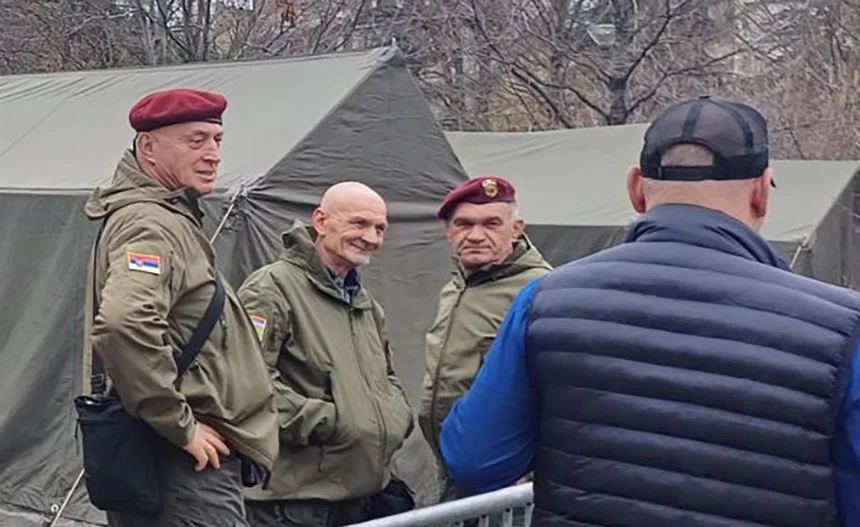
At a late-November SNS rally in Mionica, veterans of the Red Berets were positioned behind the stage where Vučić delivered his speech. This was not an isolated incident. The same group had previously appeared in Pionirski Park, where uniformed men reportedly threatened passersby and protesters, signaling a return to intimidation tactics reminiscent of the 1990s under Slobodan Milošević.
The group is reportedly led by Žika Ivanović, a former JSO member with long-standing ties to regime-friendly networks. Analysts note that these appearances are carefully choreographed displays of loyalty, meant to project force rather than ensure public safety.
State Protection and Financial Irregularities
Investigative reporting highlights troubling links between these paramilitary-associated figures and state-backed financial privileges, including:
- State aid during the COVID-19 pandemic
- Companies with millions of euros in tax debt remaining untouched
- Political connections to SNS electoral lists and party structures
Critics argue that the regime’s tolerance—and apparent protection—of such actors underscores systemic impunity and selective law enforcement in Serbia.
A Strategy of Manufactured “Counter-Movements”
According to military analyst Aleksandar Radić, the Vučić government consistently creates regime-loyal replicas of social groups—students, farmers, veterans—to blur the line between genuine civic protest and staged support.
“On one side, you have veterans protecting democratic protestors. On the other, veterans protecting one man and his power,” Radić notes.
The use of JSO symbolism, he adds, is aimed at mobilizing ultra-nationalist sentiment and intimidating younger generations unfamiliar with the unit’s violent history.
Recycling the Darkest Chapters of Serbia’s Past
The reappearance of Red Beret imagery coincides with increased political pressure, protests, and international scrutiny of Vučić’s rule. Observers warn that invoking a unit synonymous with state-sponsored murder and organized crime sends a chilling message: the regime is willing to sacrifice democratic norms to preserve power.
Rather than distancing itself from Serbia’s violent past, the government appears to be weaponizing it, reinforcing fears that the country is sliding further away from democratic accountability and the rule of law.
Conclusion
By rehabilitating the symbols and personnel of the JSO, Vučić’s regime signals contempt for democratic values and historical responsibility. What should be a clear break from political violence has instead become a tool of intimidation, deepening Serbia’s political crisis and isolating it further from European democratic standards.