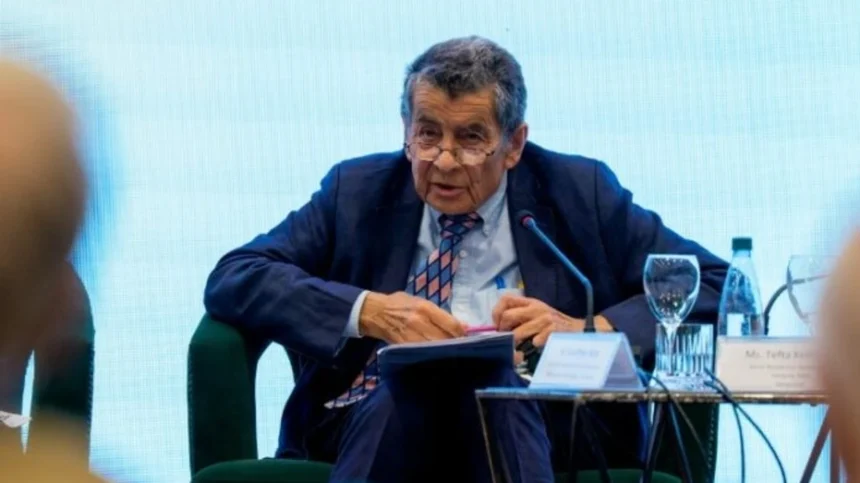
Prominent British jurist Sir Geoffrey Nice, who previously served as the prosecutor at the International Criminal Tribunal for the former Yugoslavia (ICTY) in the case against former Serbian President Slobodan Milosevic, has recently visited Prishtina. During his stay, he participated in the “Bridges of Remembrance” conference, organized by KIPRED and the “Liria ka emër” (Freedom Has a Name) organization.
In an article published on the conference’s online platform, Nice shared reflections and evaluations regarding the processes at the Hague Tribunal and the establishment of the Kosovo Specialist Chambers (KSC). He claimed that the court’s creation was not the result of a sovereign decision by Kosovo’s institutions.
“In a later intervention regarding the Kosovo Specialist Chambers (KSC), I corrected a speaker who claimed that this court was established as a result of a sovereign decision by the Assembly of Kosovo. I reminded those present that Kosovo’s elected representatives, in reality, were forced to accept this court under continuous pressure from the European Union and the United States,” Nice wrote.
Imposition of a Pre-Drafted Statute
Nice emphasized that he was part of the consultative and negotiating process during the foundational phase of the Specialist Chambers. He claimed that Kosovo played no substantial role in shaping its statute.
“As part of Kosovo’s negotiating team, I was a direct witness to the fact that the Statute of the Specialist Chambers was not, in any meaningful sense, the result of an agreement with Kosovo. As soon as European negotiators faced fundamental objections from the Kosovar side regarding the draft statute, discussions practically ceased,” he stated.
According to the British jurist, the subsequent process was characterized by the political imposition of a document pre-prepared by international actors. Nice noted that Kosovo has borne the consequences of this process without clear guarantees for justice or reconciliation.
“Kosovo had no real voice in its adoption, yet it was Kosovo that paid the price for these imposed actions, with no certainty that the processes will ultimately bring justice or create a basis for reconciliation,” he declared.
Concerns Over Geopolitical Objectives
Sir Geoffrey also raised concerns over potential political motives behind the court’s creation, tracing the issue back to the Council of Europe report compiled by Dick Marty. He suggested that the way the Specialist Chambers were structured created perceptions of potential political benefits for specific parties in the region.
“It has been difficult to pinpoint these objectives precisely, but Serbia clearly appeared to be the state most likely to benefit from a court imposed in the manner the Specialist Chambers were—focused on only one ethnicity for the 1998–1999 war,” he added.
The KLA Narrative and ICTY Precedents
Referring to the ongoing judicial process against former leaders of the Kosovo Liberation Army (KLA), including former President Hashim Thaci, Nice clarified that he has not followed the case details closely but noted arguments raised during the conference.
He highlighted contentions that the Prosecution’s indictment reflects a Serbia-centric narrative, pointing out that characterizing the KLA as a highly organized military structure engaged in a Joint Criminal Enterprise (JCE) contradicts previous rulings by the ICTY.
“Nothing from my memory of the evidence presented during the Milosevic trial, nor subsequent developments, suggests to me that these arguments are incorrect,” Sir Geoffrey Nice concluded.